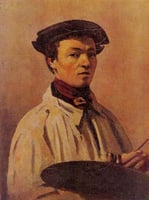
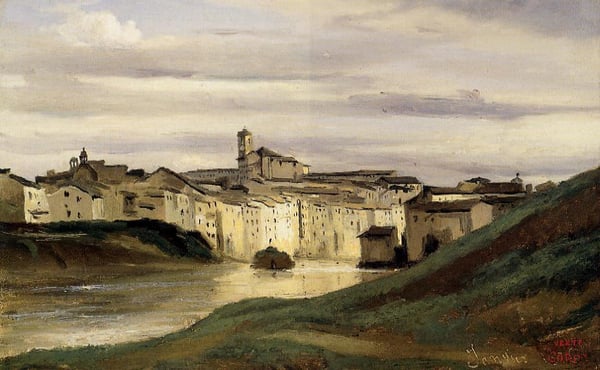
Expert analysis of Camille Corot’s The goatherd of Genzano
Style: Realism · Genre: landscape
Expert Analysis: "The Goatherd of Genzano" by Camille Corot
Camille Corot's "The Goatherd of Genzano" stands as a pivotal work within the Realist movement, bridging the gap between the idealized landscapes of the Neoclassical tradition and the raw, unvarnished observation of nature that would define mid-19th-century Realism. While firmly grounded in the landscape genre, Corot elevates the scene beyond mere topographical record, infusing it with a subtle, poetic luminosity that anticipates the concerns of the Impressionists.
Significance within Realism and Landscape Painting:
-
A New Naturalism: Unlike the highly composed, mythological landscapes of earlier French academic painting, Corot's view of the Italian countryside—specifically the area around Genzano—eschews dramatic grandeur for a quiet, unassuming truthfulness. The goatherd and his animals are not heroic figures but ordinary components of a working pastoral life. This focus on everyday rural existence, rendered with fidelity to light and atmosphere, aligns Corot with the Realist ethos of depicting contemporary life without idealization.
-
Mastery of Light and Atmosphere: Corot's hallmark is his ability to capture the en plein air quality of light—soft, diffused, and silvery. In this work, the hazy Italian sun filters through the foliage, casting gentle shadows and creating a unified atmospheric envelope. This treatment of light as a unifying, almost ethereal force was revolutionary. It moves beyond the hard outlines of Neoclassicism toward a more fluid, tonal rendering of form, directly influencing later Realists like Jean-François Millet and Barbizon school painters.
-
Structural Poetry: Despite its Realist allegiance, the painting retains a classical sense of balance and structure. The composition is carefully anchored: the diagonal line of the hillside, the verticals of the trees, and the horizontal of the distant plain create a serene, harmonious whole. Corot synthesized the Realist demand for observed truth with a lyrical, almost melancholy mood—a quality often called his "palette of silver and pearl." This fusion makes the work significant as an example of how Realism need not abandon beauty or compositional discipline.
-
Precursor to Impressionism: Most notably, "The Goatherd of Genzano" exemplifies Corot's pivotal role in the evolution toward Impressionism. His emphasis on the transient effects of light, his soft brushwork, and his decision to paint the "impression" of a scene rather than its meticulous detail all provided a direct model for artists like Monet and Pissarro. In this sense, the painting is not merely a Realist landscape but a transitional masterpiece—one that honors nature's truth while celebrating its fleeting, poetic resonance.
Conclusion: Corot's genius lies in his ability to render a simple, rural moment with profound sensitivity. "The Goatherd of Genzano" is significant because it exemplifies the Realist commitment to honest observation while simultaneously pioneering the atmospheric and compositional innovations that would redefine Western landscape painting for generations. It is a quiet but revolutionary work that proves the most powerful artistry often lies in the gentle marriage of truth and poetry.
Museum / Gallery
Visually similar
20 works with related composition and palette
The Banks of the Midouze, Mont de Marsan, as Seen from the Pont du Commerce
Camille Corot
View of Segovia
Joaquín Sorolla
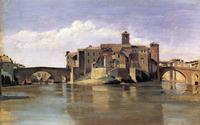
Island of San Bartolommeo
Camille Corot
Rome in the Morning
Mikhail Lebedev
Roofs
Giuseppe Abbati
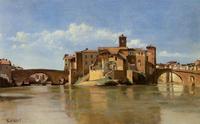
Rome, the Basilica of Constantine
Camille Corot
Sand fishermen
Angelo Dall'Oca Bianca
Gardanne (Horizontal View)
Paul Cezanne
Gardanne
Paul Cezanne
View of Puy l'Eveque
Henri Martin
City on the seashore
Volodymyr Orlovsky
Pescarenico in winter
Gerolamo Induno
View of Pincio, Italy
Camille Corot
VISTAS OF TRASTEVERE WITH BATHERS IN THE TIBER
Gaspar van Wittel
View near Vence in the Alpes-Maritimes
Winston Churchill
View of Puy l'Eveque
Henri Martin
Bords de l'Apance à Chatillon
Jean Monchablon
View of Vasto
Gabriele Smargiassi
The Arno in Rovezzano
Odoardo Borrani
Siena
Pyotr Konchalovsky