Expertenanalyse zu Camille Corots The Beach at Dunkirk
Stil: Realism · Genre: landscape
Expert Analysis: “The Beach at Dunkirk” by Camille Corot (Realism, landscape)
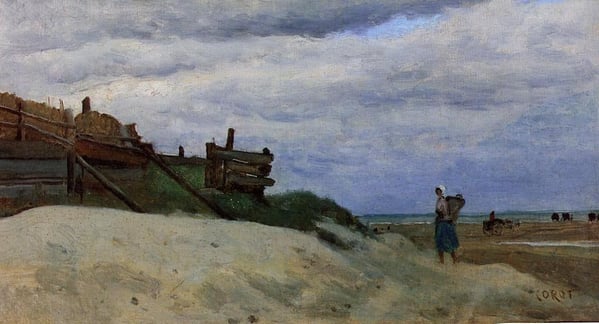
Camille Corot’s “The Beach at Dunkirk” exemplifies the Realist commitment to observing nature with fidelity and emotional restraint, while also revealing the transitional qualities that would influence later landscape painting. Though Corot is often celebrated as a precursor to Impressionism, this work firmly belongs to the Realist movement of the mid‑nineteenth century, eschewing idealized or heroic scenes in favor of a straightforward, unembellished view of a northern French coastline.
Stylistic and Thematic Significance
- Everyday Landscape as Subject: Unlike Romantic landscapes that dramatized storms or sublime vistas, Corot presents a calm, quotidian beach scene. The flat horizon, muted sky, and understated tones reflect the Realist belief that ordinary coastal life—fishing boats, wet sand, low clouds—deserves serious artistic treatment.
- Atmospheric Truth: Corot’s masterful handling of light and atmosphere—soft grays, silvered blues, and subtle shifts in the air—captures the specific weather of the English Channel. This emphasis on transient conditions (rather than permanent, timeless topography) marks an early step toward the plein‑air recording that would define Impressionism.
- Structural Composition: Despite its naturalism, the painting retains a classical balance: the horizontal bands of sky, sea, and shore create a stable geometry, while the diagonal of the beach and the scattered figures anchor the scene in a believable spatial depth. This fusion of careful design with observed reality is a hallmark of Corot’s mature Realism.
Historical Context
Corot painted “The Beach at Dunkirk” during a period when Realists were turning away from studio‑based history painting. By choosing a specific, non‑picturesque location (a working‑class beach rather than a fashionable seaside resort), he aligned himself with the Barbizon school’s ideals and with contemporaries like Jean‑François Millet, who dignified rural labor. The work’s significance lies in its quiet monumentality: it treats a transient moment of coastal life with the same seriousness previously reserved for grand historical narratives.
Legacy
This painting anticipates the atmospheric studies of Monet and Boudin along the Normandy coast, yet retains a hushed, lyrical quality distinct from the brighter palette of later Impressionism. It demonstrates that Realism was not merely a rejection of the past but a thoughtful re‑engagement with the visible world—a foundation upon which modern landscape painting was built.
Museum / Gallery
Visuell ähnlich
20 Werke mit ähnlicher Komposition und Farbpalette
The Coast of Holland
William Merritt Chase
The Coast at Sainte-Adresse
Claude Monet
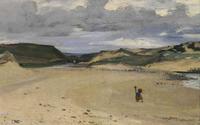
La Plage D'Ambleteuse
Carolus-Duran
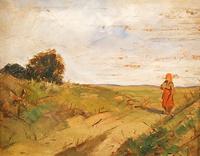
On the field
Teodor Harșia
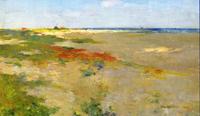
On the Suffolk Coast
Willard Metcalf
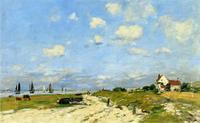
The Dunes at Etaples
Eugene Boudin
The Berck Dunes
Eugene Boudin
Deauville, the Dunes
Eugene Boudin
Stour River
Frederick George Cotman
Road at Nantucket
Abbott Handerson Thayer
Dark Path
Jakub Schikaneder
Scene in Normandy
Richard Parkes Bonington
Trail
Isaac Levitan

A Dune at Dunkirk
Camille Corot
Kystlandskap
Kitty Lange Kielland
Dune near Nordwijk with Child
Max Liebermann
The Shore at Tourgeville
Eugene Boudin

A path
Isaac Levitan
Berck, The Beach at Low Tide
Eugene Boudin
CHILDREN BY THE SEASIDE
Nathaniel Hone the Younger