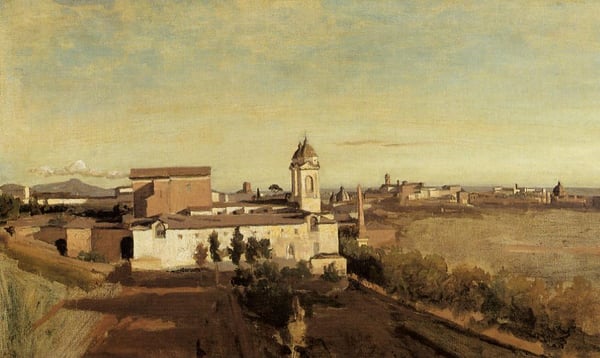
Camille Corot sanatçısının Trinita dei Monti from the Villa Medici eseri hakkında uzman analizi
Tarz: Realism · Tür: cityscape
Expert Analysis: Trinita dei Monti from the Villa Medici by Camille Corot
Camille Corot’s Trinita dei Monti from the Villa Medici stands as a pivotal work in the transition from Neoclassicism to Realism, and foreshadows the concerns of Impressionism. Painted during Corot’s first sojourn in Rome (1825–1828), the cityscape captures a specific, unidealized view of the Spanish Steps and the Trinità dei Monti church as seen from the gardens of the Villa Medici. Its significance lies in three key areas:
1. Realist Commitment to Everyday Topography
Unlike earlier Romantic or Neoclassical city views that often dramatized or idealized Rome’s ruins, Corot presents a quiet, matter-of-fact slice of urban life. The composition is balanced but unposed—trees frame the distant church, a low wall leads the eye, and small figures (perhaps local Romans or fellow artists) animate the foreground without becoming narrative. This direct, unembellished observation aligns with Realism’s rejection of artificial grandeur in favor of the ordinary.
2. Pioneering Plein Air Luminosity
Corot was among the first artists to systematically paint en plein air (outdoors), and this work demonstrates his mastery of capturing natural light and atmosphere. The soft, silvery tonality—characteristic of his early Italian studies—diffuses the strong Mediterranean sun, bathing the scene in a gentle, hazy light. The brushwork is loose yet deliberate, especially in the foliage and the distant facade, anticipating the broken color and atmospheric perspective that Claude Monet and the Impressionists would later explore.
3. Influence on the Barbizon School and Beyond
Though rooted in Realism, this painting embodies Corot’s unique fusion of structural clarity with lyrical softness. His treatment of the sky—pale blue with feathery clouds—and the subtle gradations of green and ochre reveal a sensitivity to tonal harmony that influenced the Barbizon painters (such as Daubigny and Rousseau) and later the outdoor studies of the Impressionists. The work is not merely a topographical record but a meditation on light, time, and place—a hallmark of Corot’s enduring legacy.
In the context of early 19th-century painting, Trinita dei Monti from the Villa Medici demonstrates how Corot stripped away classical artifice to render a modern, lived-in Rome, making him a crucial bridge between the rigid traditions of the Académie and the spontaneous vision of modern landscape art.
Görsel olarak benzer
İlişkili kompozisyon ve renk paletine sahip 20 eser
Rome, the Trinita dei Monti View from the Gardens of the Academie de France
Camille Corot
View of Pincio, Italy
Camille Corot
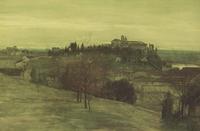
The Aventine from the Palatine
Walter Crane
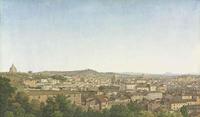
A panoramic view of Rome
Giovanni Battista Lusieri
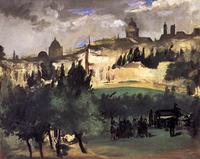
The burial
Edouard Manet
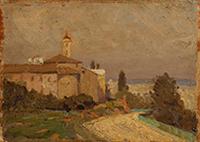
Assisi Landscape
Fujishima Takeji
Italiaans Landschap
Pierre-Henri de Valenciennes
View of Segovia
Joaquín Sorolla
Voltarra the Citadel
Camille Corot
Volterra
Camille Corot
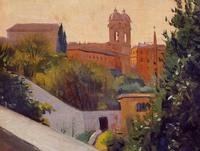
Trinity of the Mount
Felix Vallotton
View of a Town (Grodno)
Maxim Vorobiev
View of Vasto
Gabriele Smargiassi
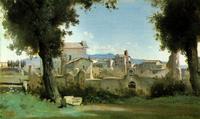
Rome - View from the Farnese Gardens
Camille Corot
The goatherd of Genzano
Camille Corot
View of La Tour de Farges
Gustave Courbet
The Forum Seen from the Farnese Gardens
Camille Corot
Pilgrims on the Via Cassia, Rome
Oswald Achenbach
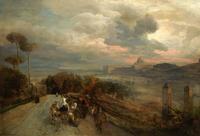
Via Cassia in Rome
Oswald Achenbach
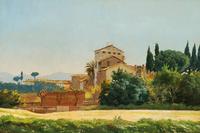
The church of San Bonaventura al Palatino, seen from the old Imperial Palace. In the background the Alban hills
Wenzel Tornøe