Expert analysis of Camille Corot’s Volterra
Style: Realism · Genre: landscape
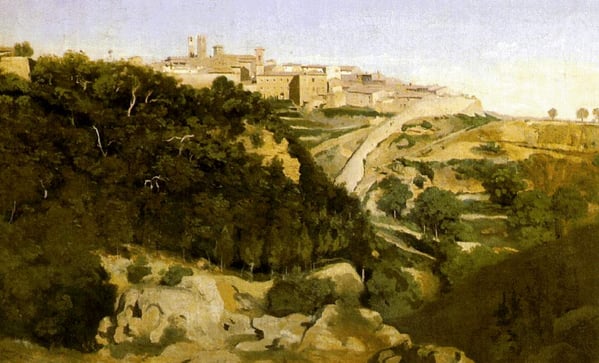
Camille Corot’s "Volterra" (1834) is a defining work of Realist landscape painting, marking a transition from the idealized landscapes of Neoclassicism toward a more naturalistic, atmospheric approach that would later influence the Impressionists.
Significance within Realism and the landscape genre:
- Corot’s depiction of the Tuscan hill town of Volterra demonstrates his commitment to painting en plein air and capturing the specific, unidealized qualities of a place. The composition balances rugged geological forms (the steep cliffs of the volcanic plateau) with soft, hazy light, creating a lyrical sense of space that is both truthful and poetic.
- Unlike the dramatic, composed landscapes of earlier traditions, Corot here emphasizes atmospheric unity—the blending of earth, sky, and architecture through subtle tonal gradations. The muted earth tones, silvery greens, and diffused light evoke a quiet, timeless mood, typical of his mature style.
- This work exemplifies Corot’s ability to merge observation with emotion. While rooted in the specific topography of Volterra, the painting transcends mere documentary record. The distant town appears almost as part of the natural landscape, its walls and towers softened by atmosphere—a hallmark of the "Corot touch" that later inspired artists like Degas and Monet.
Art-historical context:
- Painted one year after Corot’s second Italian journey (1834), Volterra reflects his deep study of the Roman Campagna and Tuscan countryside. It anticipates the Barbizon school’s naturalism while retaining a classical sense of structure.
- The work is significant for its unity of tone and light—Corot reduces contrast and detail in favor of a holistic visual experience. This approach prefigures the Impressionist emphasis on light and atmosphere, yet remains grounded in the Realist belief in depicting the visible world truthfully.
In summary, Volterra is a masterful synthesis of observation and sensibility, earning Corot his reputation as a bridge between Realism and Impressionism. It demonstrates how a landscape can be both a faithful record of place and an enduring poetic vision.
Visually similar
20 works with related composition and palette
Voltarra the Citadel
Camille Corot
Panorama of upper Bergamo
Romualdo Locatelli
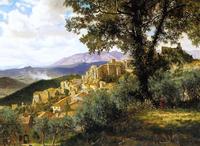
Olevano
Albert Bierstadt
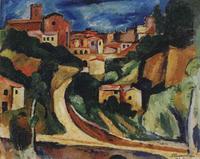
Siena
Pyotr Konchalovsky
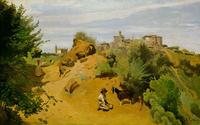
The goatherd of Genzano
Camille Corot
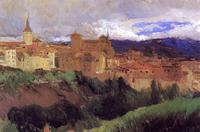
View of Segovia
Joaquín Sorolla
The Roman Odalisque (Marietta)
Camille Corot
Virgil's Tomb, Naples
Franz Ludwig Catel
Granada
Joaquín Sorolla
The Aventine from the Palatine
Walter Crane
The road
Andre Derain
Landscape in Cagnes
Felix Vallotton
Mountains at Jaca
Joaquín Sorolla
The valley of Los Naranjos
Santiago Rusinol
Villa at Caprarola
Claude-Joseph Vernet
Rome, the Trinita dei Monti View from the Gardens of the Academie de France
Camille Corot
Avignon Seen from Villenueve les Avignon
Camille Corot
Klippa Vid Cività Castellana
Jean-Joseph-Xavier Bidauld
Untitled
Georg Pauli
Le Tourette
Alexandre Jacovleff