Expert analysis of Camille Corot’s Village at the Foot of a Hill, Ile de France
Style: Realism · Genre: landscape
As an expert art historian, I will analyze "Village at the Foot of a Hill, Ile de France" by Camille Corot based solely on the provided facts: the artist, style (Realism), and genre (landscape).
Significance within Realism:
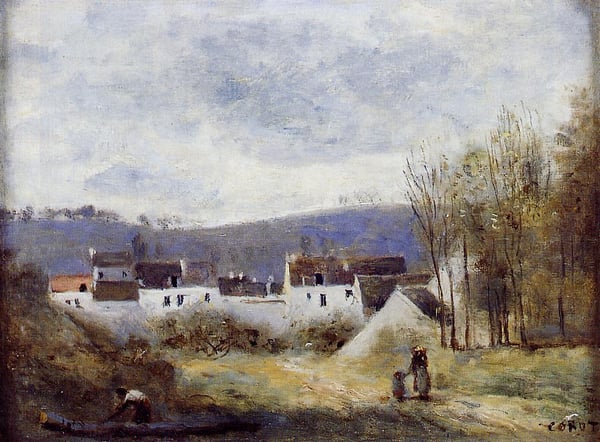
Corot’s painting is a landmark within the Realist landscape tradition because it captures the unidealized, everyday rural environment of the Ile de France region with a quiet, truthful observation. Unlike earlier Romantic or Neoclassical landscapes that often dramatized or allegorized nature, this work embodies Realism’s core commitment to depicting the ordinary world as it appears—a modest village nestled at the base of a hill, without heroic gestures or mythological references.
What makes the work notable for its period:
-
Transitional Role: Corot stands as a crucial bridge between the structured, formal landscapes of the 18th century and the looser, more atmospheric approach that would bloom into Impressionism. In "Village at the Foot of a Hill," he retains the compositional stability of classical landscape—a clear foreground, midground (the village), and distant hill—but infuses it with a Realist’s sensitivity to actual light and atmosphere. This subtle interplay of direct observation and harmonious arrangement prefigures the later Impressionist focus on transient effects.
-
Regional Specificity: The title identifies the location as "Ile de France," grounding the scene in a precise, recognizable French countryside. This is a hallmark of Realism: the desire to move away from generic Arcadian scenes toward specific, contemporary places. Corot’s depiction of the hill and village is not idealized; it is a respectful, unvarnished record of the landscape’s gentle rhythms.
-
Mood and Tone: The painting’s calm, poetic stillness—achieved through soft tonal contrasts and a muted palette—demonstrates Corot’s ability to infuse a Realist subject with a sense of intimacy and contemplation. He elevates the simple village scene to the status of fine art, arguing that the humble, unspectacular corners of the French countryside deserve the same serious treatment as grand historical subjects. This egalitarian vision is central to Realism’s ideological significance.
In summary, "Village at the Foot of a Hill, Ile de France" is significant because it perfectly exemplifies how Corot synthesized Realism’s truthful observation with a classical sense of order, creating a landscape that feels both authentic and timeless. It stands as a quiet manifesto for the beauty of the everyday, the very essence of the Realist movement.
Museum / Gallery
Visually similar
20 works with related composition and palette
Autumn in Louveciennes
Alfred Sisley
Kitchen Gardens at l'Hermitage, Pontoise
Camille Pissarro
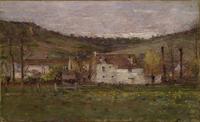
A French Hamlet
Theodore Robinson
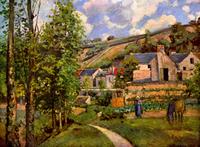
The Hermitage at Pontoise
Camille Pissarro
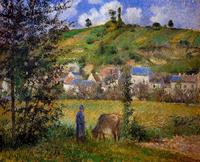
Chaponval Landscape
Camille Pissarro
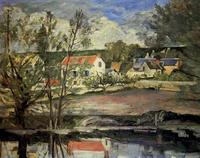
In the Oise Valley
Paul Cezanne
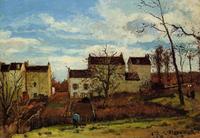
Spring at Pontoise
Camille Pissarro
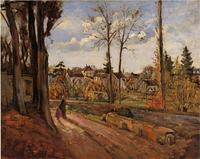
Louveciennes
Camille Pissarro
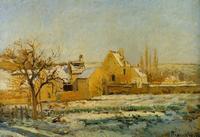
The Effect of Snow at Hermitage
Camille Pissarro
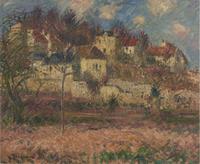
Village on the hill
Gustave Loiseau
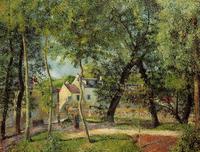
Landscape at Osny near watering
Camille Pissarro
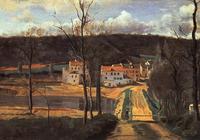
Ville d'Avray the Pond and the Cabassud House
Camille Corot
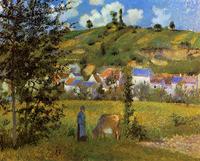
Landscape at Chaponval
Camille Pissarro
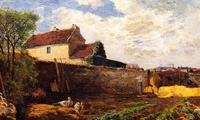
Geese on the farm
Paul Gauguin
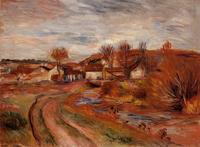
Landscape in Normandy
Pierre-Auguste Renoir
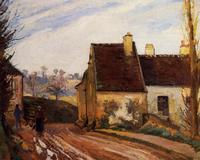
The Tumbledown Cottage near Osny
Camille Pissarro
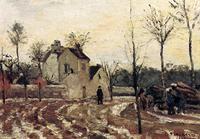
Thaw, Pontoise
Camille Pissarro
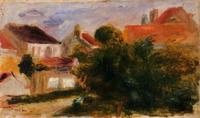
Landscape at Essoyes
Pierre-Auguste Renoir
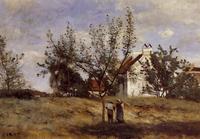
An Orchard at Harvest Time
Camille Corot
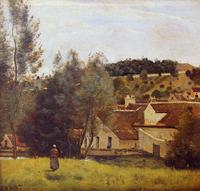
The Evaux Mill at Chiery, near Chateau Thierry
Camille Corot