Expert analysis of Camille Corot’s Ville d'Avray
Style: Realism · Genre: landscape
Expert Analysis: "Ville d'Avray" by Camille Corot
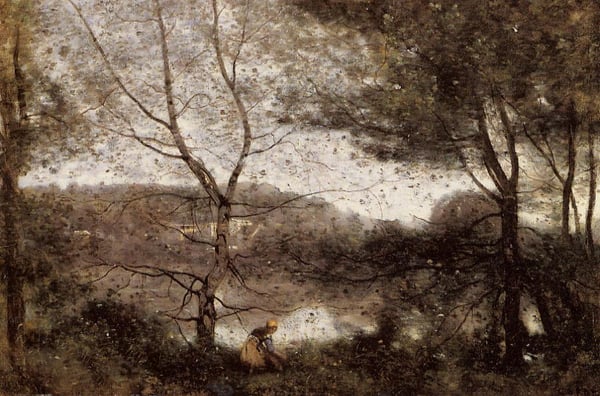
Camille Corot’s Ville d’Avray stands as a pivotal work within the Realist movement, yet it transcends strict categorization by embodying the transition from Neoclassical landscape to the more atmospheric, fleeting observations that would later define Impressionism. Painted in the mid-19th century, the work captures the small village and its surrounding ponds near Paris—a location Corot painted repeatedly, making it a personal touchstone for his artistic vision.
Significance in the Realist Tradition: Corot’s approach to Realism is not a hard-edged documentary of rural life, but a lyrical, atmospheric realism. Unlike the social or political focus of some Realists (e.g., Courbet), Corot grounds his work in the credible, everyday landscape. Ville d'Avray presents a seemingly straightforward view of water, trees, and sky, yet the artist’s mastery lies in his treatment of light and air. The soft, muted palette—silvery greens, pale blues, and warm grays—creates a hazy, almost spectral atmosphere. This “silvery tonality” became Corot’s signature, blending observed nature with a remembered, poetic mood.
Art-Historical Significance: Corot is a crucial bridge between two eras. He retained a classical sense of composition (balanced, with a deep diagonal recession into space and framing trees) from his early Neoclassical training, but he infused it with a Realist’s direct observation of transient effects—the shimmer of light on water, the softness of a cloudy sky. Ville d'Avray exemplifies this synthesis: the structure is orderly, but the handling is loose and impressionistic, with delicate, broken brushstrokes in the foliage and reflections.
Influence on Barbizon and Impressionism: Corot’s work of the 1850s and 1860s, including this painting, deeply influenced the Barbizon artists (who celebrated unspoiled nature) and, later, the Impressionists. His ability to capture a specific atmosphere—a humid, silvery afternoon—without sacrificing formal harmony made him a model for Monet, Pissarro, and others. In Ville d'Avray, the pool of water acts as a mirror, reflecting the sky and trees in a manner that dissolves solid form, foreshadowing Impressionist preoccupations with light and color.
Why This Work Matters: Ville d'Avray is significant because it demonstrates that Realism in landscape need not be purely descriptive. Corot’s “realism” is one of sensation—the feeling of a place at a particular moment, filtered through a gentle, nostalgic sensibility. It stands as a testament to his ability to merge the observed truth of nature with the timeless, poetic ideal, securing his place as a master who paved the way for modern painting.
Museum / Gallery
Visually similar
20 works with related composition and palette
Ville d'Avray
Camille Corot
Three Trees with a View of the Lake
Camille Corot
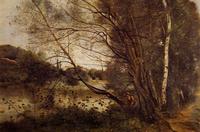
Pond at Ville d'Avray, with Leaning Trees
Camille Corot

Souvenir of Mortefontaine
Camille Corot

Recollections of Mortefontaine
Camille Corot
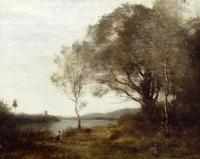
Strolling along the Banks of a Pond
Camille Corot
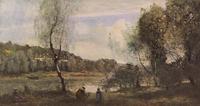
Pond of Ville d'Avray
Camille Corot
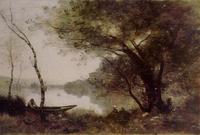
The Boatmen of Mortefontaine
Camille Corot
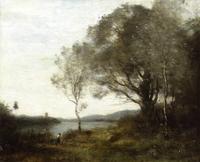
The Walk around the Pond
Camille Corot
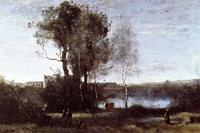
Large Sharecropping Farm
Camille Corot
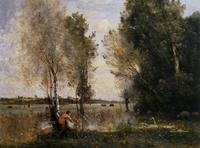
Woman Picking Flowers in a Pasture
Camille Corot
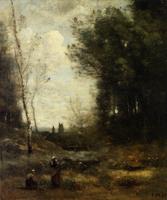
The Valley
Camille Corot

Peasant from Ville d'Avray and her Child among Two Trees at the Bank of a Pond
Camille Corot
Souvenir of Italy
Camille Corot
Forest Clearing in the Limousin
Camille Corot
The Solitude. Recollection of Vigen, Limousin
Camille Corot
Landscape
Paul Trouillebert

Orpheus Lamenting Eurydice
Camille Corot
The Little Nest Harriers
Camille Corot
Pond with Dog
Camille Corot