
Expert analysis of Albrecht Durer’s Christ before Annas
Style: Northern Renaissance · Genre: religious painting
Analysis of "Christ before Annas" by Albrecht Dürer
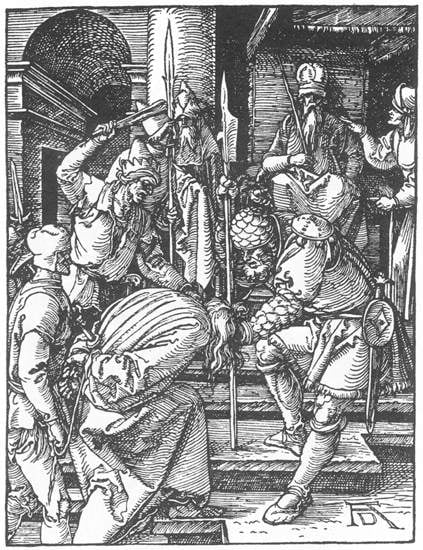
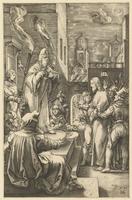
Albrecht Dürer’s Christ before Annas stands as a masterwork of the Northern Renaissance, a period distinguished by its meticulous naturalism, emotional intensity, and the fusion of late Gothic precision with early humanist inquiry. Painted within the tradition of religious narrative, this work exemplifies Dürer’s genius for translating sacred history into a profoundly human, psychologically charged scene.
Significance within the Northern Renaissance
Dürer was among the first Northern artists to fully absorb the principles of Italian Renaissance composition—particularly through his travels to Venice—while retaining the North’s hallmark attention to surface detail and symbolic clarity. In Christ before Annas, this synthesis is evident: the composition is compact and theatrically focused, drawing the viewer’s eye to the taut exchange between the bound Christ and the high priest Annas. Dürer’s handling of light and shadow (chiaroscuro) models faces and drapery with remarkable volume, lending a sculptural gravity that was avant‑garde for German art in the early 16th century.
Narrative and Emotional Depth
The episode—Christ’s preliminary interrogation by Annas, the father‑in‑law of Caiaphas—is less frequently depicted than his later trial, yet Dürer elevates it into a pivotal moment of tension. Christ stands silent and composed, his hands bound, while Annas leans forward with a mixture of authority and suspicion. The artist captures not just the physical confrontation but the psychological weight: Christ’s serene endurance contrasts with the worldly agitation of his accusers. This emotional nuance, paired with the meticulous rendering of textile folds, facial wrinkles, and the dim interior lit by a single candle, reinforces the Northern Renaissance obsession with observable reality as a vessel for spiritual meaning.
Influence and Legacy
Dürer’s printmaking innovations, notably his ability to achieve such detail in woodcut and engraving, made religious imagery accessible across Europe. Christ before Annas—likely part of a Passion cycle—demonstrates his role as a storyteller who could make a static moment resonate with universal significance. By humanizing Christ while preserving his divinity, Dürer contributed to a Northern Renaissance ideal: faith tested in the tangible world, rendered with uncompromising honesty and technical brilliance. This work remains a testament to how Northern artists transformed devotional subjects into intimate, unforgettable human dramas.
Museum / Gallery
Visually similar
20 works with related composition and palette
Christ before Herod
Albrecht Durer
Christ before Pilate
Albrecht Durer
Christ Before Pilate
Albrecht Durer
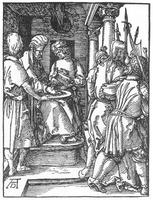
Pilate Washing His Hands
Albrecht Durer
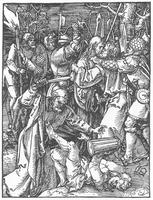
Christ Taken Captive
Albrecht Durer
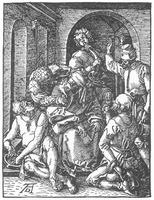
The Mocking of Christ
Albrecht Durer
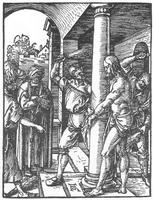
The Flagellation
Albrecht Durer
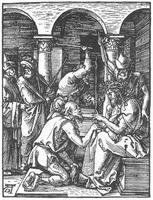
Christ Being Crowned with Thorns
Albrecht Durer
Apostle Paul Beheaded, Rome, AD 69
Jan Luyken
St. Peter And St. John Healing The Cripple
Albrecht Durer
Christ before Pilate
Albrecht Durer
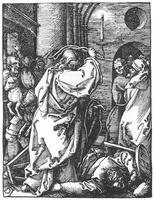
Christ Driving the Merchants from the Temple
Albrecht Durer
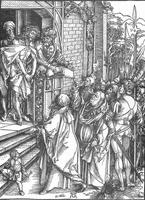
Ecce Homo
Albrecht Durer
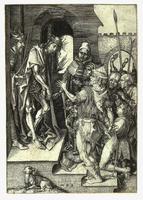
Ecce Homo
Martin Schongauer
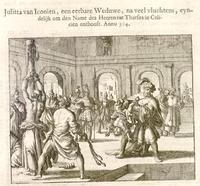
Jullieta Killed Along with Her Daughter, Tarsus, AD 304
Jan Luyken
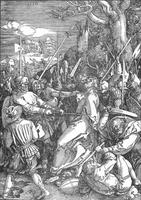
Christ Taken Captive
Albrecht Durer
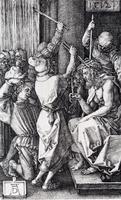
Christ Crowned With Thorns
Albrecht Durer
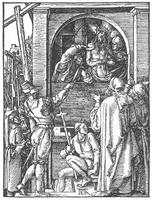
Christ Shown to the People
Albrecht Durer
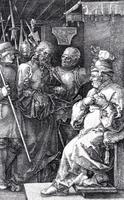
Christ Before Caiaphas
Albrecht Durer
Christ Before Caiaphas
Hendrick Goltzius