
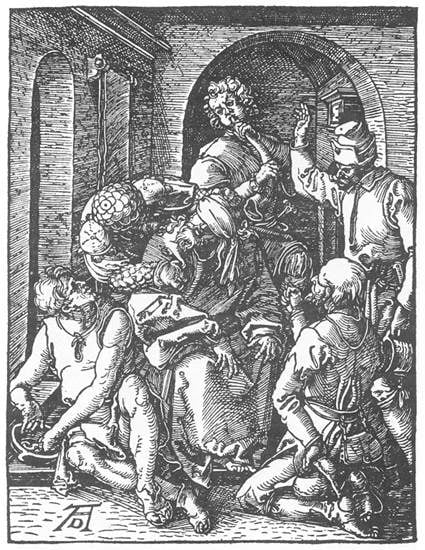
Expert analysis of Albrecht Durer’s The Mocking of Christ
Style: Northern Renaissance · Genre: religious painting
Expert Analysis of "The Mocking of Christ" by Albrecht Dürer
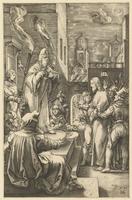
Albrecht Dürer’s The Mocking of Christ (c. 1509–1511, from the Engraved Passion series) stands as a pinnacle of Northern Renaissance religious painting and printmaking. Executed with the meticulous precision that defines Dürer’s oeuvre, this work exemplifies the synthesis of Gothic expressiveness and Italianate humanism that makes the Northern Renaissance distinctive.
Technical and Stylistic Significance
Dürer’s mastery of engraving is on full display: fine, taut lines model the figures with almost sculptural mass, while cross-hatching creates deep chiaroscuro that heightens the drama. The composition is tightly focused—Christ sits blindfolded at center, surrounded by a jeering crowd whose grotesque, individualized faces reflect a keen observation of human emotion. This blend of naturalistic detail (wrinkles, textures of hair and cloth) with symbolic exaggeration (the exaggerated grimaces of the tormentors) is a hallmark of Northern Renaissance art, where the spiritual is made tangible through the physical.
Iconographic Innovation
Unlike earlier depictions that emphasized Christ’s passive suffering, Dürer captures a moment of psychological cruelty. The blindfold and the striking hand of a soldier direct the viewer’s empathy toward Christ’s isolation. The tight, claustrophobic frame—a Dürer innovation—forces the eye to confront the tension between sacred sacrifice and brutal humiliation. This aligns with the Northern Renaissance’s focus on the imitatio Christi (imitation of Christ), making the devotional image feel immediate and visceral.
Influence of Italian Renaissance
Dürer, who traveled to Italy twice, imported classical ideals of proportion and perspective while retaining Northern emphasis on texture and emotion. The figure of Christ reflects a carefully studied anatomy, yet the emotional intensity—the furrowed brows, the clenched fists of the soldiers—remains rooted in German late Gothic pathos. This fusion marks The Mocking of Christ as a watershed: a work that bridges the devotional intensity of the North with the intellectual clarity of the South, defining the Northern Renaissance’s unique contribution to European art.
Significance within Dürer’s Oeuvre
As part of the Engraved Passion, this print was widely disseminated, shaping how generations of artists and worshippers visualized Christ’s suffering. Dürer’s ability to translate a biblical narrative into a compact, emotionally charged image made religious art accessible to a broad audience, reinforcing the role of prints in spreading Renaissance ideas. In short, The Mocking of Christ is not merely a depiction of an event but a masterclass in how technical virtuosity and spiritual engagement can coalesce into enduring art.
Museum / Gallery
Visually similar
20 works with related composition and palette
Pilate Washing His Hands
Albrecht Durer
Christ before Herod
Albrecht Durer
Christ before Annas
Albrecht Durer
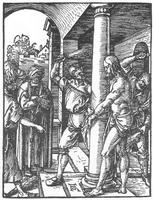
The Flagellation
Albrecht Durer
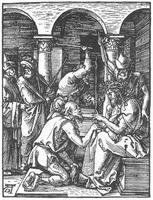
Christ Being Crowned with Thorns
Albrecht Durer
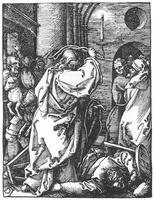
Christ Driving the Merchants from the Temple
Albrecht Durer
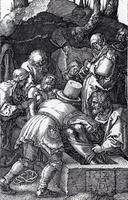
Deposition (Engraved Passion)
Albrecht Durer
The Beheading of St John the Baptist
Albrecht Durer
Christ Washing Peter s Feet
Albrecht Durer
Christ Shown to the People
Albrecht Durer
Christ Taken Captive
Albrecht Durer
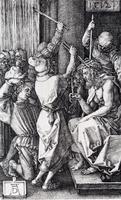
Christ Crowned With Thorns
Albrecht Durer
Martyrdom of Felicitas of Tuburbia in Mauretania, AD 201
Jan Luyken
Christ before Caiaphas
Albrecht Durer
Christ Before Pilate
Albrecht Durer
Betrayal Of Christ
Albrecht Durer
Ecce Homo
Albrecht Durer
Ecce Homo
Martin Schongauer
Christ before Pilate
Albrecht Durer
Christ Before Caiaphas
Hendrick Goltzius