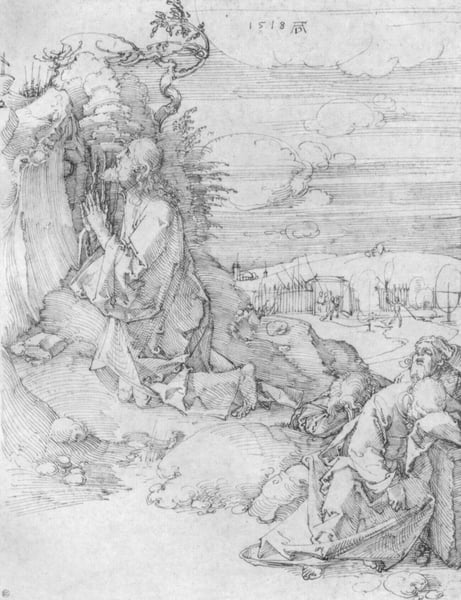
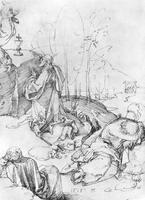
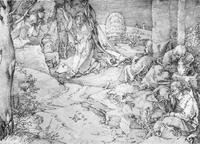
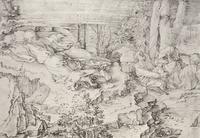
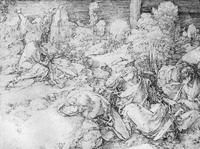
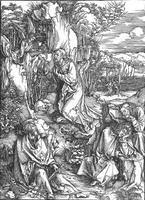
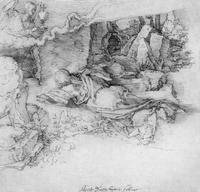
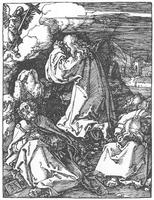
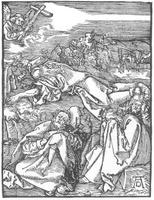
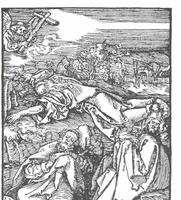
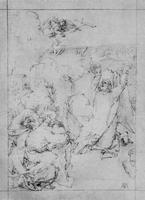
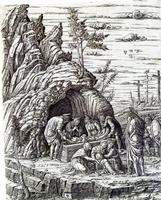
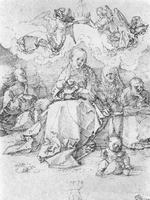
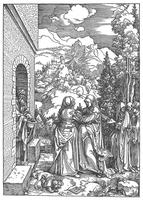
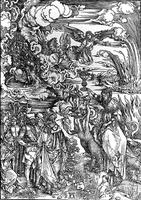
Albrecht Dürer's Christ on the Mount of Olives stands as a quintessential example of the Northern Renaissance's fusion of meticulous naturalism with profound religious sentiment. Executed within the religious painting genre, the work gains significance through Dürer's masterful ability to render a moment of intense spiritual anguish with startling psychological and physical precision—a hallmark of the Northern Renaissance style. Unlike the idealized, harmonious figures often favored by their Italian contemporaries, Dürer and other Northern artists focused on the tangible details of texture, landscape, and human expression. In this scene, the viewer is drawn into the somber, atmospheric setting of Gethsemane, where Christ's agony is made palpable through the careful rendering of drapery, shadow, and the rugged terrain. The work's significance lies in how it transforms a traditional biblical narrative into an immediate, visceral experience, reflecting the Northern Renaissance's emphasis on personal devotion and the belief that divine truth could be conveyed through the careful observation of the natural world. Dürer’s printmaking and painting here exemplify the era's ambition to merge technical virtuosity with theological depth, making the artwork a key document of its time.