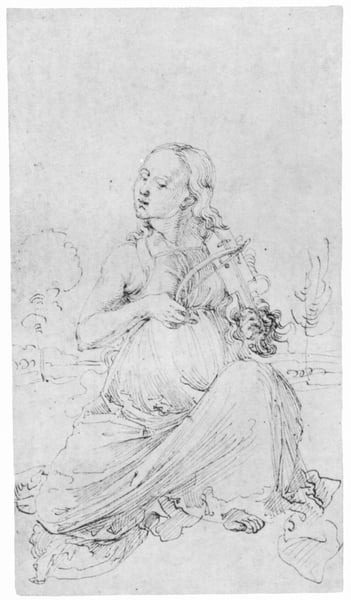
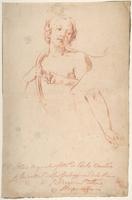
Drawing from the "Tarot" The Muse Thalia
Expert analysis of Albrecht Durer’s Drawing from the "Tarot" The Muse Thalia
Style: Northern Renaissance · Genre: illustration
Analysis of Albrecht Dürer’s "Drawing from the 'Tarot' – The Muse Thalia"
Style: Northern Renaissance | Genre: Illustration
Albrecht Dürer’s Drawing from the "Tarot" – The Muse Thalia stands as a remarkable testament to the intersection of classical humanism and meticulous Northern Renaissance draftsmanship. While the work is categorized as an illustration, it transcends mere decorative function, embodying the era’s profound engagement with allegory, symbolism, and the revival of antique themes.
Significance within Northern Renaissance and Illustration Genre:
-
Mastery of Line and Texture – Dürer’s pen-and-ink technique (or preparatory drawing for print) showcases the Northern Renaissance obsession with precise, almost scientific observation. Every fold of Thalia’s drapery, every curl of hair, and the delicate shading of her comic mask reveal a hand trained in rendering material reality with unparalleled clarity. This attention to detail was a hallmark of Northern art, distinct from the more painterly Italian approach.
-
Integration of Classical Mythology with Medieval Tarot Tradition – Thalia, the Muse of Comedy from Greek mythology, is here recontextualized within the tarot—a card game steeped in allegorical and moral lessons popular in Renaissance courts. Dürer’s choice to depict a Muse for a tarot series reflects the era’s syncretism: blending pagan wisdom with Christian and courtly symbolism. The drawing likely served as a design for a woodcut, intended to be reproduced and distributed—a key function of illustration in spreading humanist ideas beyond the elite.
-
Symbolic Layering – Thalia holds a comic mask, representing theatre and the ephemeral nature of joy, while her serene expression and classical garb evoke the enduring ideals of beauty and truth. In the Northern Renaissance, such emblematic figures were used to teach moral lessons through visual metaphor. Dürer’s rendering subtly hints at the tension between laughter’s transience and art’s permanence—a theme that resonates with the Reformation’s questioning of earthly pleasures.
-
Dürer’s Innovative Role as Illustrator – This work exemplifies Dürer’s transformative influence on the book and print market. Unlike earlier medieval illuminators, Dürer approached illustration with the same intellectual rigor as his altarpieces. Here, the composition is balanced, the figure occupies a defined space (likely the foreground of a bordered card), and the linework anticipates the printed medium’s need for clarity. This integration of fine art principles into commercial illustration helped elevate the genre’s status.
-
Humanist Ideal Embodied in Northern Realism – While inspired by Italian Renaissance models (the contrapposto stance, the classical drapery), Dürer grounds Thalia in a distinctly Northern sensibility: the face is more individualized, the textures of fabric and skin are almost tactile, and the overall mood is introspective rather than grandiose. This marriage of Italian form with German detail made Dürer a pivotal figure in the spread of Renaissance ideas north of the Alps.
In sum, The Muse Thalia is significant not only as a technical tour de force but as a window into how the Northern Renaissance reframed classical heritage for a broader, print-literate audience. Dürer’s illustration does not merely depict a Muse—it invites the viewer to contemplate the role of art, humor, and ephemerality in human life, all while demonstrating the supreme skill that defined his era’s artistic revolution.
Visually similar
20 works with related composition and palette
Young woman playing the violin
Giovanni Battista Piranesi
La Musique
Louise Abbéma
Out of This World (Stealers of Light by the Queen of Romania)
Edmund Dulac
Muse Calliope
Albrecht Durer
Golden Angel
Teodor Axentowicz
The Enchantment
Wojciech Siudmak
Engraving on copper of a Foolish Virgin
Martin Schongauer
Arts for the Hôtel Goüin
Luc-Olivier Merson
Prudentia
Albrecht Durer
Muse de la Musique
Louise Abbéma
Desdemona
Dante Gabriel Rossetti
The cicada
Léon Bazile Perrault
Madonna and Child with the little St. John
Albrecht Durer
Angel playing music
Franz Ittenbach
Huntress with a Horn
Charles-Andre van Loo (Carle van Loo)
The Violin Player
Gerard van Honthorst
Fiddler (study for the Jolly Flatboatmen)
George Caleb Bingham
Homer
Salvator Rosa
Musician of Silence
Arthur Hacker
A woman playing the violin with two children singing
Nicolas Tournier