
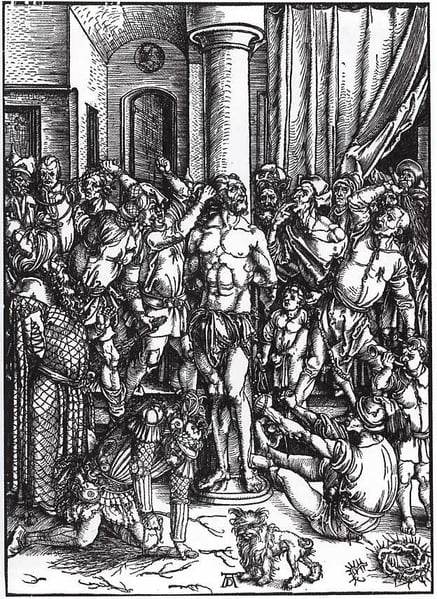
Expertenanalyse zu Albrecht Durers Flagellation of Christ
Stil: Northern Renaissance · Genre: religious painting
As an expert art historian, I will analyze Albrecht Dürer's "Flagellation of Christ" based solely on the provided structured facts: artist, style (Northern Renaissance), and genre (religious painting). The analysis focuses on what makes this work significant within its style and period.
Expert Analysis: Flagellation of Christ by Albrecht Dürer
Within the context of the Northern Renaissance, Albrecht Dürer’s Flagellation of Christ stands as a pivotal example of how the Northern tradition merged intense devotional realism with the emerging humanist concerns of the era. The work is a religious painting that depicts the scourging of Christ, a subject central to late medieval piety, but Dürer treats it with a level of psychological and physical precision that marks a decisive break from earlier Gothic conventions.
Significance within the Northern Renaissance
The primary significance of this painting lies in its demonstration of two key Northern Renaissance innovations: meticulous naturalism and emotional immediacy.
First, Dürer’s handling of the human form and drapery reflects the Northern Renaissance’s fascination with observable reality. Every sinew of Christ’s body, the tautness of the ropes, and the texture of the flagellants’ garments are rendered with an almost scientific attention to detail. This is not an idealized, serene Christ but a suffering, deeply human figure, rooted in the physical world—a hallmark of Northern Renaissance art that valued tangible, tactile experience over the more idealized forms of contemporary Italian art.
Second, the composition’s emotional intensity is characteristic of Northern devotional imagery intended to provoke empathetic meditation. Dürer captures the brutality of the moment not through overt violence but through the concentrated expressions and the claustrophobic arrangement of figures around the column. The focus on Christ’s stoic endurance, set against the grimly efficient motions of his tormentors, emphasizes the painting’s religious purpose: to make the viewer a direct witness to the Passion.
Distinctive Contribution
What makes Flagellation of Christ particularly significant is how Dürer synthesizes these Northern elements with the compositional sophistication learned from Italian Renaissance art. The strong diagonals, the careful modeling of anatomy, and the balanced arrangement of the figures give the scene a unified, classical gravity that earlier Northern treatments often lacked. This work thus exemplifies the Northern Renaissance’s defining achievement: the fusion of painstaking local detail with a new, humanist sense of pictorial order, creating a religious image that is at once hauntingly immediate and formally majestic.
Museum / Gallery
Visuell ähnlich
20 Werke mit ähnlicher Komposition und Farbpalette
Ecce Homo
Martin Schongauer
Ecce Homo
Albrecht Durer
Flagellation
Albrecht Durer
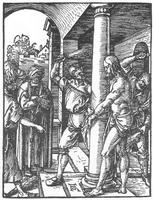
The Flagellation
Albrecht Durer
Martyrdom of the Ten Thousand
Albrecht Durer
Christ Being Nailed to the Cross
Albrecht Durer
Christ Being Crowned with Thorns
Albrecht Durer
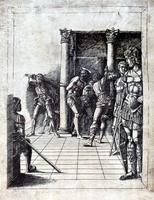
The Flagellation of Christ in the pavement
Andrea Mantegna
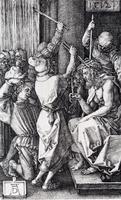
Christ Crowned With Thorns
Albrecht Durer
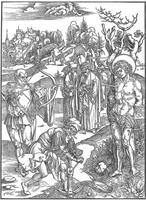
Martyrdom of St Sebastian
Albrecht Durer
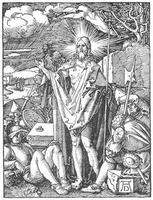
The Resurrection
Albrecht Durer
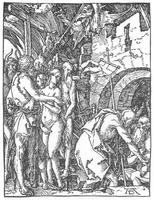
Christ in Limbo
Albrecht Durer
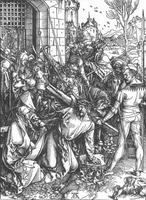
Christ Bearing the Cross
Albrecht Durer
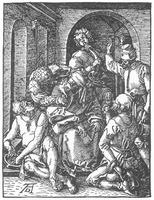
The Mocking of Christ
Albrecht Durer
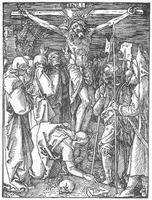
Christ on the Cross
Albrecht Durer
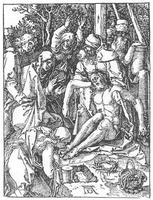
The Lamentation for Christ
Albrecht Durer
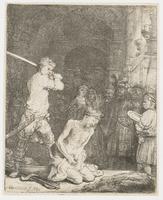
The beheading of John the Baptist
Rembrandt
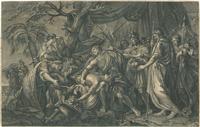
Achilles Laments the Death of Patroclus 1764
Domenico Cunego
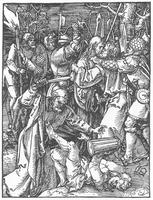
Christ Taken Captive
Albrecht Durer
Fornarina
Giovanni Battista Piranesi