
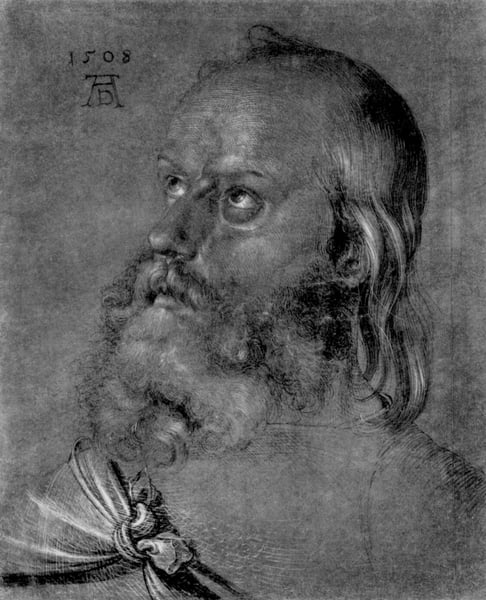
Expert analysis of Albrecht Durer’s Head of an apostle
Style: Northern Renaissance · Genre: sketch and study
Expert Analysis: "Head of an Apostle" by Albrecht Dürer
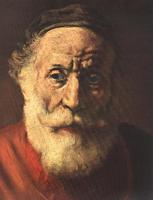
Albrecht Dürer’s Head of an Apostle stands as a masterful exemplar of the Northern Renaissance’s intersection of meticulous naturalism and spiritual gravitas. Executed as a sketch and study, this work reveals Dürer’s foundational process—a disciplined investigation of human expression, anatomy, and character that underpinned his more finished engravings and paintings.
Significance within the Northern Renaissance
Dürer, a pivotal figure in the Northern Renaissance, fused the intricate detail of Northern European traditions (rooted in late Gothic manuscript illumination and panel painting) with the emerging humanist ideals of observation and proportion. This study is significant because it demonstrates his practice of drawing from life to achieve a psychological depth rarely seen in earlier religious art. The apostle’s head is not a generalized type but a specific, aging face—furrowed brow, sunken cheeks, intense gaze—that conveys wisdom, weariness, and devotion. Such naturalistic characterization was revolutionary; it personalized the sacred, making the divine feel tangibly human without sacrificing reverence.
Genre as a Window into Process
As a sketch and study, this work offers rare insight into Dürer’s working method. He used silverpoint or pen on prepared paper to capture fleeting expressions and anatomical structures, often revisiting these studies for larger compositions (e.g., his Apocalypse woodcuts or Four Apostles paintings). The loose, energetic lines contrast with the polished finish of his prints, yet they carry a spontaneity that reveals his hand and mind at work. In a period when drawing was increasingly valued as an independent art form (not merely a preparatory step), Dürer elevated the study to a cognitive tool—a means of understanding God’s creation through close observation.
Artistic Legacy
What makes this artwork enduringly significant is its balance of Northern precision and proto-modern expressiveness. Every wrinkle and shadow is a deliberate choice, informed by Dürer’s travels to Italy (where he absorbed proportion theory) and his native German tradition’s love of texture and detail. The apostle’s head becomes a microcosm of the Northern Renaissance ideal: art as both a spiritual meditation and a scientific inquiry. In capturing a single, unidealized face, Dürer asserts that the sacred dwells in the particular—a revolutionary message that defined his era and still resonates today.
Museum / Gallery
Visually similar
20 works with related composition and palette
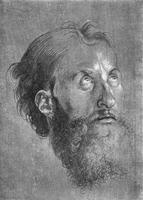
Head of an Apostle Looking Upward
Albrecht Durer
Saint Paul
Diego Velazquez
Portrait of an Old Jew
Antoine Pesne
Head of An Old Man
Thomas Stuart Smith
Bearded Old Man Wearing a Brown Cloak
Jan Lievens
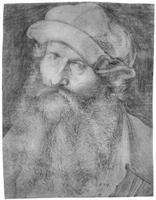
Portrait of a man (John Stabius)
Albrecht Durer
Study of an Old Man
Jan Lievens
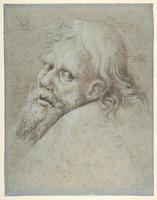
Head of a Bearded Man
Hans Hoffmann
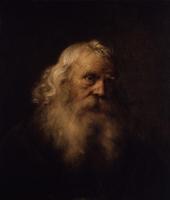
Head of an Old Man
Jan Lievens
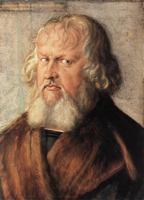
Portrait of Hieronymus Holzschuher
Albrecht Durer
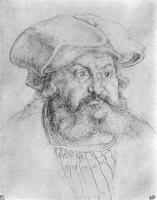
Portrait of Elector Friedrich the Wise
Albrecht Durer
Martin Luther as Junker Jörg
Lucas Cranach the Elder
Head of a Bearded Man
John Greenhill
Bearded Man with a Velvet Cap
Govert Flinck
Old man's head
Giorgio de Chirico
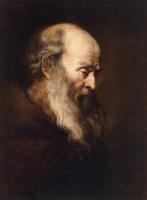
Portrait of an Old Man
Jan Lievens
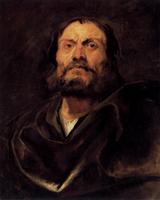
An Apostle
Anthony van Dyck
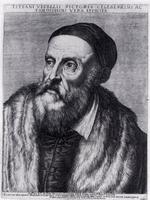
Titian
Agostino Carracci
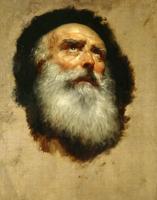
The Head of An Apostle
Anton Raphael Mengs
Old man
Rembrandt