
Expertenanalyse zu Albrecht Durers Resurrection
Stil: Northern Renaissance · Genre: religious painting
Expert Analysis: "Resurrection" by Albrecht Dürer
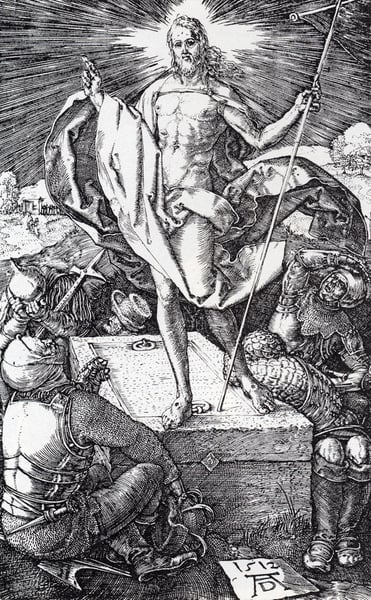
Albrecht Dürer’s Resurrection is a quintessential work of the Northern Renaissance, a period defined by its fusion of meticulous naturalism with profound spiritual symbolism. Though the specific medium is not noted here, Dürer most commonly rendered this subject in his celebrated print cycles—such as the Small Passion (c. 1510) or the Great Passion (c. 1498–1510)—where his mastery of engraving and woodcut elevated religious narrative to unprecedented detail and emotional depth.
Significance within the Northern Renaissance
-
Technical Virtuosity and Realism
Dürer brought an almost scientific precision to his rendering of texture, anatomy, and light. In Resurrection, this manifests in the dramatic contrast between the dark, empty tomb and the radiant figure of Christ. The careful hatching and cross-hatching (if a print) create a sculptural three-dimensionality that rivals painting, while the folds of Christ’s shroud and the soldiers’ armor are observed with documentary accuracy—hallmarks of Northern Renaissance attention to the tangible world. -
Synthesis of Northern and Italian Ideals
Dürer was uniquely positioned between two traditions. He absorbed Italian Renaissance principles of proportion and perspective (gained during his travels to Venice) but never abandoned the Northern Gothic love for intricate detail and symbolic density. In Resurrection, the balanced, pyramidal composition owes something to Italian harmony, yet the emotive faces of the soldiers and the eerie, supernatural glow around Christ remain deeply Northern—grounded in human experience while pointing toward divine mystery. -
Spiritual Dramatization
Unlike later Baroque depictions that emphasize theatrical motion, Dürer’s Resurrection is a study in stillness and controlled energy. Christ stands triumphant but calm, one hand raised in blessing, the other holding the victory banner (a traditional symbol of His conquest over death). The sleeping or startled guards are rendered with individualized expressions—fear, awe, exhaustion—that invite the viewer to contemplate the miracle’s psychological impact. This blend of inner piety and outer observation is a key trait of Northern Renaissance devotional art. -
Print Culture and Accessibility
Dürer revolutionized the art market by producing multiple impressions of his prints, making religious imagery accessible to a broader public. Resurrection as a print could be owned, studied, and meditated upon in homes or monastic cells, aligning with the Northern Renaissance emphasis on personal devotion and the democratization of sacred art.
Conclusion
Resurrection exemplifies Dürer’s genius for marrying technical innovation with theological depth. It stands as a bridge between the late medieval world and the modern era—meticulously observed yet spiritually charged. In the context of the Northern Renaissance, it demonstrates how artists used the new tools of realism and printmaking to make the divine palpable, ensuring that Christ’s victory resonated not only in churches but in the hands and hearts of ordinary viewers.
Museum / Gallery
Visuell ähnlich
20 Werke mit ähnlicher Komposition und Farbpalette
Resurrection
Albrecht Durer
The Resurrection of Christ
Albrecht Durer
The Resurrection
Albrecht Durer
The Incredulity of St Thomas
Albrecht Durer
The resurrected Christ between St. Andrew and Longinus
Andrea Mantegna
The Resurrection of Christ
Andrea Mantegna
Harrowing Of Hell
Albrecht Durer
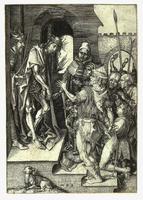
Ecce Homo
Martin Schongauer
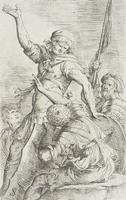
Soldiers Conversing
Salvator Rosa
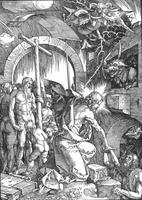
The Harrowing of Hell or Christ in Limbo, from The Large Passion
Albrecht Durer
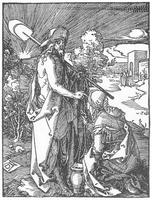
Christ Appears to Mary Magdalene
Albrecht Durer
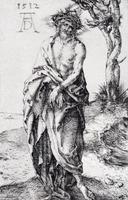
Man Of Sorrows With Hands Bound
Albrecht Durer
Ecce Homo
Palma il Giovane
Jesus Christ on the Mount of Olives
Albrecht Durer
David
Hendrick Goltzius
Flagellation of Christ
Albrecht Durer
St. Jerome and the Angel
Jusepe de Ribera
Christ in Limbo
Albrecht Durer
Five Lansquenets And An Oriental On Horseback
Albrecht Durer
Cult of Bacchus
Jan Saenredam