
Expertenanalyse zu Albrecht Durers The Death of Mary
Stil: Northern Renaissance · Genre: religious painting
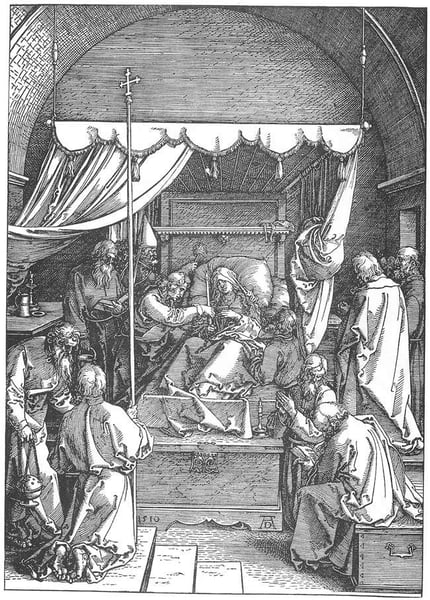
Albrecht Dürer’s "The Death of Mary" (circa 1500–1510) is a masterful woodcut from his celebrated series The Life of the Virgin, and it stands as a landmark of the Northern Renaissance in its synthesis of meticulous naturalism, emotional gravity, and innovative narrative composition. Within the genre of religious painting (here rendered as a print), Dürer elevates a traditional subject—the Dormition of the Virgin—by infusing it with the period’s characteristic attention to texture, spatial depth, and human expression.
Significance within the Northern Renaissance style:
-
Naturalistic detail and symbolic precision: Dürer’s print demonstrates the Northern Renaissance obsession with observable reality. Every element—from the folds of the apostles’ robes to the wooden grain of Mary’s bed, the stonework of the room, and the delicate fringe of the pillow—is rendered with exacting woodcut linework. This hyper-specificity grounds a sacred scene in a tangible, contemporary space, making the miracle of Mary’s death feel intimate and real. The haloed apostles are not idealized figures but individualized men with distinct faces, postures, and grief-stricken reactions, a hallmark of Northern humanism.
-
Spatial innovation and perspectival maturity: Dürer, deeply influenced by his travels to Italy and his study of Renaissance perspective, organizes the scene around a strong central axis. Mary’s bed is set diagonally into the room, receding into depth while the surrounding figures create a circular, devotional rhythm. The open book on her lap, the extinguished candle at her bedside, and the carefully drawn architectural details (the arched window, the tiled floor) all serve to anchor the viewer in a credible, three-dimensional space—a departure from the flatter, symbolic spaces of earlier Gothic art.
-
Emotional realism and narrative clarity: Unlike the serene, hierarchical depictions common in medieval art, Dürer’s apostles actively mourn. John leans forward in sorrow, Peter holds a book and gestures toward the light above, others cluster with opened mouths and clasped hands. The Virgin herself lies calm but wholly human, her face marked by age and exhaustion. This emotional directness, combined with the careful staging of the scene (the bed, the candles, the open book as symbol of her piety), allows the viewer to witness the moment of transition between life and death as both a human tragedy and a divine mystery.
-
Printmaking as a vehicle for religious art: As a woodcut, "The Death of Mary" was designed for broad dissemination—Dürer’s prints reached a wide audience beyond the elite patrons of paintings. The dense cross-hatching and controlled line variety demonstrate his technical mastery of the medium, making the print not merely a devotional image but a work of extreme artistic sophistication that defined the Northern Renaissance print tradition.
In sum, "The Death of Mary" is significant because it perfectly encapsulates Dürer’s ability to marry the Northern Renaissance’s devotion to empirical detail with the expressive, compositional principles of the Italian Renaissance, all while serving a deeply spiritual narrative. It is a quiet, but deeply moving, masterpiece of religious printmaking that redefines how a sacred death is witnessed—with both earthly tenderness and transcendent grace.
Museum / Gallery
Visuell ähnlich
20 Werke mit ähnlicher Komposition und Farbpalette
Death of the Virgin
Albrecht Durer
The Virgin Worshipped by Angels and Saints
Albrecht Durer
Christ among the Doctors in the Temple
Albrecht Durer
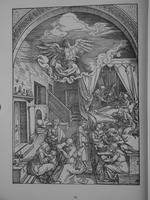
A Life of the Virgin
Albrecht Durer
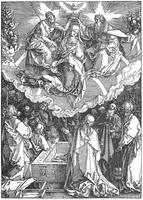
The Coronation of the Virgin
Albrecht Durer
Jezebel Promising Naboth's Vineyards to King Ahab
Lucas van Leyden
Death of the Virgin
Rembrandt
The Arrogance of Rehoboam
Hans Holbein the Younger
Honoric, King of the Vandals, Eaten by Worms and Lice, AD 477
Jan Luyken
Study for the will of Isabella the Catholic
Eduardo Rosales
The Circumcision of Christ
Albrecht Durer
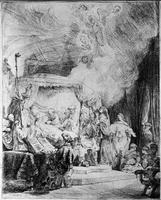
Death of the Virgin
Rembrandt
Christ Appears to His Mother
Albrecht Durer
Alexander the Great demonstrates his trust in his physician
Eustache Le Sueur
The Annunciation
Albrecht Durer
Fulk-Nerra Assailed by the Phantoms of His Victims
Gustave Dore
Mary Toft, apparently giving birth to rabbits
William Hogarth
The Presentation of Christ in the Temple
Albrecht Durer
The Presentation of the Virgin in the Temple
Albrecht Durer
Christ before Herod
Albrecht Durer