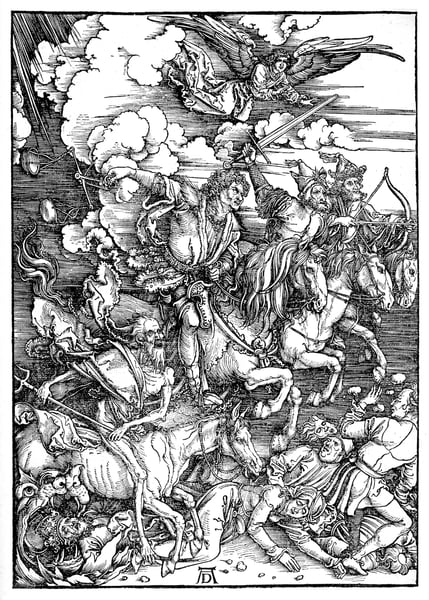
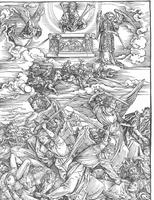
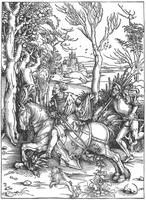
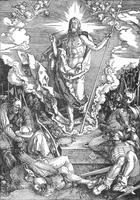
Albrecht Dürer's The Four Horsemen of the Apocalypse (c. 1498) is a landmark of the Northern Renaissance and a defining masterpiece of the woodcut medium. In this religious scene from the Book of Revelation, Dürer compresses the cataclysmic advance of Conquest, War, Famine, and Death into a single, surging horizontal frieze. What makes the work so significant is its revolutionary synthesis of precise, almost metallic engraving techniques with the expressive, often violent emotional intensity of late medieval spirituality. Dürer elevates the humble woodcut to the level of high art, creating unprecedented depth, volume, and texture through dense cross-hatching and a virtuosic control of black-and-white contrast. The figures of the horsemen trample a chaotic heap of humanity—a pope, a bishop, a queen, a peasant—visually declaring that the Apocalypse spares no earthly rank. Death, personified as a skeletal figure with a pitchfork, drives the action forward with terrifying momentum. Dürer’s work is not merely an illustration but a theological and humanist meditation on divine judgment, rendered with the observational rigor of the Northern Renaissance yet charged with a raw, visionary energy that influenced generations of artists and solidified the print as a powerful vehicle for complex narratives.