
Albrecht Durer の The Virgin and Child with St. Anne の専門的な分析
スタイル:Northern Renaissance · ジャンル:religious painting
Expert Analysis: "The Virgin and Child with St. Anne" (1519) by Albrecht Dürer
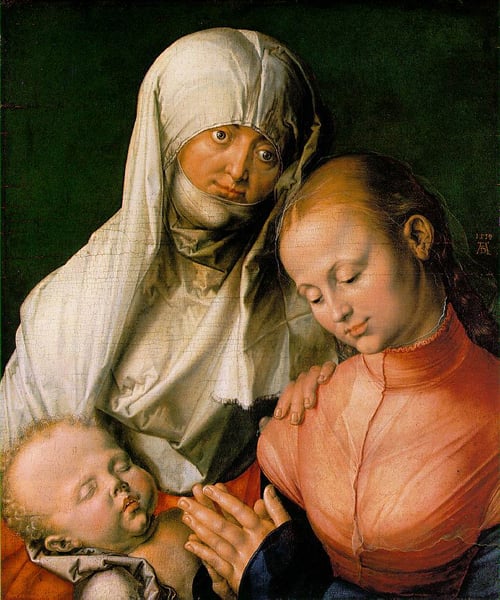
This painting stands as a masterful synthesis of Northern Renaissance precision and Italianate monumentality, marking a high point in Dürer’s mature religious work. At its core, the composition presents a tender, intergenerational family group—St. Anne, the Virgin Mary, and the Christ Child—arranged in a stable, pyramidal structure that echoes Leonardo da Vinci’s contemporary compositions in Milan, yet is translated through Dürer’s uniquely Northern sensibility.
Significance within the Northern Renaissance
-
Integration of Italian Form with Northern Detail
Dürer traveled to Italy twice and absorbed the classical balance and volumetric modeling of artists like Leonardo. In this painting, the three figures are knit together by gesture and gaze: Anne’s protective hand on Mary’s shoulder, Mary’s downcast eyes, and the Christ Child’s playful reach. The pyramidal grouping lends a serene, almost sculptural unity. However, Dürer never abandons the Northern traditions of meticulous observation: every fold of drapery is individually rendered with crisp, graphic clarity; the textures of wool, linen, and hair are tangible; and the soft, diffuse light models forms without sacrificing linear precision. -
Emotional Intimacy and Theological Nuance
Unlike many symbolic or hieratic depictions of the Holy Family, Dürer emphasizes a quiet, domestic psychology. The Christ Child grasps an apple—a clear reference to the Fall of Man and his future role as the “New Adam.” St. Anne’s gaze is inward, contemplative, while Mary cradles the child with a tenderness that is both human and reverent. This blend of sacred symbolism and naturalistic emotion was revolutionary for Northern art, making complex theology accessible through relatable human interaction. -
Technical Virtuosity in Oil
Dürer’s handling of oil paint shows his training as a printmaker and draftsman. The fine, hatched brushstrokes in the shadows, the translucent glazes on the skin, and the crisp highlights on the apple and fabric demonstrate his ability to achieve the luminosity and density of color that characterizes the best of Northern panel painting. This work is often cited as a textbook example of how Dürer married the graphic precision of his engravings with the rich coloristic possibilities of oil. -
Influence on Later Religious Art
By placing a canonical subject in a naturalistic, intimate setting, Dürer paved the way for later Northern artists—such as Hans Baldung Grien and the Cranachs—to explore humanized depictions of holy figures. The painting’s blend of devotional gravitas and everyday tenderness also anticipates the domestic realism of the Dutch Golden Age.
In sum, The Virgin and Child with St. Anne is significant because it represents Dürer’s ability to harmonize the intellectual ideals of the Italian Renaissance with the empirical, detail-driven spirit of the North. It is a devotional image that feels both timeless and immediate, demonstrating how the Northern Renaissance transformed religious art into an exploration of human connection.
Museum / Gallery
視覚的に類似
構図やパレットが近い作品 20 件
The Virgin and Child with Saint Anne
Gortzius Geldorp
Madonna Adoring the Child
Barbara Longhi
Holy Family with Mary Magdalene
Ventura Salimbeni
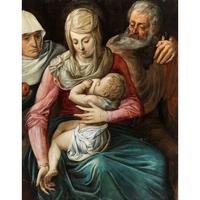
DIE HEILIGE FAMILIE
Frans Floris de Vriendt
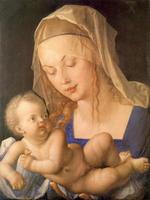
Virgin and child holding a half eaten pear
Albrecht Durer
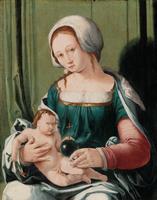
Virgin and Child
Lucas van Leyden
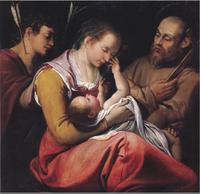
Madonna and Child with Sts Sebastian and Francis
Orazio Gentileschi
Madonna and Child playing with the veil
Mabuse
VIERGE EN ADORATION DE L’ENFANT
Hans Rottenhammer I
Madonna and Child playing with the veil
Mabuse
Virgin in Adoration before the Christ Child
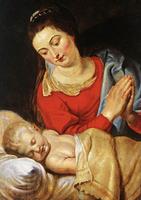
Peter Paul Rubens
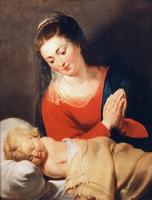
Virgin in Adoration Before the Christ Child
Peter Paul Rubens
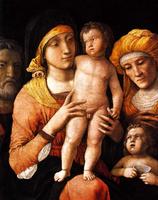
The Holy Family with St. Elizabeth and St. John the Baptist
Andrea Mantegna
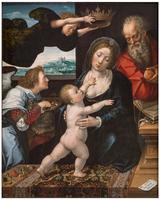
The Holy Family
Bernard Van Orley
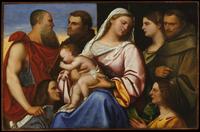
Madonna and Child with Saints and Donors
Sebastiano del Piombo
Self portrait of the artist with wife and son Alfons
Johann Friedrich Overbeck
The Mystical Marriage of Saint Catherine
Bernardino Luini
Madonna and Child with Sts Dorothy and George
Titian
Virgin and Child with St. Catherine and Mary Magdalene
Giovanni Bellini
Virgin and Child
Peter Paul Rubens