
Expertenanalyse zu Albrecht Durers Watermill at the montaсa
Stil: Northern Renaissance · Genre: landscape
Expert Analysis: "Watermill at the montaсa" by Albrecht Dürer
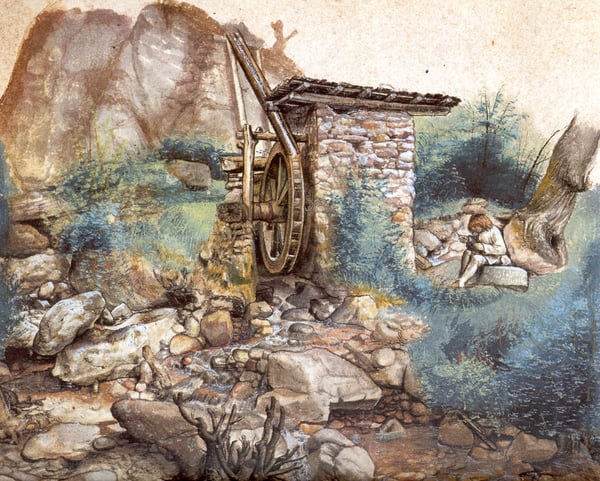
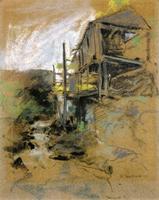
Albrecht Dürer’s Watermill at the montaсa stands as a landmark in the Northern Renaissance, particularly within the nascent genre of pure landscape. Created during a period when landscape was still largely confined to the backgrounds of religious or historical scenes, this work demonstrates Dürer’s pioneering approach to elevating the natural world—and the human structures within it—to a subject worthy of focused study.
Significance within the Northern Renaissance and Landscape Genre
-
Early Independent Landscape: In the Northern Renaissance, artists like Dürer began to break away from the medieval tradition of using nature solely as a symbolic backdrop. Watermill at the montaсa is a prime example of this shift: it is an unpretentious, secular view that treats the watermill and its surrounding terrain as the primary narrative. This marks an important step toward the later Dutch Golden Age landscape painting, which would celebrate everyday rural scenes.
-
Meticulous Naturalism and Detail: True to Dürer’s Northern Renaissance style, the work displays an almost scientific precision in its rendering of organic forms. The watermill itself is depicted with careful attention to architecture and function—the wheel, the sluice, the roof—while the surrounding foliage, rocky slopes, and flowing water are observed with the same minute detail Dürer applied to his famous studies of animals and plants. This combination of observational accuracy and compositional harmony creates a believable, immersive environment.
-
Integration of Human and Natural Elements: The watermill serves as a perfect focal point, embodying the Northern Renaissance fascination with humanity’s place in the natural order. Rather than dominating the scene, the mill is nestled into the landscape, its mechanical rhythm echoing the flow of the stream. Dürer subtly demonstrates how human industry and nature coexist, a theme that would resonate throughout later landscape art.
-
Atmospheric and Spatial Innovation: Dürer was among the first Northern artists to master atmospheric perspective—the effect of air and distance on color and clarity. In Watermill at the montaсa, the foreground is sharp and detailed, while the distant hills and sky soften into paler tones. This creates a convincing sense of depth and space, drawing the viewer’s eye from the watermill’s immediate activity to the broader horizon, and establishing a pictorial structure that would define landscape painting for centuries.
-
A Personal, Honest View: Unlike idealized Italianate landscapes, Dürer’s work retains a distinctly Northern character—rugged, intimate, and unromanticized. The “montaсa” (likely referencing a mountainous or hilly site) is depicted with its actual topography, perhaps inspired by Dürer’s travels through the Alps. This fidelity to a specific location, rather than a generic pastoral scene, underscores the Northern Renaissance emphasis on empirical observation.
Conclusion
Watermill at the montaсa is significant not only as a beautiful depiction of a rural watermill but as a critical document in the evolution of landscape art. It showcases Dürer’s technical mastery, his deep appreciation for the natural world, and his willingness to treat the everyday environment with the same reverence previously reserved for sacred subjects. Within the Northern Renaissance, this work helps define the shift toward secular, nature-focused painting—a legacy that would profoundly influence generations of artists across Europe.
Visuell ähnlich
20 Werke mit ähnlicher Komposition und Farbpalette
A Watermill
James Campbell Noble
The Water Wheel
Eric Ravilious
The Ornans Paper Mill
Gustave Courbet
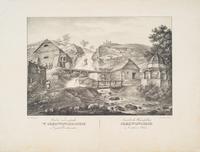
Вид на водоспад у Червоногруді, 1823 р.
Антон Лянґе
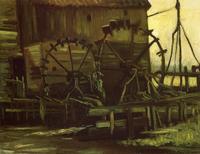
Water Wheels of Mill at Gennep
Vincent van Gogh
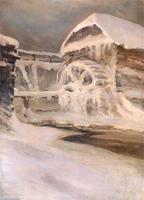
Młyn zimą
Ferdynand Ruszczyc
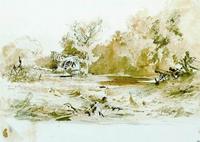
Abandoned Mill 2
Fyodor Vasilyev
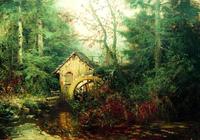
Forest Landscape with Watermill
Efim Volkov
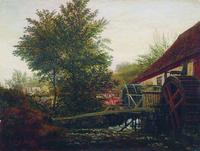
An old mill
Lev Lagorio
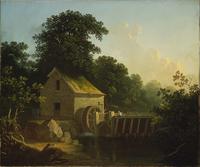
Landscape with Waterwheel and Boy Fishing
George Caleb Bingham
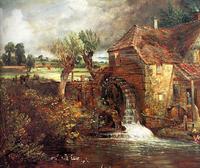
A Mill at Gillingham in Dorset
John Constable
Nocking
Sue Coe
Landscape with Lake
Konstantin Makovsky
The Enchanted Mill
Franz Marc
The Water Mill
Frances Hodgkins
Silence of the Snow, Bucket Mill on the Feugh, Finzean
Joseph Farquharson
Two Watermills and an Open Sluice
Jacob van Ruisdael
Landscape with water mill and stone bridge
Louwrens Hanedoes
Water mill near Vichy
Jean-Francois Millet
Abandoned Mill
John Henry Twachtman