Expert analysis of Albrecht Durer’s Wire Drawing Mill
Style: Northern Renaissance · Genre: cityscape
Expert Analysis of Albrecht Dürer’s "Wire Drawing Mill" (c. 1494)
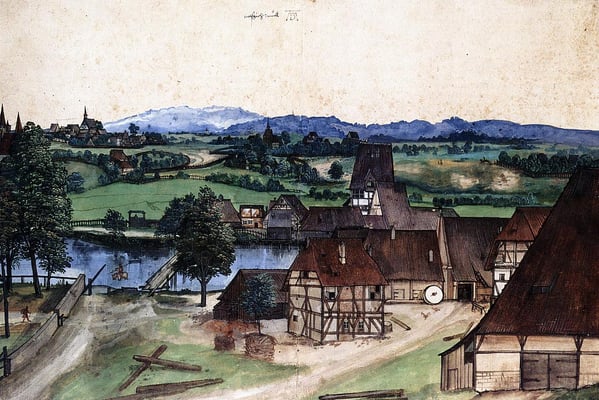
As a work of the Northern Renaissance, Dürer’s Wire Drawing Mill exemplifies the period’s hallmark fusion of meticulous natural observation with symbolic depth. The painting belongs to the cityscape genre, yet it transcends mere topographical record.
Significance in Style and Period
-
Pioneering the Pure Landscape – Among the first Western artworks to treat a non-religious, non-narrative outdoor scene as a subject in its own right, this watercolor anticipates the autonomous landscape tradition. Dürer elevates a humble industrial site—a mill for drawing metal wire—to the level of high art.
-
Northern Renaissance Precision – The work showcases Dürer’s unrivaled draftsmanship and attention to detail. Every plank, roof tile, and waterwheel is rendered with almost scientific accuracy, reflecting the Northern Renaissance obsession with tangible reality. The atmospheric perspective of the rolling hills and distant village demonstrates his assimilation of Italian spatial ideas, filtered through a Germanic eye for texture.
-
Human Industry in Harmony with Nature – The mill is nestled into a lush river valley, its activity integrated into the landscape. This balance between human labor and the natural world is a subtle but key feature of Northern Renaissance art, where daily work is dignified without idealization.
-
Technical Mastery – Executed in watercolor and body color on paper, the piece exploits the medium’s transparency to capture shifting light on water and foliage. Dürer’s ability to render both the solidity of the mill and the softness of the sky marks a turning point in Northern European watercolor technique.
What Makes It Enduring
Wire Drawing Mill is significant not as a grand historical or religious allegory, but as a quiet assertion that the ordinary world—a mill, a stream, a patch of sky—deserves an artist’s highest attention. It is a cornerstone of the Northern Renaissance’s contribution to the landscape genre, influencing later artists from Albrecht Altdorfer to the Dutch Masters.
Visually similar
20 works with related composition and palette
The Trefilería on Peignitz
Albrecht Durer
The Trefilería on Peignitz
Albrecht Durer
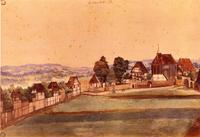
Saint John`s Church
Albrecht Durer
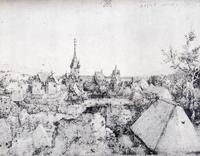
View Of Heroldsberg
Albrecht Durer
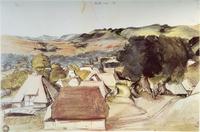
View of Kalchreut
Albrecht Durer
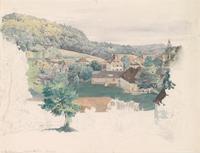
View over the town of Bad Rohitsch-Sauerbrunn (18th September 1848)
Johann Nepomuk Passini
Landscape
Eduard Gaertner
Im Tal Von Bad Rohitsch-Sauerbrunn
Johann Nepomuk Passini
Landscape. Ducks
Ivan Generalic
Village View
Master of the Small Landscapes
View of Nuremberg
Albrecht Durer
The Storm Over the Grove
Vasily Tropinin
Willow Mill
Albrecht Durer
Lake village
Nicholas Roerich
Dobrna
Ludwig Passini
Road into a Village, Plate 19 from Regiunculae Et Villae Aliquot Ducatus Brabantiae
Master of the Small Landscapes
An island
Ivan Generalic
The town Traben Trarbach and the Grevenburg on the Moselle River in Germany
Karl Bodmer
The Coal Scuttles
Felix Vallotton
Вид на село Червоноград Чортківського повіту, 1823 р.
Антон Лянґе