
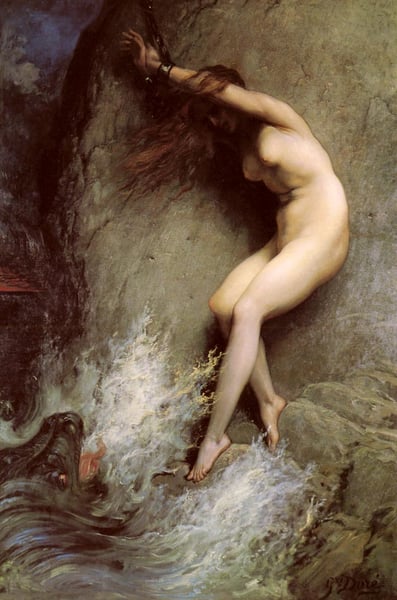
Expert analysis of Gustave Dore’s Andromeda
Style: Romanticism · Genre: mythological painting, nude painting (nu)
This analysis is based solely on the provided structured facts.
Significance within Romanticism and Mythological Nude Painting
Gustave Doré’s Andromeda stands as a quintessential example of Romanticism filtered through the lens of mythological painting and the nude (nu) tradition. The work’s significance lies in how it merges two often opposing impulses: the classical discipline of the female nude with Romanticism’s emotional intensity and sublime drama.
-
Romanticism’s Core Tensions: By depicting the mythological scene of Andromeda—a princess chained to a rock as a sacrifice—Doré amplifies the Romantic fascination with peril, isolation, and overwhelming nature. The nude form is not a passive, idealized Venus but a vulnerable, heroic figure caught in an extreme emotional and physical predicament. This transforms the academic tradition of the nude into a vehicle for psychological and natural spectacle.
-
Genre Convergence: As a mythological painting, the work invokes ancient narrative, but its Romantic style rejects calm, balanced composition in favor of dynamic, often turbulent surroundings. The nude becomes a focal point of contrast: the perfect, defenseless human body set against a vast, untamed environment (implied by the genre’s typical Romantic treatment of landscape and sea). This juxtaposition underscores the movement’s key theme—human insignificance before the sublime forces of fate and nature.
-
The Nude as Expressive Symbol: In the nude painting tradition, Andromeda’s exposed form traditionally signifies both vulnerability and virtue. Doré’s Romantic interpretation heightens this: the nude is not merely anatomical study but a vehicle for raw emotion—fear, resignation, and imminent terror. The significance lies in how the artist uses the classical nude to articulate a distinctly Romantic state of suspense and heroic suffering, bridging idealized beauty with existential dread.
In summary, Andromeda is significant because it captures Romanticism’s dramatic, emotional core while employing the mythological nude as a powerful symbol of human vulnerability against the sublime—a hallmark that distinguishes Romantic mythological painting from its neoclassical predecessors.
Museum / Gallery
Visually similar
20 works with related composition and palette

Mary Magdalene In The Cave
Jules Joseph Lefebvre

Ingres, Roger Deliverant Angelique
James McNeill Whistler

The Toilet of Venus
William-Adolphe Bouguereau

The Source (Bather at the Source)
Gustave Courbet

A water nymph
Léon Bazile Perrault

Angelica in Chains
Jean Auguste Dominique Ingres
The Morning Mists
Herbert James Draper

Perseus and Andromeda
Jean Auguste Dominique Ingres

Undine
Henri Fantin-Latour

Venus Bathing
Camille Corot

Musidora
Thomas Sully

Bather
William-Adolphe Bouguereau

The Foam Sprite
Herbert James Draper
Andromeda Chained to a Rock
Henri-Pierre Picou
The Oceanides
Gustave Dore

The Wave
Guillaume Seignac

A Mermaid
John William Waterhouse

Biblis
William-Adolphe Bouguereau
Andromeda
Rembrandt
La Nymphe de la Grotte d'Azur
Jean Benner