
Expert analysis of Gustave Dore’s The Oceanides
Style: Romanticism · Genre: mythological painting
Expert Analysis of The Oceanides by Gustave Doré
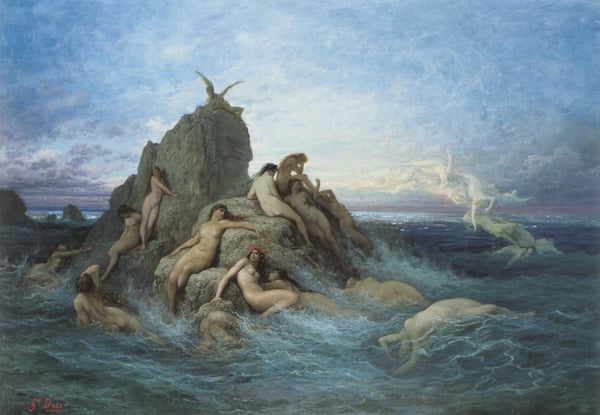
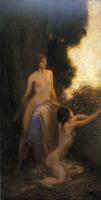
Gustave Doré’s The Oceanides is a consummate example of Romantic mythological painting, distinguished by its fusion of grand literary imagination with the sublime, untamed forces of nature. Executed during the height of Doré’s career—a period when he was celebrated for his monumental illustrations of Dante, Milton, and the Bible—this work exemplifies Romanticism’s preoccupation with awe-inspiring landscapes, emotional intensity, and the heroic or tragic relationship between humanity (or in this case, mythological beings) and the natural world.
The Subject and Its Romantic Treatment
The Oceanides, in Greek mythology, are the three thousand daughters of Oceanus and Tethys, each representing a sea, river, or spring. Doré departs from a purely decorative depiction of these nymphs; instead, he portrays them as vulnerable, sentient beings caught within a vast, turbulent seascape. The scene is not a serene idyll but a dramatic moment of cosmic interaction. The nymphs appear to emerge from or dissolve into the foaming waves, their bodies sculpted by the same wild energy that drives the stormy sea. This fusion of human form with the elemental chaos is a hallmark of Romanticism: the individual is both part of nature and dwarfed by its power.
Significance within Romanticism
Doré’s The Oceanides is significant for several reasons:
-
Sublime Scale and Composition: The painting employs a low horizon and a turbulent sky, with towering waves and broken clouds that seem to stretch infinitely. This compositional strategy—common in the works of Caspar David Friedrich or J.M.W. Turner—creates a sense of overwhelming grandeur. The tiny humanoid figures of the Oceanides are scattered across the foreground, emphasizing their fragility and the primal, untamed might of the sea.
-
Dramatic Light and Shadow: Doré was a master of chiaroscuro, and here he uses stark contrasts to heighten emotional impact. Bright shafts of light break through the storm clouds, illuminating the crests of waves and the pale limbs of the nymphs, while deep shadows obscure the abyssal depths. This interplay suggests both divine presence and the unknowable, terrifying aspects of nature.
-
Narrative and Symbolism: Unlike many mythological paintings that freeze a specific story, The Oceanides is ambiguous and open-ended. The viewer is left to wonder: are these nymphs grieving? celebrating? caught in a primal dance of creation and destruction? This ambiguity invites a personal, emotional response—a core Romantic ideal. The work can be read as a meditation on the eternal cycle of life, death, and rebirth, with the Oceanides as personifications of nature’s capricious beauty.
Doré’s Unique Contribution
While Doré is best known for his engravings and illustrations, The Oceanides shows his skill as a painter in oil, translating his graphic precision into a fluid, painterly style. The work’s significance also lies in its synthesis of literary mythology with the Romantic sublime. Doré draws on the same mythological source as the Ancients, but reframes it through a 19th-century lens of awe, melancholy, and the sublime—echoing themes found in contemporary poetry (e.g., Victor Hugo or Alfred de Vigny) and the philosophical fascination with the infinite.
In summary, The Oceanides stands as a powerful statement of Romanticism’s ability to transform classical myth into a vehicle for exploring human emotion and the overwhelming forces of the natural world. It is a testament to Doré’s visionary imagination and his capacity to make the mythological feel immediate, frightening, and transcendent.
Visually similar
20 works with related composition and palette
The Two Bathers
William-Adolphe Bouguereau
Evening
Henri Fantin-Latour
By Summer Seas
Herbert James Draper
Repose
Camille Corot
Mermaids at Play
Arnold Böcklin
Untitled
Herbert James Draper
Genius of Greek Poetry
George Frederick Watts
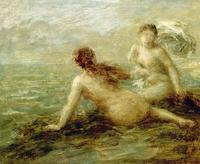
Bathers by the Sea
Henri Fantin-Latour
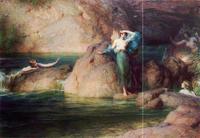
Halcyone
Herbert James Draper
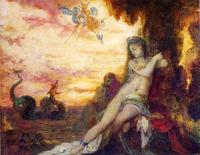
Perseus and Andromeda
Gustave Moreau
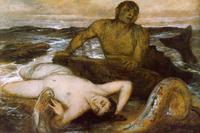
Triton and Nereid
Arnold Böcklin
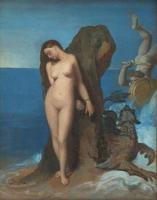
Perseus and Andromeda
Jean Auguste Dominique Ingres
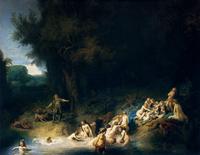
Diana Bathing, with the Stories of Actaeon and Callisto
Rembrandt
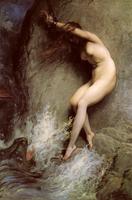
Andromeda
Gustave Dore
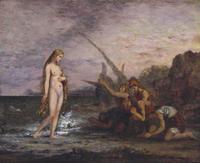
The Birth of Venus
Gustave Moreau
The Oreads
William-Adolphe Bouguereau
Sea Melodies
Herbert James Draper
Nereide
Adolf Hirémy-Hirschl
The Morning Mists
Herbert James Draper
Reveil
Herbert James Draper