Expertenanalyse zu Gustave Dores Don Quixote
Stil: Romanticism · Genre: illustration
Expert Analysis: Don Quixote by Gustave Doré
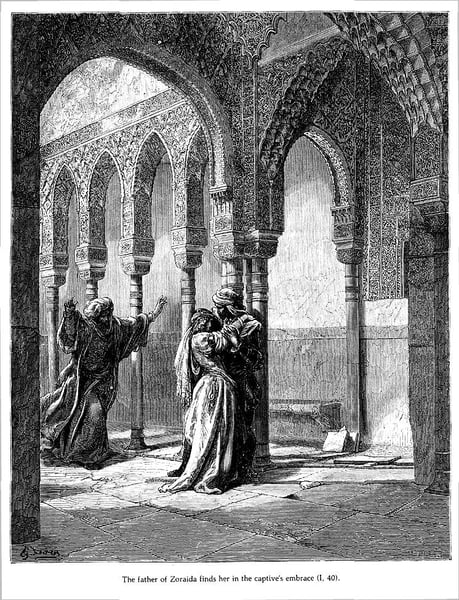
Gustave Doré’s illustration of Don Quixote stands as a masterwork of Romanticism, a movement that prized emotion, individualism, and the sublime over classical restraint. Doré’s visual interpretation of Cervantes’ iconic novel is significant not only for its technical virtuosity but for how it encapsulates the Romantic fascination with the chivalric imagination, melancholy idealism, and the tension between reality and illusion.
As a work of illustration, Doré’s piece transcends mere accompaniment to text. It functions as a vivid narrative in its own right, capturing the gaunt, wind-worn figure of Don Quixote with an almost hallucinatory intensity. The composition typically presents the knight-errant in a stark, dramatic landscape—often under brooding skies or amid desolate plains—emphasizing his isolation and the lonely grandeur of his quest. Doré’s use of deep chiaroscuro, dense cross-hatching, and sweeping line work imbues the scene with a theatrical, almost cinematic energy, characteristic of Romanticism’s preference for the dramatic and the sublime.
What makes this artwork significant within the Romantic style is its psychological depth. Doré does not simply depict Quixote as a comic figure; he elevates him to a tragic, visionary hero. The exaggerated proportions of the thin, armored figure against the vastness of the landscape speak to the Romantic theme of the individual’s struggle against an indifferent world. The etching or engraving medium, wielded with Doré’s unparalleled skill, allows for minute detail—the worn face, the rusted armor, the loyal but weary Rocinante—that invites the viewer to empathize with Quixote’s noble, if deluded, pursuit of honor.
In the genre of illustration, Doré’s Don Quixote set a new standard for literary visual interpretation. His ability to translate the novel’s ironies, pathos, and poetic melancholy into a single arresting image helped shape the modern visual identity of Cervantes’ hero. For Romantic audiences, Doré’s Quixote embodied the eternal conflict between the ideal and the real—a core Romantic obsession—making this illustration not just a picture, but a profound statement on the power of the human spirit to dream beyond its circumstances.
Visuell ähnlich
20 Werke mit ähnlicher Komposition und Farbpalette
The Emir's Head Shown in the Seraglio
Gustave Dore
The Crusaders massacre the inhabitants of Caesarea
Gustave Dore
Coffee in Las Golondrinas
Marià Fortuny
An Arab Sage
Rudolf Ernst
Patio. At the Alhambra
Achille Zo
The slaughter of the Abenserraigs
Marià Fortuny
Dans Le Palais Du Sultan
Benjamin Constant
The Grief of the Pasha
Jean-Leon Gerome
The Slaying of the Abencerrages
Marià Fortuny
Basking - A Corner in the Alhambra
Tom Roberts
An oriental in front of the entrance to the Alhambra
Gustavo Simoni
Choosing the Favourite
Giulio Rosati
After Prayers
Rudolf Ernst
Arabs playing chess
Gustavo Simoni
The Palace Guard
Rudolf Ernst
In the harem
Juan Jiménez Martín
St. Francis of Assisi
Gustave Dore
Invocation to Muhammad
Gustave Dore
Musicians in a courtyard, Tlemcen
Gustavo Simoni
The carpet merchant
Gustavo Simoni