
Expert analysis of Gustave Dore’s Don Quixote
Style: Romanticism · Genre: illustration
Expert Analysis: "Don Quixote" by Gustave Doré
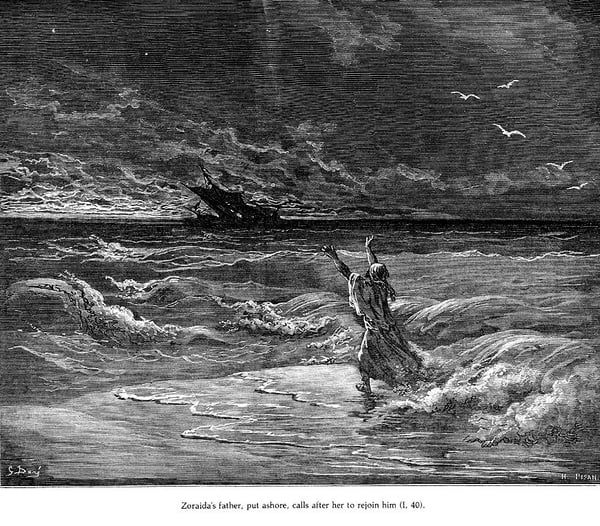
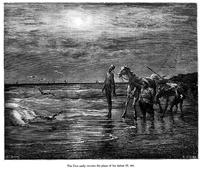
Gustave Doré’s illustration for Cervantes’ Don Quixote stands as a defining achievement of Romanticism in the graphic arts. Executed in the Romantic style, this work channels the movement’s core preoccupations: the sublime, the heroic, and the imaginative power of the individual mind. Doré’s etching does not merely depict a scene; it translates the psychological and emotional landscape of Cervantes’ novel into a visual drama of light, shadow, and exaggerated form.
Significance within Romanticism:
Romanticism rejected the ordered, rational compositions of Neoclassicism in favor of dynamic emotion and the depiction of inner turmoil. Doré achieves this through a masterful use of chiaroscuro—deep blacks pierced by stark, raking light—which imbues the image with a theatrical, almost supernatural intensity. The gaunt, elongated figure of Don Quixote is rendered not as a realistic knight but as a feverish vision, embodying the Romantic ideal of the solitary dreamer who rebels against mundane reality. The landscape, often vast and desolate in Doré’s illustrations, mirrors the hero’s grand delusions, while the windmill (a common subject) becomes a monstrous, titanic adversary—transforming the ordinary into the sublime.
Genre as Illustration:
As an illustrator, Doré elevated the role of the image from mere accompaniment to essential interpretation. His Don Quixote illustrations are not passive records; they actively shape how readers perceive the novel. Doré’s attention to historical detail (armor, architecture, Spanish landscape) grounds the fantasy in a tangible world, yet his expressive linework and exaggerated proportions push the scenes into the realm of myth. This synthesis of meticulous research and Romantic exaggeration made his Don Quixote the definitive visual standard for generations—so much so that subsequent editions and adaptations often borrow directly from his compositions.
Why It Matters:
The significance of Doré’s work lies in its ability to crystallize the Romantic spirit: the celebration of imagination over reason, the heroic failure of the idealist, and the beauty found in decay, madness, and melancholy. By translating Cervantes’ text into such potent visual terms, Doré ensured that his illustrations would become inseparable from the story itself—a testament to the power of Romantic illustration to shape literary memory.
Visually similar
20 works with related composition and palette
St. Paul Shipwrecked
Gustave Dore
A Voyage to the Moon
Gustave Dore
Journey to the Center of the Earth
Edouard Riou
Don Quixote
Gustave Dore
Journey to the Center of the Earth
Edouard Riou
Untitled
Albin Brunovsky
The Storm at Sea
Pieter Bruegel the Elder
Ships on a Stormy Sea, with Figures on the Shore
Alexandre Jean Noel
Flying Dutchman
Albert Pinkham Ryder
A Storm (Shipwreck)
J.M.W. Turner
Abishai Saves David's Life
Gustave Dore
Full Sail off Sandy Hook Entrance to New York Harbor
Pavel Svinyin
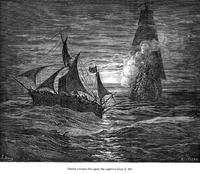
Don Quixote
Gustave Dore
The Bass Rock, for The Provincial Antiquities of Scotland
J.M.W. Turner
God turn all these things to the best
Nicola Samorì
Lighthouse at Ostend
Andreas Achenbach
Buonconte Da Montefeltro
Gustave Dore
Christ at the Sea of Galilee
Tintoretto
Illustration to "A Week of Kindness"
Max Ernst
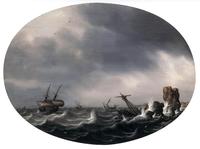
Stormy Sea
Simon de Vlieger