
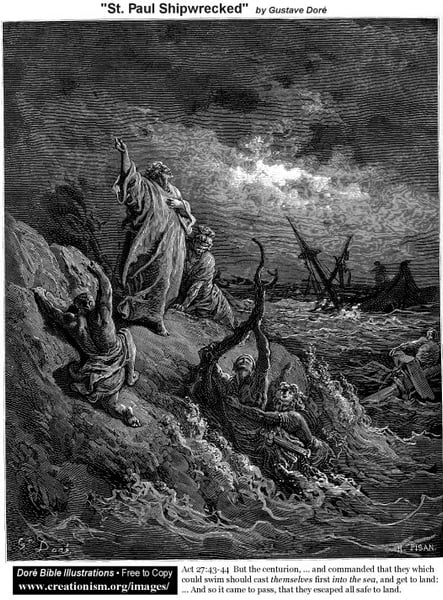
Expert analysis of Gustave Dore’s St. Paul Shipwrecked
Style: Romanticism · Genre: religious painting
Expert Analysis of "St. Paul Shipwrecked" by Gustave Doré
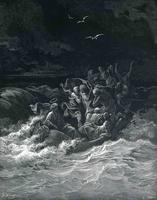
As a work of Romanticism in the religious painting genre, Gustave Doré’s St. Paul Shipwrecked achieves significance through its vivid synthesis of spiritual narrative and the Romantic sublime. The painting draws its subject from the biblical account of St. Paul’s journey to Rome, but Doré—operating within the Romantic ethos—transforms the episode into a sweeping drama of human vulnerability against overwhelming natural forces.
The composition is dominated by a churning, storm-ravaged sea and a sky torn by lightning, elements that embody the Romantic fascination with nature’s raw, uncontrollable power. The ship, reduced to splintered wreckage, becomes a symbol of human fragility, while the figures—clinging to debris or engulfed by waves—are rendered with emotive, gestural urgency typical of Romanticism’s emphasis on individual experience and emotional intensity. The interplay of deep shadow and stark highlights (chiaroscuro) heightens the sense of peril and divine intervention, a core Romantic motif.
What makes the work significant within its period is how it pushes religious iconography beyond static devotion into a visceral, almost existential confrontation with the sublime—a hallmark of Romantic painting. Doré’s theatrical composition, with its dramatic diagonals and turbulent motion, aligns with the period’s rejection of neoclassical order in favor of dynamic, emotionally charged scenes. By placing a sacred event within a chaotic, natural cataclysm, he underscores the Romantic belief that the divine is most powerfully encountered through the awe and terror of the natural world. Thus, St. Paul Shipwrecked stands as a quintessential Romantic religious painting: a work that uses biblical narrative to explore the limits of human endurance and the overwhelming presence of a force beyond reason.
Visually similar
20 works with related composition and palette
An Angel Appears to Balaam
Gustave Dore
Don Quixote
Gustave Dore
Jephthah's Daughter Comes to Meet Her Father
Gustave Dore
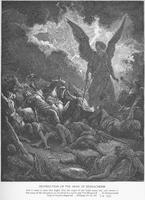
Sennacherib's Army Is Destroyed
Gustave Dore
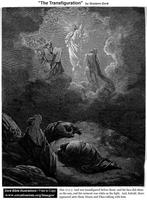
The Transfiguration
Gustave Dore
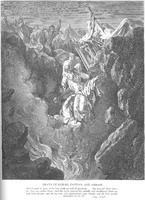
The Death of Korah, Dathan, and Abiram
Gustave Dore
Abishai Saves David's Life
Gustave Dore
The Portals of Dis
Gustave Dore
The Prophet Ezekiel
Gustave Dore
Evangelist John Exiled on Patmos, AD 97
Jan Luyken
A Huge Angel Stands Atop Noah's Ark, Its Back Turned Towards
Wilhelm von Kaulbach
Buonconte Da Montefeltro
Gustave Dore
Elijah Destroys the Messengers of Ahaziah
Gustave Dore
The Styx--The Irascible
Gustave Dore
Elijah Ascends to Heaven in a Chariot of Fire
Gustave Dore
Sodom
Gustave Dore
The Inferno, Canto 8
Gustave Dore
The ship of fortune
Rembrandt
The Styx--Phlegyas
Gustave Dore
Agony In The Garden
Albrecht Durer