
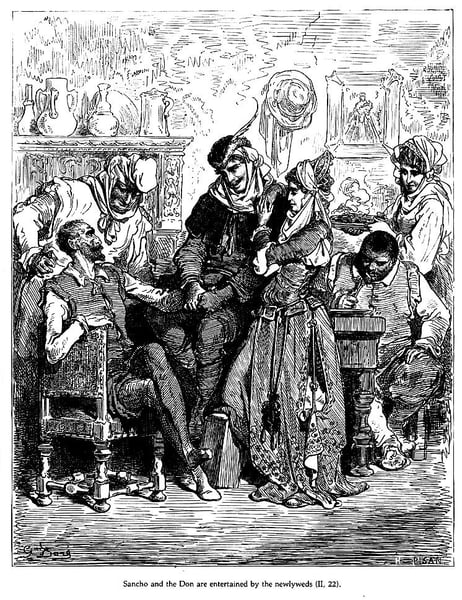
Expertenanalyse zu Gustave Dores Don Quixote
Stil: Romanticism · Genre: illustration
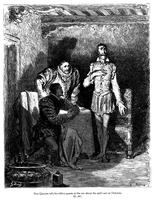
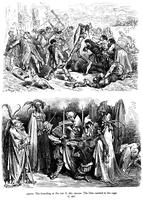
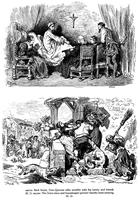
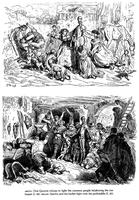
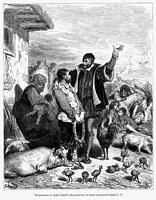
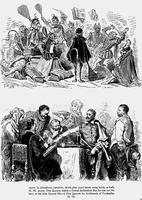
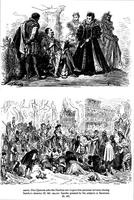
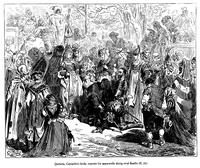
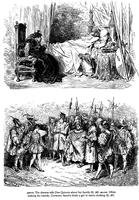
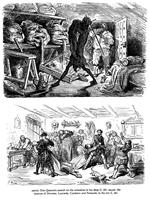
Gustave Doré’s illustration for Don Quixote stands as a masterful union of Romantic sensibility and narrative craft. Executed in the 1860s (the definitive edition appeared in 1863), Doré’s engravings for Cervantes’ epic are celebrated not merely as accompaniments but as interpretive expansions that shaped the visual identity of the knight-errant for generations.
Significance within Romanticism: Doré epitomizes the Romantic fascination with the sublime, the grotesque, and the psychological interior. His Don Quixote illustrations are a textbook case of Romanticism’s love affair with the individual’s struggle against a prosaic world. Doré’s Quixote is not a buffoon but a tragic, heroic figure—emaciated, spectral, yet glowing with unquenchable idealism. The artist uses dramatic chiaroscuro (deep blacks slashed by bright shafts of light) to externalize Quixote’s inner visionary state: windmills become giants, inns become castles, and the harsh plains of La Mancha become a stage for hallucinatory grandeur. This aligns directly with Romanticism’s rejection of Enlightenment rationalism in favor of imagination, emotion, and the sublime terror of the infinite.
Significance within the Genre of Illustration: Doré elevated book illustration from secondary decoration to a primary, autonomous art form. For Don Quixote, he produced over 370 wood-engraved plates that function as a parallel narrative. His compositions are cinematic in their dynamism—wide-angle landscapes dwarfing the protagonists, abrupt close-ups that capture Quixote’s fanatical eyes, and intricate crowd scenes that teem with life. Importantly, Doré balances the novel’s comedy with its pathos: Sancho Panza is rendered with earthy humor, but Quixote’s tilt at the windmills is staged as a monumental, almost religious tableau. This duality—the coexistence of the ridiculous and the sublime—was Doré’s great contribution to the illustrated book, influencing posterity from film storyboards to graphic novels.
Artistic Techniques: Doré’s training as a caricaturist and his virtuosity in wood engraving enabled him to achieve unprecedented tonal range. In the famous scene of Quixote charging the windmills, the sky boils with storm-cloud lines, the knight’s lance becomes a grotesque extension of his skeletal frame, and the blades of the “giants” loom like monstrous arms. Every detail—the ragged coat, the mule’s bony ribcage, the dust kicked up by hooves—is etched with a feverish precision that makes the fantastical feel tactile. This technical bravura, combined with his Romantic empathy for the “mad” hero, secured Doré’s Don Quixote as a definitive visual companion to the text, one that transcends illustration to become a work of art in its own right.
Visuell ähnlich
20 Werke mit ähnlicher Komposition und Farbpalette
Don Quixote
Gustave Dore
The Stoning Of St. Stephen
Rembrandt
Nuccia accepts Meo Patacca for her husband (Plate 52/52)
Bartolomeo Pinelli
Don Quixote
Gustave Dore
Don Quixote
Gustave Dore
Don Quixote
Gustave Dore
Don Quixote
Gustave Dore
Don Quixote
Gustave Dore
Don Quixote
Gustave Dore
Don Quixote
Gustave Dore
Don Quixote
Gustave Dore
Lads getting on with the job
Francisco Goya
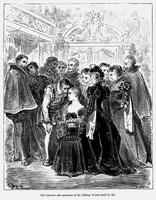
Don Quixote
Gustave Dore
Burning of William White, a Priest, Norwich, England, AD 1428
Jan Luyken
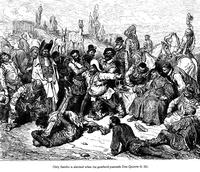
Don Quixote
Gustave Dore
Don Quixote
Gustave Dore
Don Quixote
Gustave Dore
The Drinkers
Adriaen van Ostade
The pancake woman
Rembrandt
A Barber's Shop
Henry Bunbury