
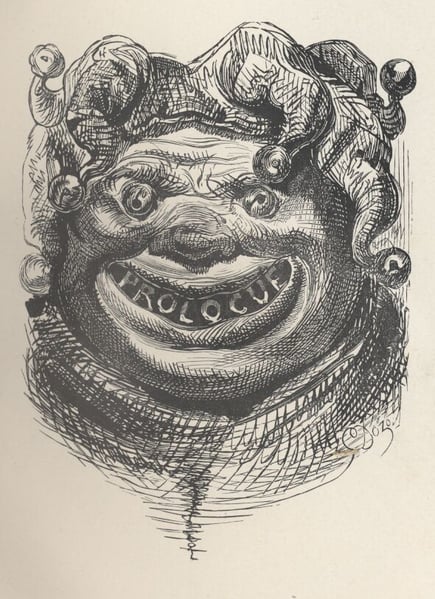
Expertenanalyse zu Gustave Dores Gargantua and Pantagruel
Stil: Romanticism · Genre: illustration
Expert Analysis: "Gargantua and Pantagruel" by Gustave Doré
Gustave Doré’s illustrations for François Rabelais’s Gargantua and Pantagruel stand as a landmark achievement in the Romantic illustration genre, merging literary satire with a visual imagination that amplifies the novel’s exuberant grotesquerie and philosophical depth. As a work of Romanticism, Doré’s engravings transcend mere book decoration to become independent artistic statements—charged with emotional intensity, dramatic chiaroscuro, and a sublime sense of scale that captures both the monstrous and the human.
Significance Within Romanticism
Doré’s treatment of Rabelais’s epic aligns perfectly with Romanticism’s fascination with the irrational, the colossal, and the fantastical. His depictions of the giants Gargantua and Pantagruel are not simply oversize humans; they are embodiments of raw natural power and Rabelaisian excess, rendered through Doré’s signature use of deep shadows and stark highlights. The cross-hatching and sweeping lines create a sense of turbulent energy, while the compositions often place minuscule human figures against enormous architectural ruins or vast, chaotic landscapes—evoking the Romantic sublime, where awe and terror coexist. This technique heightens the absurdity and moral satire of Rabelais’s world, making Doré’s illustrations a visual companion to the novel’s carnivalesque spirit.
Role as an Illustration
Doré revolutionized the field of book illustration in the 19th century, and the Gargantua and Pantagruel series (first published in 1854) is a prime example of his ability to transform a classic text into a vivid, accessible visual experience. Rather than passively mirroring the narrative, his images interpret and amplify key episodes—such as Pantagruel’s birth or the voyage to the Oracle of the Bottle—with a theatricality that invites the viewer into the story’s grotesque humor and philosophical play. Each plate functions as a self-contained masterpiece, yet when sequenced, they form a rhythmic commentary on human folly, greed, and wisdom.
Enduring Legacy
Doré’s Gargantua and Pantagruel remains significant for its synthesis of literary and visual art, influencing later illustrators and fantasy artists. The engravings’ dense detail and atmospheric intensity prefigure surrealism and modern graphic narratives, while their unabashed embrace of the monstrous and the ridiculous underscores Romanticism’s celebration of unfettered imagination. In essence, Doré did not merely illustrate Rabelais—he gave the text a second life, turning a Renaissance satire into a timeless spectacle of visual storytelling.
Visuell ähnlich
20 Werke mit ähnlicher Komposition und Farbpalette
Anna Margit, Bohóc Kék Piros Csikos Ruhában
Anna Margit
Tristan comes to Tintagel dressed as a jester
Arthur Rackham
Arlequín selectivo
Martin Pereira
Scheiber Hugó Cirkusz1930
Scheiber Hugó
Thanks
Sue Coe
Scheiber Hugó, Bohóc,
Scheiber Hugó
Arlequin
Joan Ponc
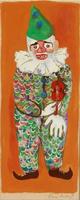
Anna Margit, Bohóc. . ,
Anna Margit
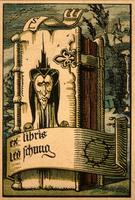
Ex-Libris
Léo Schnug
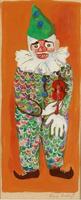
Anna Margit, Bohóc
Anna Margit
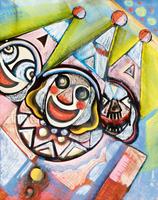
Scheiber Hugó, Cirkusz 1930
Scheiber Hugó
As Pagliacco
Enrico Caruso
Seated fat clown
Pablo Picasso
Thiers
Honore Daumier
Keying Up, The Court Jester
William Merritt Chase
Scheiber Hugó Bohocok
Scheiber Hugó
Pierrot
Martin Pereira
Harlequin
George Stefanescu
Percy Huxter
Arthur Pan
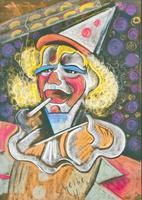
Scheiber Hugó, Bohóc,
Scheiber Hugó