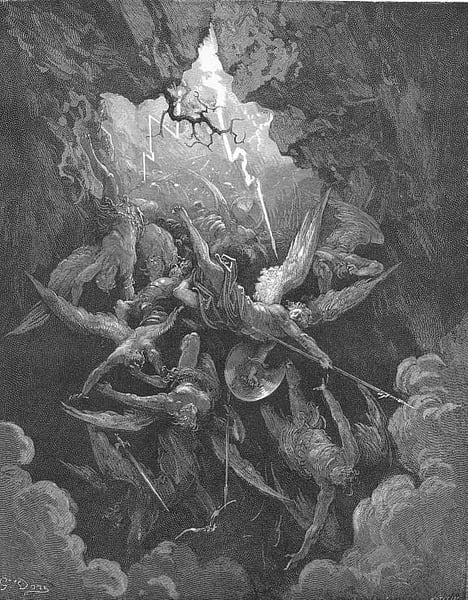
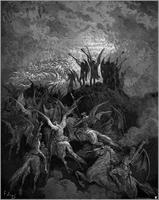
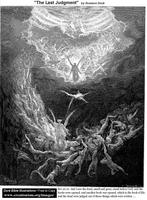
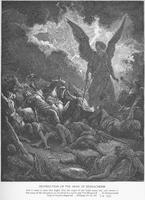
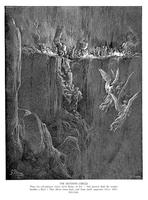
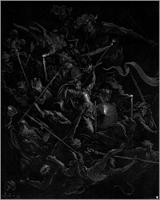
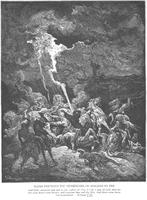
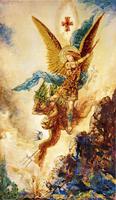
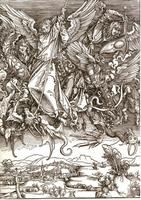
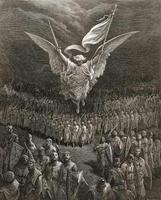
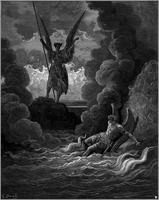
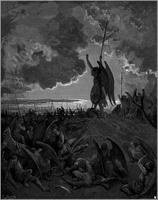
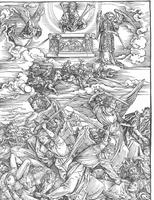
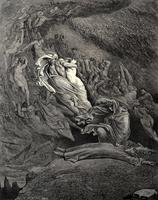
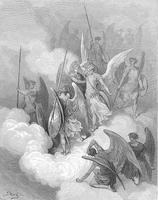
Gustave Doré’s “Hell at last, Yawning, received them whole” represents a pinnacle of the Romantic imagination, merging sublime literature with virtuosic illustration. Executed for John Milton’s Paradise Lost (Book VI), the work transcends its role as mere literary accompaniment, functioning instead as an independent meditation on chaos, punishment, and the terrifying grandeur of the cosmos.
The Romantic Sublime in Visual Form
The artwork’s primary significance lies in its perfect embodiment of the Romantic Sublime—the aesthetic of overwhelming terror and awe in the face of infinite power. Doré depicts not a discrete scene but a cosmic cataclysm. The composition is a downward vortex: a churning mass of angelic bodies is pulled inexorably into an abyss of absolute blackness. There is no ground, no horizon, no respite. This lack of spatial anchorage creates profound vertigo in the viewer, mirroring the psychological terror of damnation. The sublime here is not found in a stormy landscape or vast mountain range, but in the absence of form—the “yawning”