
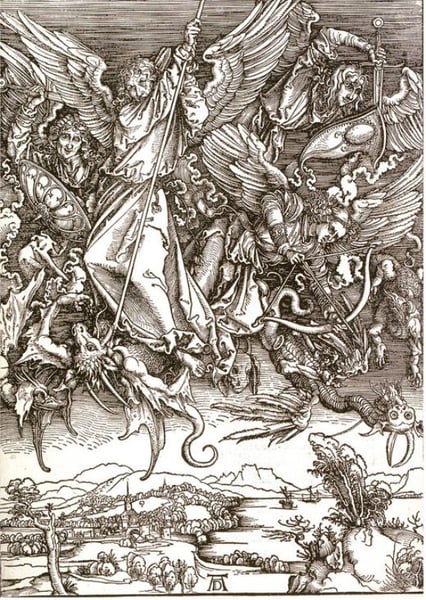
Expertenanalyse zu Albrecht Durers St. Michael and the Dragon, from a Latin edition
Stil: Northern Renaissance · Genre: religious painting
This artwork, "St. Michael and the Dragon, from a Latin edition" by Albrecht Dürer, stands as a masterwork of the Northern Renaissance and a landmark in the history of printmaking. While the provided facts describe it as a religious painting, Dürer most likely rendered this iconic scene as a highly detailed woodcut or engraving—a medium in which he achieved unprecedented technical brilliance and expressive power.
Significance within the Northern Renaissance:
What makes this piece extraordinary is how Dürer synthesizes the meticulous naturalism of Northern European art with the heroic grandeur and classical ideals of the Italian Renaissance. The composition is a battlefield of swirling, dynamic lines—a hallmark of Dürer's print technique. St. Michael, armored in exquisitely detailed plate, is not a static medieval icon but a powerfully muscled, active figure. He descends with dramatic force, his spear piercing the dragon's open mouth. This captures the Northern Renaissance obsession with surface detail (the armor’s reflections, the texture of scales and feathers) while also embracing the Italian humanist interest in the human form in motion, anatomy, and perspective.
Stylistic and Thematic Impact:
As a religious scene, it is a dramatic visualization of the Book of Revelation (Revelation 12:7-9). Dürer’s version, often part of his celebrated Apocalypse series (1498), was revolutionary. It was one of the first artist-created, self-published book projects, elevating the woodcut from mere illustration to a fine art form. The composition is dense and almost claustrophobic: the land below is littered with tiny, fleeing figures and broken bones, while the sky is a chaotic tangle of angels and demonic beasts. This conveys the cataclysmic struggle between good and evil as a real, physical confrontation.
The "Latin edition" note further underscores its significance: Dürer designed these prints to be accessible to an elite, humanist audience (Latin readers) and to be distributed widely, demonstrating the Northern Renaissance's marriage of art, technology (the printing press), and theological devotion. In this work, every carved line—whether the delicate feathers of the angel’s wings or the coarse, scaly texture of the dragon—serves to amplify the drama, making the divine battle feel immediate, terrifying, and triumphant. Dürer’s fusion of Gothic intensity, Renaissance science, and masterful craft makes "St. Michael and the Dragon" a defining image of its era.
Museum / Gallery
Visuell ähnlich
20 Werke mit ähnlicher Komposition und Farbpalette
St Michael Fighting the Dragon
Albrecht Durer
The Battle of the Angels
Albrecht Durer
The Temptation of St. Anthony
Martin Schongauer
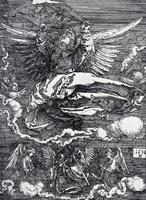
Sudarium Spread Out By An Angel
Albrecht Durer
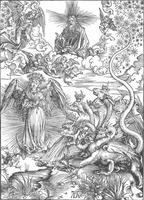
The woman clothed with the sun and the seven headed dragon
Albrecht Durer
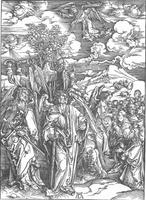
Four Angels Staying the Winds and Signing the Chosen
Albrecht Durer
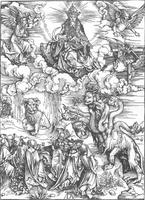
The Sea Monster and the Beast with the Lamb s Horn
Albrecht Durer
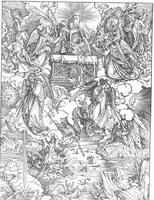
The Seven Trumpets Are Given to the Angels
Albrecht Durer
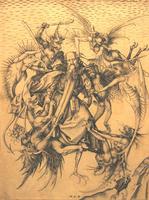
Holy Antonius
Martin Schongauer
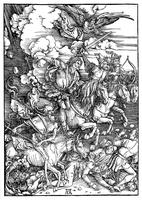
The Four Horsemen of the Apocalypse, Death, Famine, Pestilence and War
Albrecht Durer
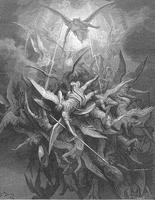
Him The Almighty Power Hurled Headlong Flaming from the Eternal Sky
Gustave Dore
The Whore of Baylon
Albrecht Durer
The Resurrection of Christ
Albrecht Durer
The Inferno, Canto 21
Gustave Dore
Resurrection
Albrecht Durer
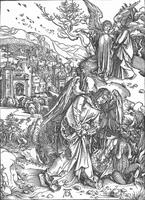
The Angel with the Key to the Bottomless Pit
Albrecht Durer
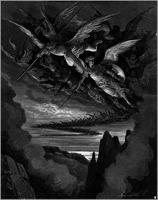
Paradise Lost
Gustave Dore
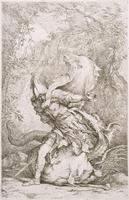
Jason and the Dragon
Salvator Rosa
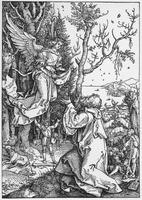
Joachim and the Angel from the 'Life of the Virgin'
Albrecht Durer
Last Judgment
Pieter Bruegel the Elder