
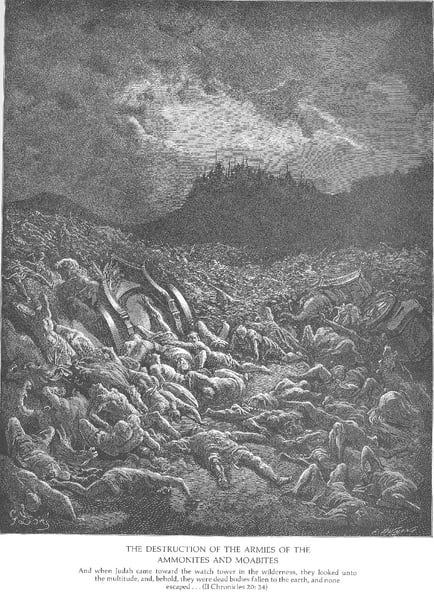
Expert analysis of Gustave Dore’s The Ammonite and Moabite Armies Are Destroyed
Style: Romanticism · Genre: religious painting
Expert Analysis: "The Ammonite and Moabite Armies Are Destroyed" by Gustave Doré
This work stands as a quintessential example of Romantic religious painting, where Gustave Doré harnesses the movement’s core preoccupations—sublime awe, dramatic emotion, and the cosmic struggle between good and evil—to render a biblical cataclysm with visceral power. Though created as an illustration, Doré’s composition transcends its format, embodying Romanticism’s fascination with the monumental and the terrifying.
Significance within Romanticism:
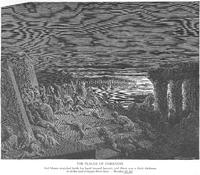
Doré exploits Romantic chiaroscuro and a swirling, chaotic composition to depict the divine destruction of the enemy armies. The scene is dominated by a raging sky, lightning bolts, and a flood of writhing bodies, emphasizing nature’s fury as an instrument of God’s will. This reflects the Romantic ideal of the sublime—an overwhelming, almost fearful encounter with forces beyond human control. The heroic scale of the conflict, with its dramatic diagonals and stark contrasts of light and dark, aligns with the period’s rejection of Neoclassical restraint in favor of raw emotion and dynamic action.
Significance within religious painting:
Doré’s treatment is notable for its narrative intensity. Rather than a static devotional image, it reads like a frame from an epic—a hallmark of his illustrative style that brought biblical stories to life for a 19th-century audience. The lack of a central divine figure (God is implied only through the storm) shifts focus to the human (and inhuman) spectacle of judgment, making the spiritual drama feel immediate and cataclysmic. This approach anticipates later cinematic storytelling and demonstrates how Romanticism reinvigorated religious art by prioritizing visceral experience over doctrinal symbolism.
Legacy: Doré’s ability to blend literary narrative with painterly drama in this and similar works helped democratize religious art, making it accessible to a broad public. His influence echoes in later fantastical and epic visual media, cementing this piece as a bridge between traditional religious painting and modern spectacle.
Visually similar
20 works with related composition and palette
The Death of Gideon's Sons
Gustave Dore
The Fifth Plague. Livestock Disease
Gustave Dore
The Avaricious
Gustave Dore
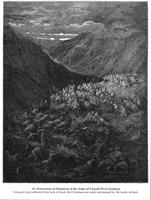
Destruction at Damascus of the Army of Conrad III of Germany
Gustave Dore
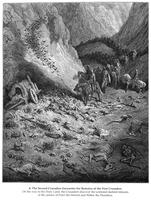
The army of the Second Crusade find the remains of the soldiers of the First Crusade
Gustave Dore
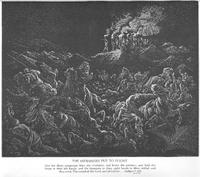
The Midianites Are Routed
Gustave Dore
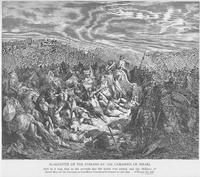
The Israelites Slaughter the Syrians
Gustave Dore
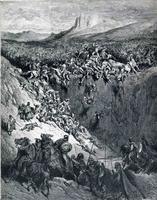
Samson Destroys the Philistines with an Ass' Jawbone
Gustave Dore
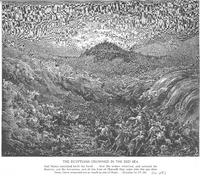
The Egyptians Drown in the Sea
Gustave Dore
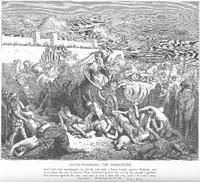
David Attacks the Ammonites
Gustave Dore
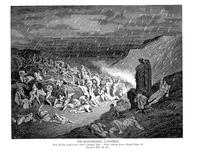
The Blasphemers--Capaneus
Gustave Dore
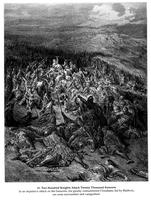
Two Hundred Knights Attack Twenty Thousand Saracens
Gustave Dore
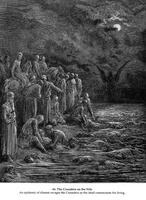
The Crusaders on the Nile
Gustave Dore
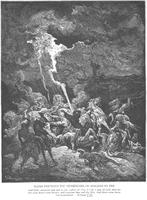
Elijah Destroys the Messengers of Ahaziah
Gustave Dore
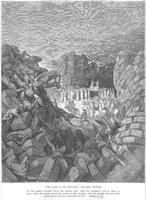
The Walls of Jericho Fall Down
Gustave Dore
Nothing. The event will tell
Francisco Goya
Combat between Soldiers of Ish-bosheth and David
Gustave Dore
Death of Frederick I of Germany
Gustave Dore
At Los Olivares de Mallorca
Carlos Saenz de Tejada
The Ninth Plague. Darkness
Gustave Dore