
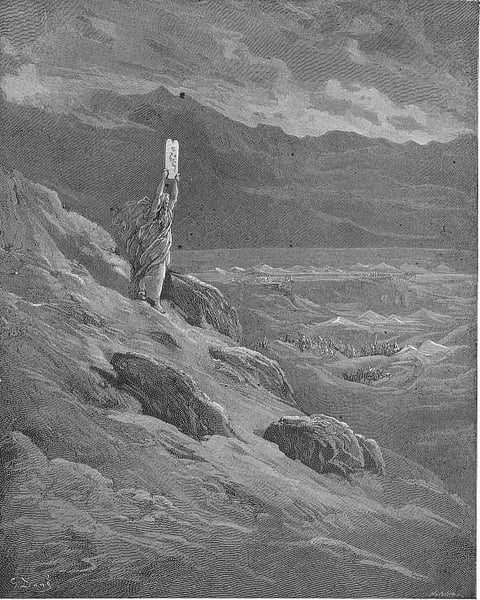
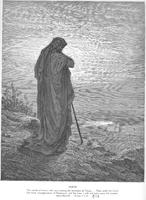
The beseech That Moses might report to them his will And terror cease
Ayrıntılar
Gustave Dore sanatçısının The beseech That Moses might report to them his will And terror cease eseri hakkında uzman analizi
Tarz: Romanticism · Tür: religious painting
Expert Analysis: Gustave Doré’s The Beseech That Moses Might Report to Them His Will And Terror Cease
This work, by the prolific French artist Gustave Doré, stands as a striking example of Romantic religious painting—a genre through which Doré channeled the era’s fascination with the sublime, the emotional, and the monumental. While Doré is best known for his book illustrations (e.g., Dante’s Inferno, Milton’s Paradise Lost, and the Bible), this painting demonstrates his ability to translate the epic scale of biblical narrative into a single, charged moment.
Significance within Romanticism:
Doré’s painting embodies the Romantic obsession with human vulnerability in the face of divine power. The title itself—The Beseech That Moses Might Report to Them His Will And Terror Cease—suggests a scene of desperate supplication, likely drawn from the Israelites’ plea for Moses to intercede with God (Exodus 20:18-19). The composition emphasizes a stark contrast between the mortal, trembling crowd and the distant, authoritative figure of Moses, who stands as a mediator between human terror and divine will.
Dramatic chiaroscuro, a hallmark of Romantic painting, here amplifies the emotional tension. Deep shadows envelop the foreground figures, their raised arms and anguished faces barely illuminated by a supernatural light that likely emanates from the presence of God above. Doré’s use of stormy, brooding skies and rugged, almost chaotic rock formations further heightens the sense of awe and dread—qualities the Romantics prized as the “sublime.”
Genre and Context:
As a religious painting, Doré’s work eschews the serene, orderly piety of earlier Neoclassical treatments. Instead, it leverages theatrical composition and visceral emotion to convey the terror of encountering the numinous. The Israelites are not passive worshippers but a crowd gripped by existential fear, their gestures urgent and pleading. This approach aligns with Romanticism’s shift toward subjective experience, where faith is less about doctrinal calm than about overwhelming spiritual confrontation.
Doré’s technical skill—his virtuosic handling of light, anatomy, and crowd dynamics—transforms a biblical episode into a universal drama of human frailty and divine mystery. The painting’s significance lies in how it encapsulates Romantic ideals: faith as awe, nature as overwhelming, and humanity as dwarfed by forces beyond its control. It is a masterwork of narrative intensity, demanding both emotional engagement and contemplation of the sacred.
Görsel olarak benzer
İlişkili kompozisyon ve renk paletine sahip 20 eser
The Poets Emerge from Hell
Gustave Dore
The Inferno, Canto 34
Gustave Dore
St. Paul Shipwrecked
Gustave Dore
The Prophet Ezekiel
Gustave Dore
Abraham, God and Two Angels
Gustave Dore
The Lustful
Gustave Dore
Sodom
Gustave Dore
The Transfiguration
Gustave Dore
Jephthah's Daughter Comes to Meet Her Father
Gustave Dore
The Ascent
Gustave Dore
Buonconte Da Montefeltro
Gustave Dore
Hagar and Ishmael in the Wilderness
Gustave Dore
Don Quixote
Gustave Dore
Journey to the Center of the Earth
Edouard Riou
The Levite Carries the Woman's Body Away
Gustave Dore
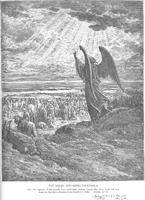
An Angel Appears to the Israelites
Gustave Dore
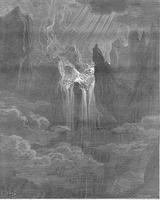
Wave rolling after wave, where way they found If steep, with torrent rapture
Gustave Dore
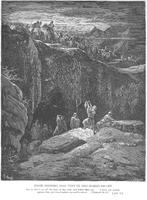
David Shows Saul How He Spared His Life
Gustave Dore
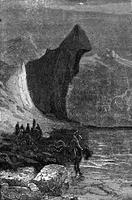
Journey to the Center of the Earth
Edouard Riou
The Prophet Amos
Gustave Dore