
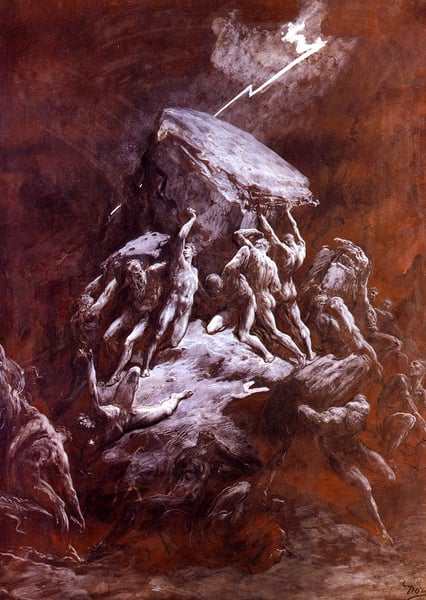
Analisi esperta di The Clash of the Titans di Gustave Dore
Stile: Romanticism · Genere: mythological painting
Expert Analysis of "The Clash of the Titans" by Gustave Doré
Gustave Doré’s The Clash of the Titans stands as a monumental example of Romantic mythological painting, a work that captures the movement’s core fascination with the sublime, the heroic, and the overwhelming power of nature and myth.
Significance within Romanticism:
Executed in the Romantic style, this painting embodies the period’s rejection of neoclassical restraint in favor of emotional intensity, dynamic composition, and dramatic scale. Doré—a master of illustration and painting—uses the mythological subject to explore themes of cosmic struggle, human insignificance, and the awe-inspiring forces of the universe. The “titans” of the title (likely referencing the primordial deities of Greek myth) are not merely figures in a battle; they are embodiments of raw, untamed energy.
Dramatic Composition and Sublime Effect:
The work is structured around a violent, swirling clash. Doré places the titans in a compressed, vertical space, their colossal forms tumbling through a storm-wracked sky. Light and shadow are wielded with theatrical intensity: lightning bolts split the darkness, illuminating muscular bodies locked in combat, while deep chasms of shadow suggest infinite depth and chaos. This chiaroscuro technique heightens the sense of a world in primordial upheaval—a hallmark of the Romantic sublime, where beauty and terror coexist.
Mythological Painting as Emotional Allegory:
In the Romantic tradition, mythological scenes were often moral or emotional allegories. Here, the titans’ struggle transcends mere narrative; it becomes a visual metaphor for the titanic forces of nature, passion, or historical upheaval. Doré’s titans are not idealised gods but elemental beings—more akin to geological forces or storms—reflecting Romanticism’s interest in the irrational, the violent, and the boundless.
Doré’s Technical Legacy:
While Doré is most famous for his engravings for The Divine Comedy and Don Quixote, The Clash of the Titans demonstrates his ability to translate his graphic dynamism into oil painting. The work’s significance lies in its fusion of meticulous detail with torrential energy: every muscle, cloud, and crack of lightning is rendered with near-sculptural precision, yet the overall effect is one of overwhelming motion and chaos. This tension between control and abandon is a defining feature of Romantic painting.
Conclusion:
The Clash of the Titans is significant not only as a masterful mythological composition but as a quintessential Romantic statement. It channels the era’s obsession with the sublime, the primal, and the heroic struggle against fate—or against the very fabric of existence. Doré transforms an ancient myth into a visceral, modern vision of power and terror, reminding us that Romanticism’s true subject is always the human soul confronting the infinite.
Visivamente simili
20 opere con composizione e palette affini
The hoarders and wasters
Gustave Dore
The Prideful--Oderisi
Gustave Dore
Schismatics--Mahomet
Gustave Dore
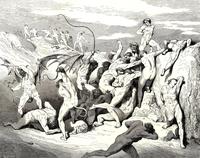
The Inferno, Canto 18
Gustave Dore
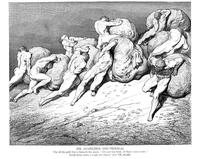
The Avariscious and Prodigal
Gustave Dore

Creation
George Frederick Watts
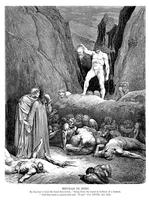
Bertram De Born
Gustave Dore
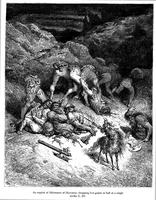
Don Quixote
Gustave Dore
The murderers carry the body of Fualdes
Théodore Géricault
Thieves
Gustave Dore
World Destroyed by Water
Gustave Dore
The Inferno, Canto 7
Gustave Dore
The Blasphemers--Capaneus
Gustave Dore
Satan Calling Up his Legions
William Blake
Forgers II
Gustave Dore
The Embarkation of the Souls
Gustave Dore
Geri Del Bello
Gustave Dore
The Inferno, Canto 15
Gustave Dore
Denunciation Of Cain
George Frederick Watts
The Inferno, Canto 28
Gustave Dore