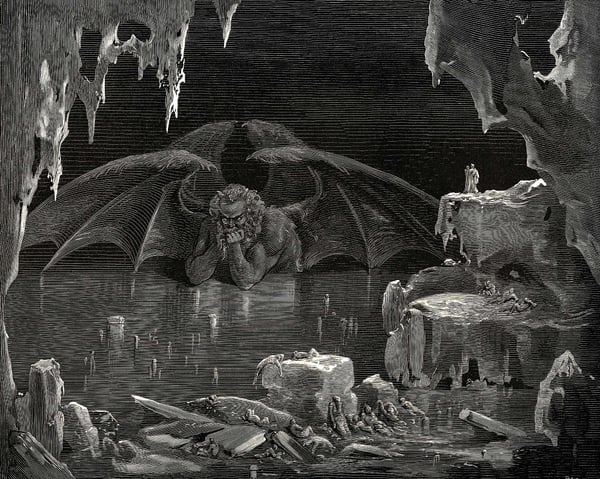
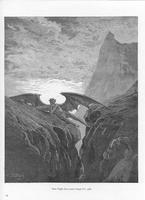
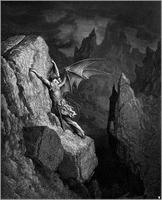
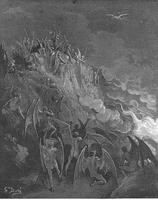
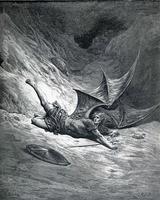
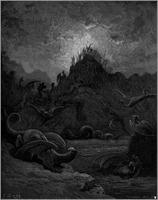
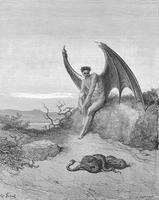
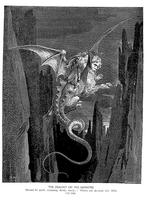
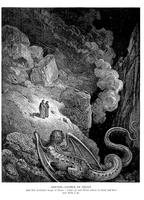
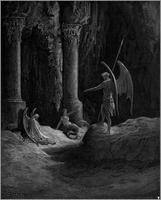
Gustave Doré’s "The Inferno, Canto 34" is a defining example of Romanticism in the illustration genre, achieving significance through its fusion of dramatic emotional intensity with meticulous narrative clarity. As a Romantic work, it embodies the movement’s preoccupation with the sublime—the awe-inspiring and terrifying power of nature and myth—by depicting the final, frozen circle of Dante’s Hell with a towering, ice-encased Lucifer. The composition emphasizes scale and contrast: the colossal, shadowy figure of Satan looms over the tiny, struggling forms of Dante and Virgil, evoking both horror and pity. This use of extreme light and dark (chiaroscuro) and the tortured, monumental poses are hallmarks of Romanticism’s revolt against neoclassical restraint. Within the illustration genre, Doré’s rendering elevates a literary passage into a self‑standing visual parable; the dense, cross‑hatched lines and theatrical perspective not only make the infernal landscape visceral but also define the Romantic illustrator’s role as a co‑creator of meaning. The work’s lasting significance lies in how it synthesizes Romantic emotionalism with the illustrative demands of story‑telling, setting a benchmark for how fine art can serve—and transcend—a literary source.