Analisi esperta di Ugolino di Gustave Dore
Stile: Romanticism · Genere: illustration
Expert Analysis of Gustave Doré’s Ugolino (c. 1861)
Style & Period Significance
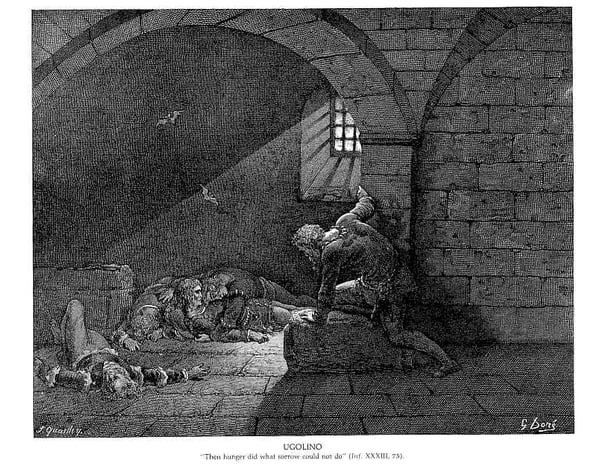
Within the framework of Romanticism, Gustave Doré’s Ugolino stands as a masterful illustration that harnesses the movement’s core tenets: intense emotion, the sublime horror of human suffering, and a fascination with medieval and literary themes. Romanticism rejected Neoclassical restraint in favor of dramatic feeling, and Doré’s work here is exemplary. The scene—drawn from Dante’s Inferno (Canto XXXIII)—portrays Count Ugolino della Gherardesca, imprisoned with his sons and grandsons in the Tower of Hunger, condemned to starve. Romantic artists often turned to Dante for its vivid, allegorical depictions of torment, and Doré captures this with visceral immediacy.
Composition & Technical Virtuosity
Doré’s illustration is renowned for its chiaroscuro—the stark contrast between deep, impenetrable shadows and slivers of grim light. The figures are rendered in a dense, tangled mass: Ugolino’s gaunt, anguished face is almost skeletal, his body contorted in despair, while the children cling to him in a mixture of fear and resignation. The cramped, claustrophobic space of the tower is suggested not by detailed architecture but by the oppressive dark that envelops the group, isolating them in a void of hopelessness. Doré’s linework—meticulous yet emotionally charged—gives texture to the rags, hollow cheeks, and clenched hands, making the physical and psychological decay palpable.
Thematic Depth & Emotional Impact
The work’s significance lies not only in its technical brilliance but in its representation of ultimate human tragedy. In Dante’s narrative, Ugolino is a traitor condemned to devour his own children after their deaths—a horrifying cycle of betrayal and starvation. Doré freezes a moment before that irreversible act: the father’s gaze is fixed outward, perhaps on his children’s suffering or on his own impending madness. The Romantic ideal of the “sublime” is fully realized here—the viewer is simultaneously repulsed and mesmerized by the magnitude of agony, the dark grandeur of sin and punishment.
Influence & Legacy
Doré’s Ugolino is a landmark in illustration as fine art. While illustrations were often considered secondary to painting, Doré’s engravings elevated the genre, influencing later symbolist and surrealist artists. His ability to translate literary intensity into indelible images helped make Dante’s Inferno accessible to a wide 19th-century audience, and this plate remains one of the most recognized visual interpretations of the poem. The image’s raw, unflinching focus on suffering also prefigures modern graphic narrative and horror illustration, cementing Doré’s role as a bridge between Romanticism and later psychological art.
Conclusion
Gustave Doré’s Ugolino is a seminal work of Romantic illustration that distills the movement’s obsession with extreme emotion, moral darkness, and literary grandeur. Through dramatic chiaroscuro, expressive anatomy, and a profound sense of claustrophobic despair, Doré not only visualizes Dante’s epic but also creates an enduring symbol of human anguish. Its significance endures as a prime example of how illustration can achieve the depth and power of the finest Romantic painting.
Visivamente simili
20 opere con composizione e palette affini
The Inferno, Canto 33
Gustave Dore
Ugolino and Gaddo
Gustave Dore
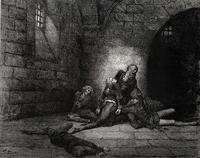
The Inferno, Canto 33
Gustave Dore
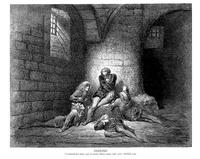
Ugolino
Gustave Dore
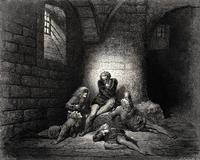
The Inferno, Canto 33
Gustave Dore
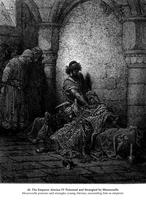
The Emperor Alexius IV Poisoned and Strangled by Mourzoufle
Gustave Dore
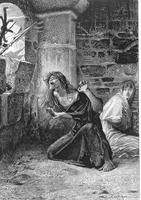
Sister Gudule and Esmeralda
Luc-Olivier Merson
Plan and elevation of the kitchen in the same
Giovanni Battista Piranesi
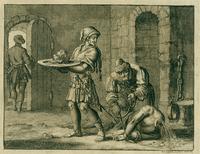
John the Baptist Beheaded, AD 23
Jan Luyken
Ash Wednesday
Carl Spitzweg
Jabesh-Gileadites Recover the Bodies of Saul and His Sons
Gustave Dore
In the shadow people are weeping and praying, surrounded by others who are exhorting them (plate 6)
Odilon Redon
Don Quixote
Gustave Dore
The Martyrdom of the Holy Innocents
Gustave Dore
Four illustrations to a Spanish book
Rembrandt
Martyrdom of Felicitas of Tuburbia in Mauretania, AD 201
Jan Luyken
The Yard of a Madhouse
Francisco Goya
Torture of Origen, Alexandria, AD 234
Jan Luyken
Bertram De Born
Gustave Dore
The entombment
Rembrandt