
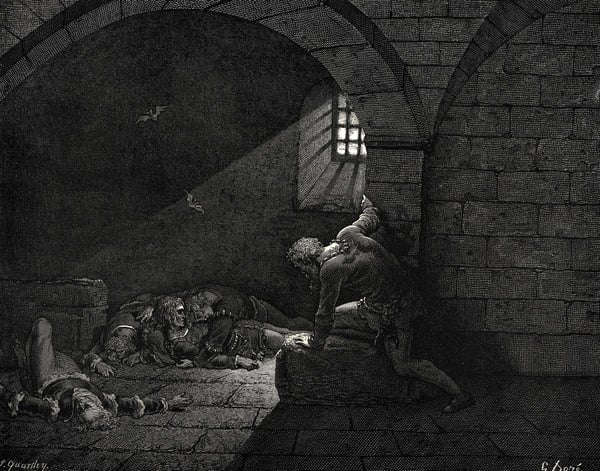
Analisi esperta di The Inferno, Canto 33 di Gustave Dore
Stile: Romanticism · Genere: illustration
Expert Art Historical Analysis: "The Inferno, Canto 33" by Gustave Doré
As a quintessential work of Romanticism and an exemplary piece of illustration, Gustave Doré’s visualization of Canto 33 from Dante’s Inferno achieves a profound synthesis of literary narrative and emotional immediacy. Within the Romantic canon, Doré’s work stands out for its ability to translate the sublime terror of Dante’s text into a visceral visual language—emphasizing the movement, darkness, and psychological intensity that define the era’s aesthetic.
Significance within Romanticism: Doré harnesses key Romantic principles: the sublime, the grotesque, and the exploration of extreme human emotion. The composition of Canto 33—depicting Count Ugolino’s harrowing famine and his children’s silent suffering—is drenched in chiaroscuro, with deep shadows and stark highlights that amplify despair. The figures are contorted, their expressions raw and pitiable, evoking the Romantic fascination with the tormented individual against an indifferent or hostile universe. The cavernous, crumbling architecture echoes the era’s interest in ruin and decay as a conduit for intense feeling.
Significance as Illustration: Doré elevates illustration from mere textual accompaniment to a standalone artistic statement. His mastery of line and tone creates a dramatic narrative that is both faithful to Dante’s allegory and powerfully independent. The meticulous engraving technique allows for a density of detail—gnarled stone, skeletal bodies, cascading waterfalls of ice—that immerses the viewer in the scene’s moral and physical horror. In doing so, Doré sets the standard for how Romantic illustration can amplify literature’s emotional resonance, making the invisible horrors of the Inferno unforgettablely vivid.
What makes this work significant: Doré’s Canto 33 is a landmark because it crystallizes the Romantic obsession with hellish transcendence through visual art. It transforms a moment of literary pathos into an icon of suffering that transcends its source, influencing generations of illustrators and filmmakers. The work’s ability to provoke both revulsion and empathy—to make the viewer feel the cold and the hunger—epitomizes Romanticism’s goal: to stir the soul through the sublime encounter with terror and pity.
Visivamente simili
20 opere con composizione e palette affini
Ugolino
Gustave Dore
The Inferno, Canto 33
Gustave Dore
Ugolino and Gaddo
Gustave Dore
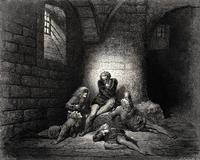
The Inferno, Canto 33
Gustave Dore
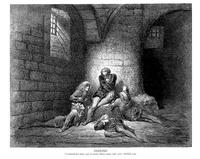
Ugolino
Gustave Dore
The Emperor Alexius IV Poisoned and Strangled by Mourzoufle
Gustave Dore
Ash Wednesday
Carl Spitzweg
Sister Gudule and Esmeralda
Luc-Olivier Merson
Plan and elevation of the kitchen in the same
Giovanni Battista Piranesi
The Martyrdom of the Holy Innocents
Gustave Dore
Idylls of the King
Gustave Dore
In the shadow people are weeping and praying, surrounded by others who are exhorting them (plate 6)
Odilon Redon
Spoliarium
Juan Luna
The Yard of a Madhouse
Francisco Goya
The entombment
Rembrandt
Faust rescues Marguerite from her prison
Eugene Delacroix
John the Baptist Beheaded, AD 23
Jan Luyken
The Death of Timophanes
Antoine-Jean Gros
Illustration of Victor Hugo's Novel the Man Who Laughs
Georges Rochegrosse
Plague Hospital
Francisco Goya