Expert analysis of Paul Klee’s Aroundfish
Style: Surrealism · Genre: still life
Art Historical Analysis: Aroundfish by Paul Klee
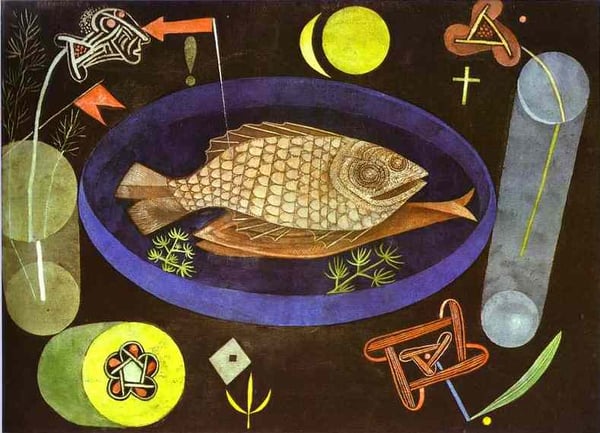
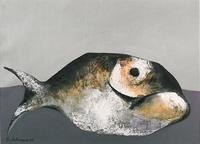
Paul Klee’s Aroundfish stands as a remarkable synthesis of two seemingly divergent artistic currents—the structured, pedagogic rigor of the Bauhaus and the dreamlike, irrational impulses of Surrealism. Created during his tenure as a master at the Bauhaus (1921–1931), this work exemplifies Klee’s unique ability to merge formal discipline with poetic fantasy.
Context and Period Significance (Bauhaus):
The Bauhaus was a school that championed the unification of art, craft, and technology, emphasizing fundamental design principles such as color theory, geometric form, and material honesty. Klee taught there alongside figures like Kandinsky and Albers, and his own theoretical writings on visual rhythm and color harmony deeply informed his practice. In Aroundfish, this Bauhaus influence appears in the careful, almost modular arrangement of shapes and lines—the fish is not a naturalistic creature but a constructed sign, built from arcs, angles, and overlapping planes. The composition feels balanced yet dynamic, reflecting Klee’s belief that art should be “a visible construction of invisible forces.”
Stylistic Innovation (Surrealism and Still Life):
Although Klee is often associated with Surrealism, his approach was more introspective and less overtly automatic than that of Breton or Dalí. Aroundfish treats the still life genre as a playground for subconscious symbolism. The fish—a recurring motif in Klee’s work—can be read as a floating signifier: a creature of both water and air, of earthly life and ethereal dream. The surrounding “around” elements (arrows, dots, organic swirls, and geometric fragments) suggest a hidden narrative or a cosmic diagram. The palette is muted yet exact: earthy browns, soft blues, and touches of red and yellow that activate the surface without overwhelming it. This careful orchestration of color and form makes the still life feel less like a depiction of objects and more like a psychological landscape.
What Makes It Significant:
Aroundfish is significant because it challenges the boundary between rational design and irrational content. Where many Bauhaus works lean toward abstraction and functionalism, Klee infuses his with whimsy, humor, and mystery. Conversely, while Surrealist works often abandon compositional structure for free association, Klee anchors his imagery in rigorous pictorial logic. The painting thus serves as a bridge—a demonstration that the Bauhaus ethos of “form follows function” could accommodate the poetic and the strange. It invites viewers to “read” the painting as a kind of visual poem, where every line and color has intention, yet the overall meaning remains open, like a riddle.
In sum, Aroundfish is a masterpiece of ambiguous harmony, proving that even within the disciplined framework of the Bauhaus, art could still dream.
Visually similar
20 works with related composition and palette
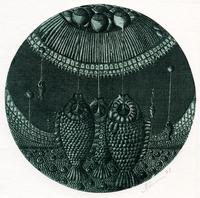
Bosch Pupil
Oleksandr Aksinin
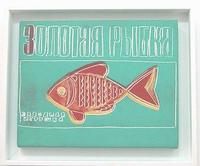
Toy Fish
Andy Warhol
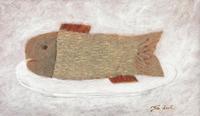
A Fish
Jean David
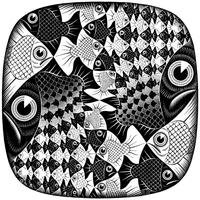
Fishes and Scales
M.C. Escher
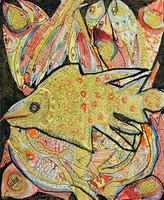
Golden Fishes in the Dark Sea
Twins Seven Seven
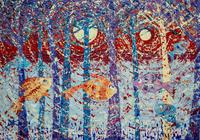
8 fishes
Raiskina Marina
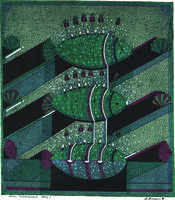
Nearly Canonical Image
Oleksandr Aksinin
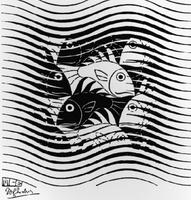
Fishes in Waves
M.C. Escher
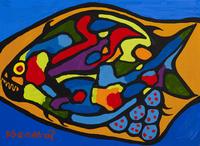
Sacred Trout Through The Portal of Time
Norval Morrisseau
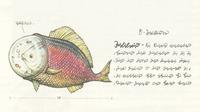
Fish from "Codex Seraphinianus"
Luigi Serafini
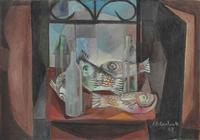
Natureza Morta
Emiliano Di Cavalcanti
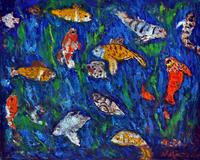
Towards Light
George Stefanescu
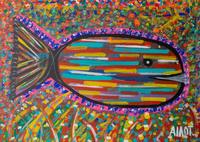
The Fish In Dirty Sea
Alan Tellez
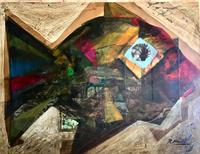
A037 - The fish
Ramiro Martín Martín
Exlibris of Roman Fylypchuk
Oleksandr Aksinin

Celestial Dreams
Jahar Dasgupta
The Goldfish
Paul Klee
Ukrainian folk icon of the Trinity
Orthodox Icons
Still Life
Louis Marcoussis
Untitled
Bahman Mohasses