
Analisi esperta di Fishes and Scales di M.C. Escher
Stile: Op Art · Genere: tessellation
Expert Analysis of Fishes and Scales by M.C. Escher
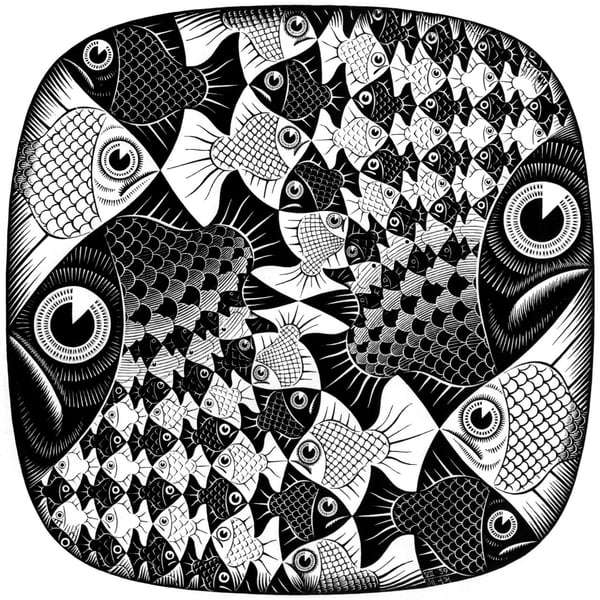
M.C. Escher’s Fishes and Scales is a masterful example of tessellation within the Op Art tradition, demonstrating his unparalleled ability to transform a rigid mathematical grid into a fluid, optically dynamic composition. The work’s significance lies in its seamless fusion of two distinct visual phenomena: the repetitive, interlocking pattern typical of a tessellation, and the perceptual instability characteristic of Op Art.
As a tessellation, the artwork achieves a perfect, gapless subdivision of the plane. The “fishes” and “scales” are not separate motifs but interdependent shapes—one emerges from the negative space of the other. This dual-image interplay forces the viewer’s eye to oscillate between seeing the fish as the primary subject and the scales as a background texture, creating a visual ambiguity that is central to Op Art’s goal of stimulating retinal vibration. Escher’s precision in contour and scale ensures that neither form dominates, keeping the composition in a state of perceptual tension.
Within the Op Art movement—which flourished in the 1960s, though Escher’s work often preceded it—Fishes and Scales stands out for its organic subject matter. While many Op artists relied on abstract geometric patterns (e.g., Bridget Riley’s stripes or Victor Vasarely’s chevrons), Escher anchors his optical effects in recognizable nature. The fish and scales become vehicles for exploring the same principles of figure-ground reversal, moiré patterns, and kinetic illusion, but with an added layer of representational wit. This bridges the gap between Op Art’s cerebral formalism and a more whimsical, narrative appeal.
The artwork’s significance is also rooted in its demonstration of Escher’s signature technique: the metamorphosis of shape. The transition from fish to scale is not abrupt but gradual, achieved through subtle adjustments in curvature and spacing. This metamorphic quality creates a sense of rhythmic flow, as if the pattern is alive and shifting before the eyes—a hallmark of Op Art’s engagement with visual perception.
In summary, Fishes and Scales is significant because it exemplifies how tessellation can generate Op Art’s signature optical effects without sacrificing representational clarity. It stands as a testament to Escher’s precision, his innovative use of dual imagery, and his ability to make mathematical order feel both playful and hypnotic.
Visivamente simili
20 opere con composizione e palette affini
Fishes in Waves
M.C. Escher

Metamorphosis II excerpt 4
M.C. Escher
8 fishes
Raiskina Marina
Toy Fish
Andy Warhol
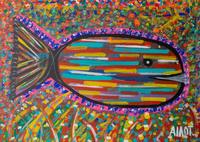
The Fish In Dirty Sea
Alan Tellez
Nearly Canonical Image
Oleksandr Aksinin
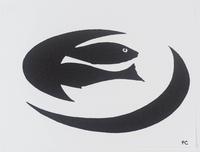
Two Fish on a Plate
Patrick Caulfield
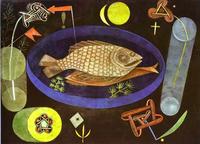
Aroundfish
Paul Klee
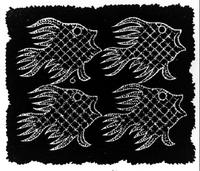
Plane-filling Motif with Fish and Bird
M.C. Escher
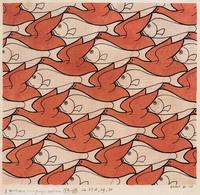
Bird Fish
M.C. Escher
Bosch Pupil
Oleksandr Aksinin
A037 - The fish
Ramiro Martín Martín

IMGP Rosa Rot Malwerk Silvia L Lueftenegger Contemporary Art Design Performance Theater Shoe 6881P
Silvia L. Lueftenegger RosaRot
Sacred Trout Through The Portal of Time
Norval Morrisseau
Sky and Water II
M.C. Escher
Fish
M.C. Escher
A Fish
Jean David
Twon Intersecting Planes Colour
M.C. Escher
Towards Light
George Stefanescu
Fish & Boat
M.C. Escher