Expert analysis of Paul Klee’s Castle Garden
Style: Cubism · Genre: abstract
Expert Analysis of Castle Garden by Paul Klee
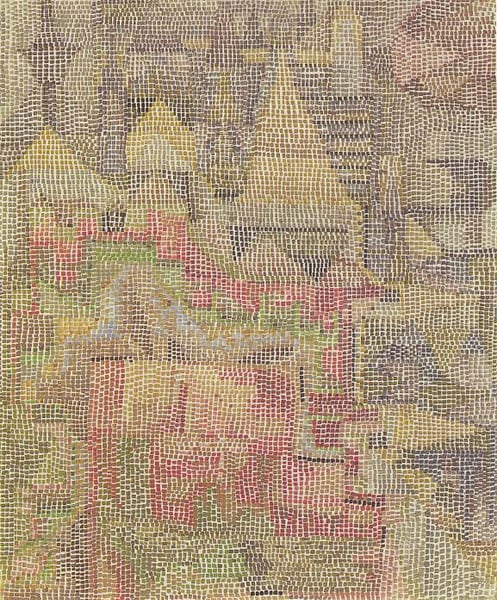
Paul Klee’s Castle Garden stands as a compelling synthesis of Cubist structure and Bauhaus pedagogy, rendered through an abstract vocabulary that redefines how architectural space and nature can coexist on a flat plane. Executed during his tenure at the Bauhaus, the work embodies the school’s core mission: to unite art, craft, and technology while exploring the fundamental elements of form and color.
Cubist Foundations
Though Klee never strictly adhered to orthodox Cubism, Castle Garden exhibits the movement’s hallmark fragmentation of space and multiple viewpoints. The composition breaks down the titular garden into interlocking geometric planes—triangles, rectangles, and arcs—that simultaneously suggest turrets, walls, pathways, and foliage. This fractured perspective allows the viewer to perceive the garden from above, within, and around all at once, rejecting Renaissance single-point perspective in favor of a dynamic, intellectual reconstruction of reality.
Abstract Genre and Bauhaus Ideals
The abstraction here is not mere distortion but a deliberate reduction to pure visual language. Klee strips away descriptive detail, leaving only essential lines, color fields, and rhythmic patterns. This aligns with Bauhaus principles of functional clarity and formal economy. The grid-like organization of the composition echoes the Bauhaus emphasis on modular design, while the playful interplay of warm and cool hues (perhaps yellows and blues against earthy tones) demonstrates Klee’s deep study of color theory—a cornerstone of Bauhaus preliminary courses taught by Johannes Itten and Wassily Kandinsky.
Significance within Period and Style
What makes Castle Garden significant is its reconciliation of seemingly opposing impulses: the rigorous geometry of Cubism and the intuitive, lyrical tenderness of Klee’s personal iconography. At the Bauhaus, where industrial austerity often dominated, Klee introduced a poetic, childlike wonder without sacrificing structural discipline. The work functions as a visual metaphor for the Bauhaus dream of harmony between nature and the built environment—a castle transformed into a garden of abstract signs.
Ultimately, Castle Garden is a masterclass in how Cubist analysis can be harnessed for abstract expression, and a testament to Klee’s ability to infuse Bauhaus rationalism with emotional resonance. It remains a pivotal example of the period’s exploration of the line between representation and pure abstraction.
Visually similar
20 works with related composition and palette
Cacodemonic
Paul Klee
Rising Star
Paul Klee
Water and Bush Tucker Story
Johnny Warangkula Tjupurrula
Yala Tjukurpa (Potato Dreaming)
Johnny Warangkula Tjupurrula
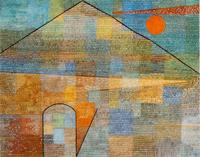
Ad Parnassum
Paul Klee
Structural II
Paul Klee
Rose Garden with Triangular Window
Ilka Gedo
Untitled (Non Objective Composition)
Pavel Filonov
Untitled
Maria Helena Vieira da Silva
Bush Hen Dreaming
Abie Loy Kemarre
Energy Field
Constantin Flondor
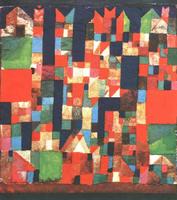
City Picture with Red and Green Accents
Paul Klee
Cote de provence
Paul Klee
Lupulnga
Makinti Napanangka
Ville toride
Gustave Singier
Maskelyne DA Region of the Moon (from the series Lunar Maps)
Nancy Graves
Architettura 1
Bice Lazzari
Bush Hen Dreaming
Abie Loy Kemarre
Women's Dreaming at Lupulnga
Makinti Napanangka
Dream City
Paul Klee