Expert analysis of Paul Klee’s Dream City
Style: Cubism · Genre: abstract
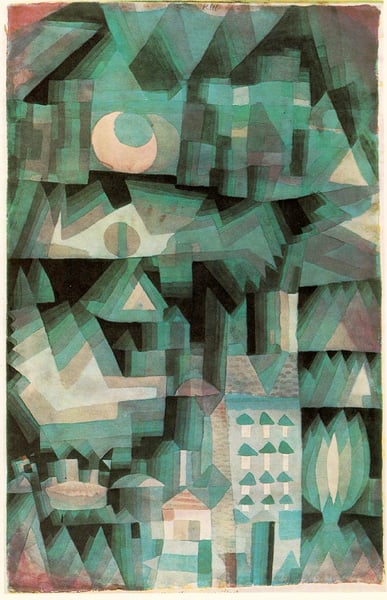
Analysis of "Dream City" by Paul Klee
Within the framework of the supplied facts—Cubist style, abstract genre, and Bauhaus period—Paul Klee’s Dream City emerges as a singular synthesis of structural fragmentation and lyrical spatial invention. While Klee is more commonly aligned with Expressionism and Surrealism, this work demonstrates how the Bauhaus environment encouraged him to distill Cubist principles into a personal, contemplative abstraction.
Cubism refracted through Bauhaus sensibility
Klee adopts Cubism’s hallmark disassembly of form—overlapping planes, shifted perspectives, and interlocking geometries—but softens its analytical rigor with a dreamlike fluidity. Unlike Picasso or Braque, who anchored Cubism in still lifes or figures, Klee applies these devices to an imaginary urban landscape. The “city” is not rendered as a coherent, legible architecture; instead, facets of buildings, streets, and windows float in a shallow, color-saturated space. This reflects the Bauhaus ethos of exploring form as a dynamic, almost musical arrangement of shapes and hues, liberated from literal representation.
Abstract genre as a vehicle for inner vision
The abstraction in Dream City is not an escape from reality but a translation of it into a symbolic language. Klee famously described art as “making the invisible visible.” Here, the city becomes a mental construct—a dream—where Cubist facets suggest the multiplicity of subjective experience. The composition likely balances rectilinear blocks (anchoring order) with curved or diagonal intrusions (hinting at the subconscious). This tension between chaos and structure is a hallmark of Klee’s Bauhaus teaching, where he explored color theory and the “thinking eye” to produce harmony from dissonance.
Significance within the Bauhaus and Cubist trajectories
What makes Dream City significant is its role as a hybrid: it borrows Cubism’s revolutionary approach to space but reorients it toward the Bauhaus’s emphasis on synthesis—of art, craft, and imagination. While Cubism had been radical in the 1910s, by the 1920s Klee and his Bauhaus colleagues (like Kandinsky and Albers) pushed abstraction further into the realm of psychological resonance. Dream City stands as a testament to this evolution: a city not of bricks and mortar, but of forms that evoke memory, fantasy, and the underlying rhythms of perception itself. In doing so, it bridges the analytical abstraction of early Cubism with the Bauhaus’s vision of art as a universal, spiritual language.
Museum / Gallery
Visually similar
20 works with related composition and palette
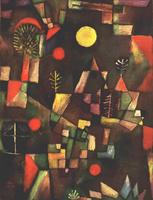
Full moon
Paul Klee
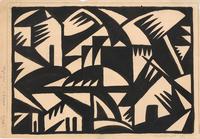
Bortnyik Sándor, Ritmus 1.
Sandor Bortnyik
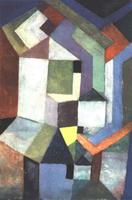
Pious northern landscape
Paul Klee
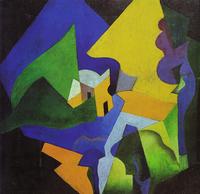
Costruzione spaziale - paesaggio
Enrico Prampolini
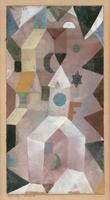
The Chapel
Paul Klee
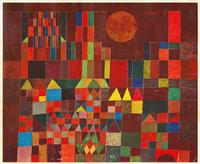
Castle and Sun
Paul Klee
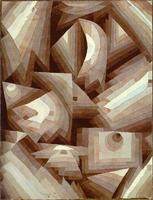
Crystal Gradation
Paul Klee
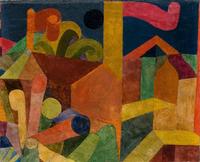
Oriental Garden
Paul Klee
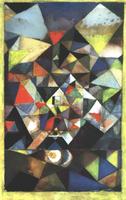
With the Egg
Paul Klee
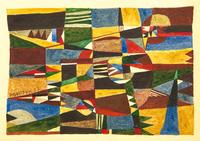
Melody
Ivan Marchuk
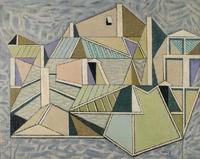
Paris Roofs II
Nikos Hadjikyriakos-Ghikas
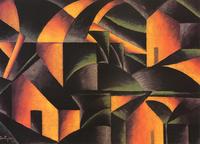
Yellow-Green Landscape
Sandor Bortnyik
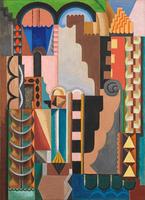
Composition monumentale
Auguste Herbin
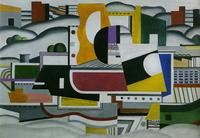
The Large Tug boat
Fernand Leger
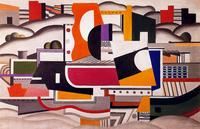
The great tug
Fernand Leger
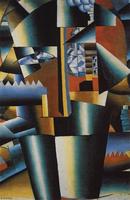
Portrait of Ivan Kliun
Kazimir Malevich
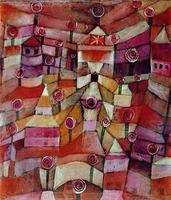
Rose garden
Paul Klee
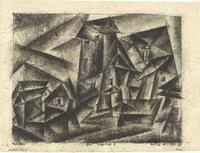
The Village of Legefeld I (Dorf Legefeld I)
Lyonel Feininger
Birsk
Lyubov Popova
Window
Robert Delaunay