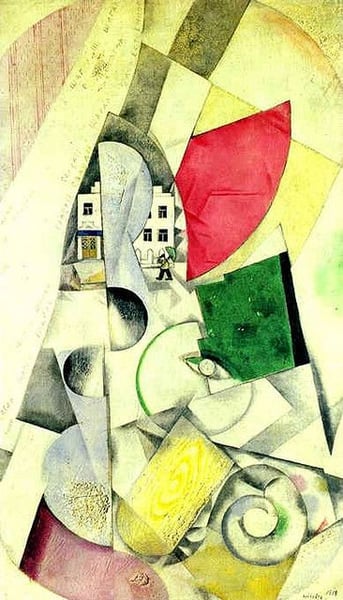
Cubist landscape
Détails
Analyse experte de Cubist landscape de Marc Chagall
Style : Cubism · Genre : cityscape
This analysis is based solely on the provided structured facts: Artwork: "Cubist landscape" by Marc Chagall; Style: Cubism; Genre: cityscape.
Expert Analysis:
Marc Chagall’s Cubist landscape stands as a compelling, if less orthodox, contribution to the Cubist movement, specifically within the cityscape genre. While Chagall is more famously associated with dreamlike, narrative Surrealism and folkloric imagery, this work demonstrates his engagement with the formal language of Cubism—the deconstruction of perspective, the fragmentation of forms, and the use of geometric planes—applied to the urban environment.
Significance within Cubism:
- Hybridization of Cubist Structure with Lyrical Imagination: Unlike the analytical, almost scientific approach of Picasso and Braque (who focused on still lifes and figures), Chagall infuses the Cubist grid with a poetic, almost whimsical sensibility. In this landscape, the fractured planes of buildings and streets may not be purely analytical; they instead serve as a scaffold for emotional, even nostalgic, associations. This distinguishes the work from orthodox Cubism by prioritizing subjective feeling over strict formal inquiry.
- Expanding the Cubist Cityscape: While Cubist painters like Robert Delaunay explored urban dynamism (e.g., Eiffel Tower series), Chagall’s cityscape likely introduces a more intimate, folkloric or Eastern European inflection. The fragmentation is not about speed or modernity alone but about memory—reassembling a city from disjointed, emotionally charged fragments.
Significance within the Cityscape Genre:
- Defamiliarization of the Familiar City: Chagall uses Cubist disassembly to break the city into its essential visual and emotional components. The viewer is not given a realistic panorama but a mosaic of perspectives—a roof, a window, a street corner—that invites a contemplative, almost childlike re-seeing of the urban landscape. This anticipates later Surrealist treatments of city spaces as psychological zones.
- Contrast with Traditional Cityscapes: Where conventional cityscapes rely on linear perspective to create depth and order, Chagall’s Cubist method deliberately destroys that order. The city becomes a flat, interlocking puzzle of shapes, forcing the viewer to piece together the scene anew with each glance.
Conclusion: The significance of Cubist landscape lies in its bridging of Cubist technique with Chagall’s distinctive poetic vision. It is not a pure Cubist exercise but a hybrid that enriches the style by demonstrating that fragmentation and multiple viewpoints could serve emotional and narrative ends—not just formal ones. As a cityscape, it transforms the urban environment from a backdrop into a living, fractured memory, marking an important step toward the fully realized dreamscapes of Chagall’s later, more famous work.
Museum / Gallery
Visuellement similaire
20 œuvres à la composition et à la palette proches
A glass
Pablo Picasso
Clock
Lyubov Popova
Cubist Composition
Georges Valmier
Composition, cubisme ornemental
Serge Charchoune
Composition
Georges Valmier
Man with a Guitar
Georges Braque
Suprematism
Olga Rozanova
Pilot
Kazimir Malevich
Composition
Alexander Rodchenko
Komposition
Gosta Adrian-Nilsson
Still Life with a Bunch of Grapes
Georges Braque
In Blue
Wassily Kandinsky
Composition
Georges Valmier
Small dream in red
Wassily Kandinsky
The Violin
Georges Braque
Head of a man
Pablo Picasso
See See Rider
Jimmy Ernst
Interior
Robert Blackburn
The aficionado (The torero)
Pablo Picasso
Blue Figure in a Chair
Arshile Gorky