The Cattle Dealer
Dettagli
Analisi esperta di The Cattle Dealer di Marc Chagall
Stile: Cubism · Genere: genre painting
Expert Analysis: "The Cattle Dealer" by Marc Chagall
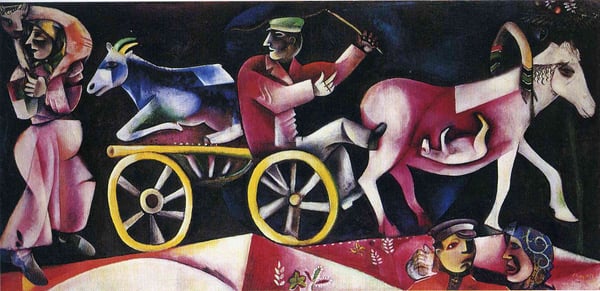
Marc Chagall's The Cattle Dealer is a striking example of how an artist traditionally associated with fantastical, dreamlike imagery can harness the structural discipline of Cubism while reorienting it toward a deeply personal, narrative-driven genre painting. This work stands out as a significant synthesis of two seemingly opposing impulses: the analytical deconstruction of form prized by Cubism and the emotional, often folkloric storytelling that defines Chagall’s oeuvre.
Cubist Reimagined Through Emotion:
While Cubism (as developed by Picasso and Braque) often subjugates subject matter to abstract geometric frameworks, Chagall uses its fragmented planes and shifting perspectives to infuse a mundane market scene with heightened psychological resonance. The cattle dealer, depicted through angular facets and overlapping views, is not merely a commercial figure but a symbol of rural Jewish life—a subject Chagall frequently returned to with nostalgia. The Cubist vocabulary here becomes a tool for compressing time and space: the cow, the dealer, and the landscape are disassembled and reassembled not for formal experiment alone, but to convey the tangled, layered memories of the artist’s Belarusian childhood.
Genre Painting Elevated:
As a genre painting, The Cattle Dealer places everyday labor at the center of high-art discourse. Chagall takes the humble transaction between a farmer and a cattle buyer and transforms it into a nearly mythic encounter. The use of Cubist fragmentation disrupts any straightforward reading of the scene—figures may have multiple profiles, objects float in ambiguous gravity—yet the core human interaction remains legible and poignant. This tension between abstraction and readability is the work’s greatest achievement: it respects the analytical rigor of Cubism while refusing to abandon the narrative warmth of genre painting.
Significance in Cubism’s Evolution:
Chagall’s version of Cubism is notable for its retention of color symbolism and emotional weight. Unlike the monochromatic palette of early analytical Cubism, The Cattle Dealer likely employs vibrant, arbitrary hues (typical of Chagall’s palette) that suggest inner states rather than optical reality. This injects a lyrical, almost surreal quality into the Cubist framework—foreshadowing how Chagall would later merge Cubist form with Surrealist content. The painting thus represents a critical bridge: it demonstrates that Cubism could be a flexible language for expressing cultural identity, personal memory, and the poetry of everyday life, rather than an end in itself. In doing so, Chagall carved a unique niche within the movement, proving that abstraction and narrative could coexist without sacrificing artistic innovation.
Visivamente simili
20 opere con composizione e palette affini
Selling the Horse
Bela Kadar
Selifan
Marc Chagall
Longing
Bela Kadar
Going to Church
William H. Johnson
In Yerevan
Martiros Sarian
Workers
Pavel Filonov
Madonna with the Sleigh
Marc Chagall
Sowing
William H. Johnson
To Russia, with Asses and Others
Marc Chagall
Peddler
Jackson Pollock
Asking the Way
Marc Chagall
War
Marc Chagall
Plow
Martiros Sarian
Going West
Jackson Pollock
I and the Village
Marc Chagall
Bucolic Landscape
Heinrich Campendonk
Saint Anthony (part of Tapestry in six paintings)
Niko Pirosmani
Oxen. Scene from the Life of Savages
Pavel Filonov
Mann, Pferd, Kuh
Heinrich Campendonk
Farm Family
William H. Johnson