To Russia, with Asses and Others
Dettagli
Analisi esperta di To Russia, with Asses and Others di Marc Chagall
Stile: Cubism · Genere: symbolic painting
Expert Analysis: "To Russia, with Asses and Others" by Marc Chagall
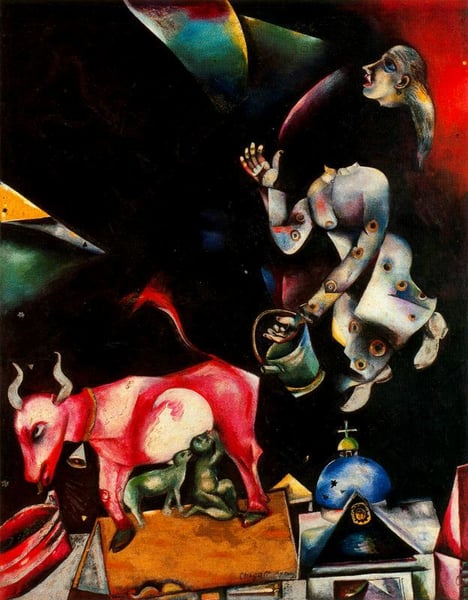
Marc Chagall’s "To Russia, with Asses and Others" stands as a pivotal synthesis of Cubist formal innovation and deeply personal, dreamlike symbolism. While Chagall is often celebrated for his fantastical, folkloric imagery, this work demonstrates his unique adaptation of Cubism—not as a purely analytical deconstruction of form, but as a vehicle for emotional and narrative expression.
Significance within Cubism
Chagall’s Cubism diverges from the rigorous geometry of Picasso or Braque. Here, he employs fragmented planes and tilted perspectives typical of Cubist space, but he subverts them with a fluid, almost childlike spontaneity. The “asses” (donkeys) and other figures are rendered in blocky, reduced shapes, yet their whimsical poses and overlapping outlines retain a sense of motion and life. The composition’s spatial ambiguity—where foreground and background collapse—serves not to abstract reality but to evoke the fluid logic of memory and fantasy. This makes the painting a key example of how Chagall infused Cubist vocabulary with emotional resonance, bridging avant-garde technique and narrative intimacy.
Symbolic Depth and Genre
As a symbolic painting, the work is rich with autobiographical and cultural references. The title itself, “To Russia,” suggests a longing for Chagall’s homeland—a theme recurring in his art after he left Russia for France. The donkey (a traditional symbol of humility, stubbornness, or even the Everyman) may represent the artist’s own journey or the resilience of Russian folk life. The “others” could be spectral figures from his childhood in Vitebsk: fiddlers, lovers, floating animals. Chagall’s characteristic floating figures and inverted elements defy gravity, echoing the Cubist destabilization of perspective but also evoking a dream state where logic yields to feeling.
Overall Impact
This work is significant because it exemplifies how Chagall expanded Cubism’s boundaries, using its formal tools to explore identity, nostalgia, and the subconscious. It is not a sterile exercise in form but a vibrant, poetic fusion—one that anticipates his later, more overtly surrealist works. "To Russia, with Asses and Others" remains a testament to Chagall’s ability to honor the avant-garde while speaking a deeply personal visual language, making it a landmark in the dialogue between Cubist structure and expressive symbolism.
Museum / Gallery
Visivamente simili
20 opere con composizione e palette affini
Milkmaid with cows
Bela Kadar
Cows, Yellow-Red-Green
Franz Marc
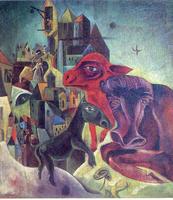
Untitled
Max Ernst
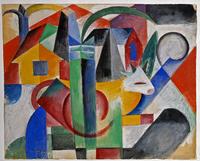
Gelb-weiße Kuh vor Häusern
Heinrich Campendonk
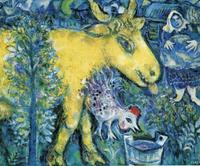
The Farmyard
Marc Chagall
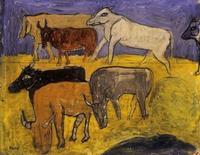
Calf
Bertalan Por
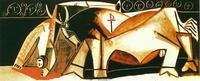
Bullfighting Scene (The picador raised)
Pablo Picasso
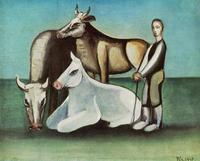
Bulls
Bertalan Por
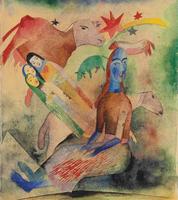
Maria Verkündigung
Heinrich Campendonk
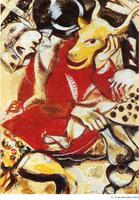
To My Betrothed
Marc Chagall
La vie du ferme
Gustave de Smet
Rape of Europa
Francisco Toledo
Man and Beasts amidst Nature
Heinrich Campendonk
Crying Eyes
Enzo Cucchi
The Yellow Cow
Franz Marc
I and the Village
Marc Chagall
The Cattle Dealer
Marc Chagall
Vaca mala
Francisco Toledo
Still life with a bull's head, book and candle range
Pablo Picasso
Bull (plate VI)
Pablo Picasso