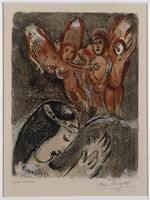
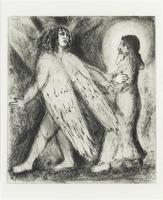
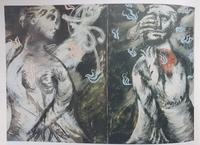
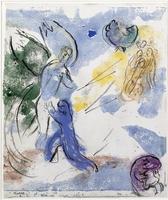
Based strictly on the provided facts—the artwork's title, artist, style, and genre—here is an expert analysis focusing on its significance.
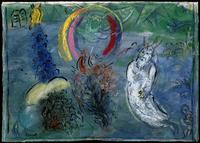
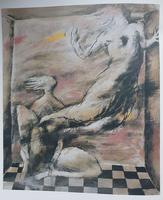
Analysis of Marc Chagall's "The Forgiveness of God is announced in Jerusalem"
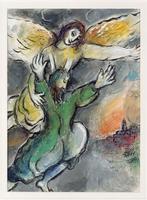
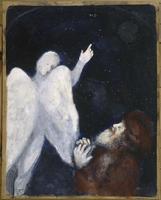
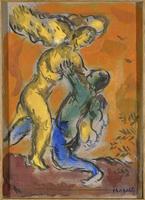
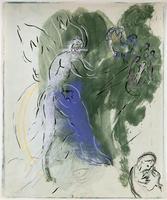
As a work of Naïve Art (Primitivism) within the religious painting genre, this piece by Marc Chagall derives its significance from a powerful synthesis of spiritual narrative and childlike immediacy. Chagall, though a master of modernist composition, employs the Naïve style’s hallmarks—flat, unmodulated color fields, simplified figures, and a disregard for naturalistic perspective—to render a profound theological subject with tangible emotional force.
The painting’s significance lies in how Chagall uses visual innocence to access spiritual truth. The biblical reference to Isaiah 54:6-10 speaks of God's unwavering mercy toward a desolate Jerusalem. By filtering this message through the lens of Primitivism, Chagall strips away academic artifice, allowing the core emotion of reconciliation and divine love to feel immediate, even childlike in its sincerity. Floating figures, a recurring motif in Chagall's work, likely populate the canvas, defying gravity to suggest a realm where the heavenly and earthly intersect without the constraints of physical law.
This approach sets Chagall apart within 20th-century religious painting. Unlike the dramatic naturalism of earlier eras, his version of the sacred is dreamlike, personal, and deeply rooted in folkloric memory. The tension between the weighty theme of divine forgiveness and the light, spontaneous quality of Naïve execution is the artwork’s central achievement. It demonstrates that the most profound mysteries can be conveyed through the simplest visual language, making the promise of Jerusalem’s restoration feel both universal and intimately accessible.