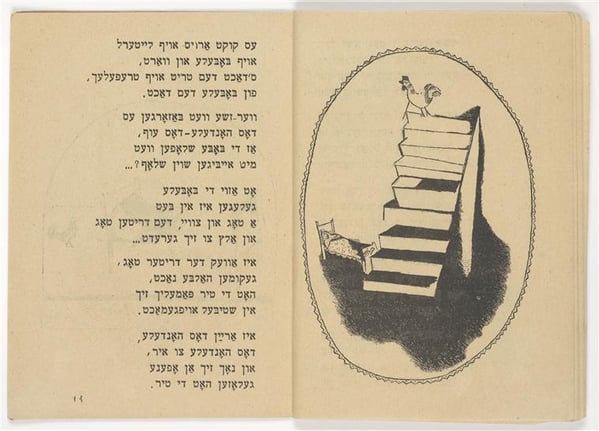
Expert analysis of Marc Chagall’s The Story of the Rooster. The little goat
Style: Naïve Art (Primitivism) · Genre: illustration
Expert Analysis: "The Story of the Rooster. The little goat" by Marc Chagall
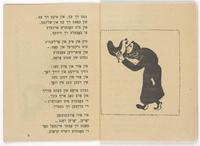
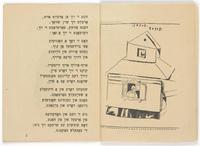
Marc Chagall’s illustration for The Story of the Rooster. The little goat is a quintessential example of how the artist synthesized Naïve Art (Primitivism) with deeply personal, folkloric symbolism. Though Chagall was formally trained and highly sophisticated, he deliberately adopted a childlike, untutored aesthetic—flat planes, skewed perspectives, and vibrant, non-naturalistic color—to evoke the raw emotional truth of memory and myth.
Significance within Naïve Art and Primitivism:
In the context of early 20th-century Primitivism, Chagall’s work stands apart from contemporaries like Henri Rousseau (who painted from direct observation of the exotic) or the Cubists’ geometric “primitivism.” Chagall’s “naïveté” is not about imitating tribal art or untrained painters, but about accessing a folk consciousness—the legends, fables, and everyday magic of his Jewish-Russian upbringing. This piece, as an illustration, operates as a visual narrative where the rooster and little goat are not mere animals but archetypes: the rooster often symbolizes vigilance, passion, or resurrection in Chagall’s lexicon, while the goat can represent stubbornness, the earthy, or even pastoral innocence.
The Role of Illustration as a Genre:
Chagall produced numerous illustrations for books (e.g., Gogol’s Dead Souls, the Bible, and La Fontaine’s fables). Here, the work’s significance lies in how it liberates illustration from mere accompaniment to autonomous art. The composition likely uses floating forms, inverted scales, and a dreamlike space where sky and ground merge—hallmarks of Chagall’s style. The viewer is invited not to “read” a literal story but to feel the narrative’s emotional core: the tender, slightly absurd coexistence of creatures in a world untethered from realism.
Why This Matters:
This artwork epitomizes Chagall’s unique contribution to Primitivism: he did not reject modernity for a “savage” ideal but instead re-enchanted the modern world with folk memory. The rooster and the little goat become surrogates for human joys, fears, and the timeless cycles of life. In the Naïve Art tradition, where detail and “correct” anatomy are sacrificed for expression, Chagall achieves a poetic clarity that few illustrators have matched. The work is a testament to how Primitivism can be both deeply personal and universally resonant—a fusion of folktale and avant-garde freedom.
Museum / Gallery
Visually similar
20 works with related composition and palette
The Story of the Rooster. The little goat
Marc Chagall
The Story of the Rooster. The little goat
Marc Chagall
The Story of the Rooster. The little goat
Marc Chagall
The Story of the Rooster. The little goat
Marc Chagall
Construction I
Theo van Doesburg
Illustration for review "Troyer/Courant"
Marc Chagall
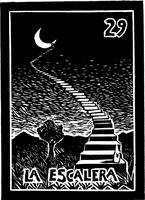
#29: La Escalera (The Staircase)
Marina Pallares
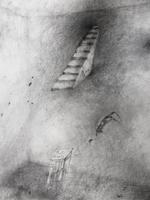
Lento sfumato 10
Lech Jankowski
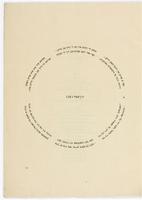
Illustration for review "Troyer/Courant"
Marc Chagall
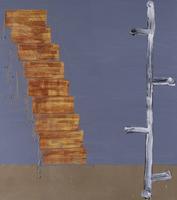
The Difference Between II
Basil Beattie
Niebios kości
Lech Jankowski
Untitled
Alevtyna Kakhidze

Stairs (These Stairs Can Be Climbed)
Alice Aycock
Little orfan anphetamine
Gianfranco Baruchello
Untitled
Raoul De Keyser
The Roman antiquities, t. 4, Plate XXIX. Following the above table.
Giovanni Battista Piranesi

Climacophobia
John Vassos
Exlibris of K.Tovstiuk
Oleksandr Aksinin
Steps
Josef Albers
Never Before
Basil Beattie