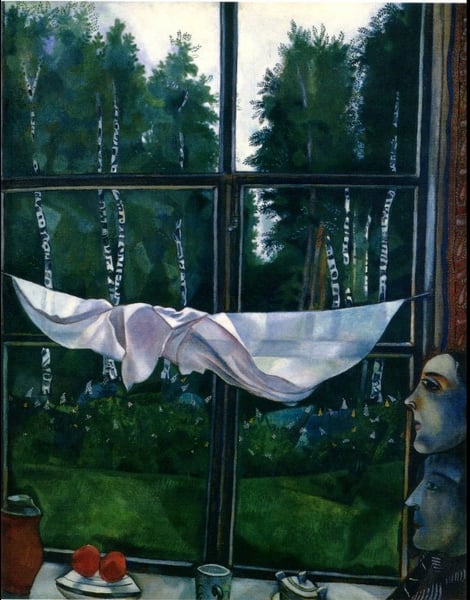
Window in the Country
Dettagli
Analisi esperta di Window in the Country di Marc Chagall
Stile: Naïve Art (Primitivism) · Genere: genre painting
Expert Analysis: "Window in the Country" by Marc Chagall
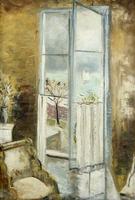
Marc Chagall’s “Window in the Country” is a quintessential example of Naïve Art (Primitivism), a style that deliberately rejects academic polish in favor of childlike directness, vivid color, and unconventional perspective. As a genre painting—depicting a slice of everyday rural life—the work at first seems simple: a window framing a pastoral scene. Yet Chagall transforms this ordinary subject into something deeply symbolic and dreamlike, which is precisely what makes the work significant within its movement.
Significance within Naïve Art / Primitivism
Chagall stands apart from other Naïve artists (like Henri Rousseau) by infusing his “simple” forms with rich personal mythology. In “Window in the Country,” the window functions not merely as a compositional device but as a threshold between interior domesticity and an enchanted exterior. The flattened space, disproportionate figures, and Fauvist-inspired palette—vivid greens, blues, and reds—are hallmarks of Primitivism. These choices strip away illusionistic depth, forcing the viewer to engage with the image’s emotional and symbolic content rather than its realism.
What elevates this work
- The window motif: For Chagall, windows often symbolize the boundary between the real and the imagined, the earthly and the spiritual. Here, the open window invites the outside world into the intimate interior, blending the mundane act of looking with a sense of wonder.
- Genre painting reimagined: While traditional genre scenes aim for accurate representation of everyday life, Chagall’s version feels suspended in a timeless, poetic reverie. The figures—if any appear—are likely rendered with his signature floating or disproportionate forms, suggesting that “country life” is not just observed but felt inwardly.
- Influence on Modernism: Chagall’s synthesis of folk art, Jewish heritage, and avant-garde ideas (Cubism, Fauvism, Surrealism) through a Naïve lens paved the way for later Surrealist and Expressionist explorations of the subconscious. “Window in the Country” encapsulates this hybrid: a seemingly naive style that harbors sophisticated layers of nostalgia, memory, and mystical transcendence.
Conclusion
“Window in the Country” is significant because it demonstrates how Naïve Art, in Chagall’s hands, becomes a vehicle for profound personal and cultural expression. It transforms a simple genre scene into an icon of modern primitivism—where innocence is not ignorance but a deliberate artistic choice to see the world anew.
Museum / Gallery
Visivamente simili
20 opere con composizione e palette affini
The window of the poet
Pyotr Konchalovsky
Katya with a doll by the window
Pyotr Konchalovsky
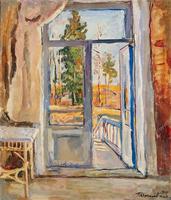
Spring. Open door on the balcony.
Pyotr Konchalovsky
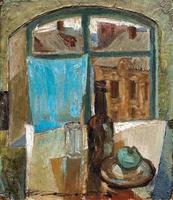
Still Life with a Curtain
Valentin Khrushch
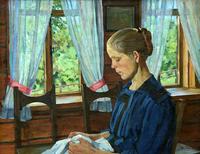
Shura's Portrait
Konstantin Yuon
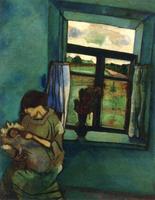
Bella and Ida by the Window
Marc Chagall
From The Window
Kmetty János
Woman at the Window
Henri Matisse
A doll
Mstislav Dobuzhinsky
Interior
Olga Boznańska
Interior
Octav Angheluta
In the Room. Winter
Boris Kustodiev
The Interior. Second Part
Konstantin Somov
Still Life and a Window
Arthur Segal
View of the Pond at Charleston
Vanessa Bell
The Closed Window
Henri Matisse
Winter window
Pyotr Konchalovsky
Open Window, Etretat
Henri Matisse
Through a Window, Riviera
Paul Nash
Her Room
Andrew Wyeth