Expertenanalyse zu Boris Kustodievs In the Room. Winter
Stil: Realism · Genre: interior
Expert Analysis of "In the Room. Winter" by Boris Kustodiev
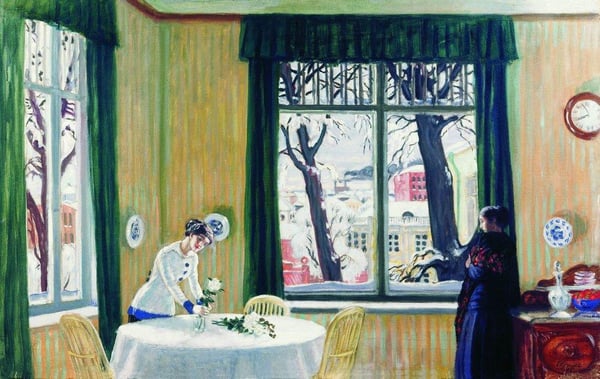
Boris Kustodiev’s In the Room. Winter stands as a masterful example of Russian Realism applied to the intimate interior genre, yet it transcends mere documentation through its uniquely evocative synthesis of warmth, nostalgia, and meticulous detail. While Kustodiev is celebrated for his festive, carnival-like scenes of Russian life, this work shifts focus to the quiet sanctuary of a domestic space—a subject that reveals his equal prowess in capturing the poetry of the everyday.
Significance within Realism and Kustodiev’s Oeuvre:
-
Mastery of Atmospheric Contrast: The painting’s title immediately invokes a central tension: the harsh external cold versus the cocooned interior. Kustodiev’s realism here is not photographic but sensory. He uses a warm, almost amber palette for the room—glowing wood, soft textiles, and the golden light of a lamp or stove—to create an enveloping sense of comfort. The implied winter outside (perhaps visible through a frosty window) is felt as a distant presence, making the interior a refuge. This contrast was a recurring motif in Kustodiev’s work, but here it is stripped of spectacle, achieving a quieter, more profound emotional resonance.
-
Celebration of Bourgeois Domesticity: Kustodiev, like many Realists, was drawn to the lives of the Russian merchant and middle classes. In the Room. Winter is a rich ethnographic document of that world: the patterned wallpaper, the heavy drapes, the samovar or ornate furniture. Yet the painting avoids mere cataloging. Every object feels imbued with habitation—a chair slightly askew, a half-open book. The realism serves not just to record but to honor the texture of a lived, unhurried life. This focus on the ordinary as worthy of high art was a cornerstone of the Realist movement, and Kustodiev elevates it with a painterly sensuousness that borders on the decorative.
-
Intersection of Realism and Decorative Richness: Kustodiev’s style often blurs the line between careful observation and artistic arrangement. In this interior, the composition feels both natural and carefully balanced—a diagonal of light, the solid geometry of furniture, the soft curves of fabric. His brushwork is precise but not stiff; the surfaces of wood, glass, and cloth are rendered with a tactile realism that invites the viewer to feel the cold of a windowpane or the plushness of an armchair. This attention to materiality, combined with a subtle warmth of color, makes the scene feel alive despite its stillness.
What Makes It Significant:
In the Room. Winter is significant because it demonstrates Kustodiev’s ability to find monumental depth in a private, unposed moment. In an era of rapid social change in Russia, his interiors offered a vision of stability, tradition, and comfort—not as political statement, but as a sincere celebration of home. The painting stands as a testament to the Realist tenet that truth and beauty can be found in the quietest corners of life, and it remains a poignant example of how an artist can turn a simple room into a world.
Museum / Gallery
Visuell ähnlich
20 Werke mit ähnlicher Komposition und Farbpalette
Namnsdag
Fanny Brate
Summer Day
Nikolay Bogdanov-Belsky
Interiør Med Lesende Kvinne
Kitty Lange Kielland
The Dining Room
Paul Signac
In the rooms
Boris Kustodiev
Cottage Interior (also known as Interior at Jersey)
Berthe Morisot
The Dining Room in the Country
Pierre Bonnard
The Terrasse Children with Black Dog
Pierre Bonnard
Interior
Edouard Vuillard
The Interior. Second Part
Konstantin Somov
Laying the table
Victor Gabriel Gilbert
Room in Brooklyn
Edward Hopper
House In Uspensky
Boris Kustodiev
On a Verandah in September
Kmetty János
Young Woman in front of a Mirror
Anna Ancher
Interior with the Artist's Wife at the Window
Carl Holsøe
Two mothers. Native mother and stepmother.
Vladimir Makovsky
The Interior
Konstantin Yuon
Flower Girls
Olga Boznańska
Blåst
Tove Jansson