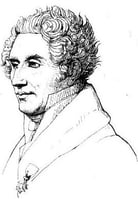
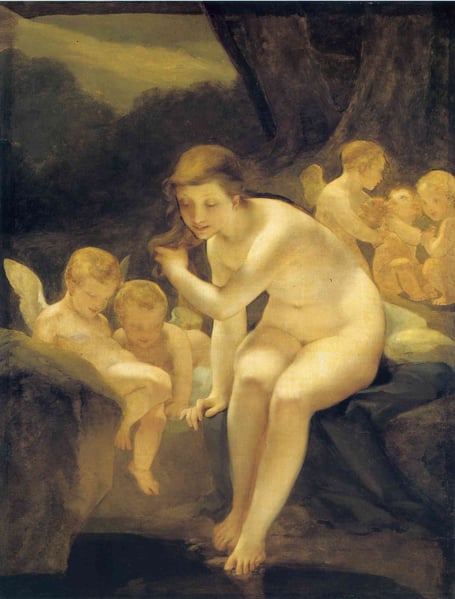
Venus Bathing (Innocence)
Details
Expert analysis of Pierre-Paul Prud'hon’s Venus Bathing (Innocence)
Style: Romanticism · Genre: mythological painting
Expert Analysis of Venus Bathing (Innocence) by Pierre-Paul Prud'hon
As a mythological painting executed in the Romantic style, Venus Bathing (Innocence) stands as a pivotal work that bridges the refined elegance of late 18th-century Neoclassicism with the emerging Romantic sensibility of the early 19th century. Pierre-Paul Prud'hon, often called the "French Correggio" for his soft, sfumato modeling and dreamlike atmospheres, imbues this classical subject with a deeply emotional and tender quality that marks the work’s significance within the Romantic movement.
The choice of Venus—goddess of love and beauty—bathing is a traditional mythological motif, yet Prud'hon transforms it through the subtitle "Innocence." Rather than depicting Venus as a bold, overtly sensual deity, he presents her in a state of vulnerable, almost virginal purity. This aligns with Romanticism’s preoccupation with inner feeling, vulnerability, and the sublime, moving away from the cold rationality of Neoclassicism toward a more intimate, subjective interpretation of myth. The soft, diffused light and delicate, blurred contours (a hallmark of Prud’hon’s technique) create an ethereal, otherworldly glow that emphasizes the figure’s emotional isolation and innocence—qualities that resonate with Romantic ideals of the pure, untainted soul.
The artwork’s significance also lies in its masterful fusion of form and sentiment. Prud’hon’s flowing, serpentine lines and the gentle, almost melting transitions from light to shadow give the figure a palpable sense of breath and life, while the enveloping darkness of the background heightens the mood of private reverie. This chiaroscuro treatment, combined with the subject’s introspective pose (often with averted gaze or modest gesture), invites the viewer into a moment of quiet contemplation—a hallmark of Romantic art’s shift from public, didactic narratives to private, psychological drama.
In the broader Romantic context, Venus Bathing (Innocence) exemplifies how artists of the period repurposed classical mythology to explore modern themes of emotion, innocence, and the tension between sensuality and spirituality. Prud’hon’s work here is a crucial link, demonstrating that Romanticism could be both deeply personal and exquisitely refined, and that mythological painting could serve as a vehicle for the most tender of human sentiments. It remains a defining example of Romanticism’s ability to infuse ancient stories with new, heartfelt meaning.
Museum / Gallery
Visually similar
20 works with related composition and palette
Venus and Cupid
Paul Baudry
The Torch of Venus
Pierre-Paul Prud'hon
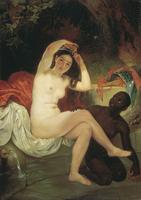
Bathsheba
Karl Bryullov
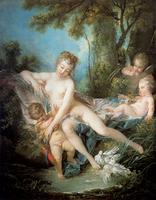
Venus comforts Amor
Francois Boucher
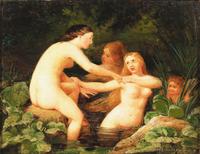
Bathing girls
Elisabeth Jerichau-Baumann
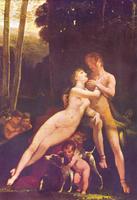
Venus und Adonis
Pierre-Paul Prud'hon
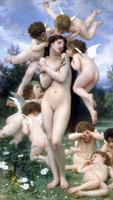
The Return of Spring
William-Adolphe Bouguereau
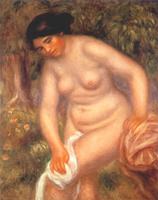
Bather drying herself
Pierre-Auguste Renoir
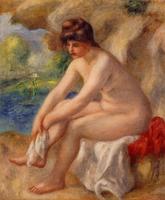
Leaving the Bath
Pierre-Auguste Renoir
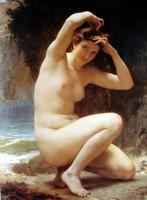
The Toilet of Venus
William-Adolphe Bouguereau
After the bath
Jose Ferraz de Almeida Junior
Venus Anadyomene
Jean Auguste Dominique Ingres
Nymph and Cupid
Nikolaos Gyzis
Venus Bathing
Camille Corot
Venus, Hymen and Love
Pierre-Paul Prud'hon
Venus, Cupid and Jealousy
Agnolo Bronzino
Spring
Bertalan Szekely
Musidora
Thomas Sully
Nudes in the Woods
Emmanuel Benner
A Seating Bather
Pierre-Auguste Renoir