Analyse experte de Genserich's Invasion of Rome de Karl Bryullov
Style : Romanticism · Genre : history painting
Analysis of "Genserich's Invasion of Rome" by Karl Bryullov
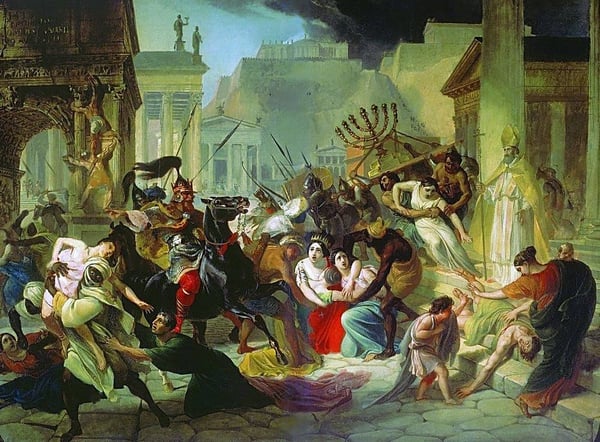
Karl Bryullov’s Genserich's Invasion of Rome stands as a compelling testament to the Romantic fascination with historical cataclysm and human drama. As a history painting executed in the Romantic style, the work embodies the movement’s core concerns: the sublime terror of natural and human forces, the emotional intensity of a pivotal moment, and the moral weight of historical judgment.
Romanticism’s Emphasis on Dramatic Historical Narrative
Bryullov, already celebrated for his monumental The Last Day of Pompeii, applies a similar emotional and compositional framework here. The invasion of Rome by the Vandal king Genserich (AD 455) is not merely a record of events but a theatrical spectacle of chaos and suffering. The painting captures the instant of violent rupture—soldiers pouring through gates, civilians in panic, looters and flames—all rendered with an operatic fervour that prioritizes emotional impact over archaeological precision. This treatment aligns perfectly with Romanticism’s rejection of Neoclassical restraint, opting instead for dynamic diagonals, stark chiaroscuro, and a surging crowd that pulls the viewer into the maelstrom.
Significance within History Painting
Within the genre of history painting, Bryullov’s work is significant for its fusion of academic technique with Romantic sensibility. He employs a meticulously structured composition—pyramidal groupings, balanced masses, and a clear focal point of the invading horde—while using colour and light to heighten drama. The searing reds and golds of torches and banners contrast with the cold marble of Rome, suggesting a clash between civilization and barbarism. Notably, Bryullov introduces a moral dimension: the invaders are not merely villains; their force of nature overwhelms a decadent empire, echoing Romantic themes of inevitable downfall and the sublime power of history itself.
Contribution to Bryullov’s Legacy
This painting further solidifies Bryullov’s reputation as a master of the historical sublime. While Pompeii focused on natural disaster, Genserich’s Invasion turns to human-caused catastrophe, broadening his exploration of how great civilizations collapse. The work’s scale, emotional range, and technical bravura made it a touchstone for Russian Romanticism and influenced later painters who sought to combine historical gravity with visceral immediacy. In summary, Genserich’s Invasion of Rome is significant because it epitomizes the Romantic history painting: a vivid, morally charged, and visually overwhelming reconstruction of a pivotal moment, rendered with the full force of Bryullov’s virtuosity.
Museum / Gallery
Visuellement similaire
20 œuvres à la composition et à la palette proches
The Conquest of Jerusalem by Emperor Titus
Nicolas Poussin
Il Sacrificio Di Polissena
Giambattista Pittoni
Sacrificio Di Polissena
Giambattista Pittoni
Abduction of the Sabine Women
Nicolas Poussin
Hector's Farewell from Andromache and Astynax
Franz Anton Maulbertsch
The Destruction of the Temple at Jerusalem
Nicolas Poussin
Marius Returning to Rome
François Gérard
The Destruction of the Temples in Jerusalem by Titus
Nicolas Poussin
The Destruction and Sack of the Temple of Jerusalem
Nicolas Poussin
The Death of Brutus
Pierre-Narcisse Guerin
Adoration of the Magi
Nicolas Poussin
The death of Virginia
Vincenzo Camuccini
The Pool of Bethesda
Louis Cheron
The Death of Priam
Pierre-Narcisse Guerin
Entry of Alexander into Babylon
Charles Le Brun
The Abduction of the Sabine Women
Nicolas Poussin
The abduction of the Sabinas
Peter Paul Rubens
A Roman Triumphal Entry, Possibly of Marcus Claudius Marcellus
Vincenzo Camuccini
The Triumph of David
Nicolas Poussin
The Sabine Women
Jacques-Louis David