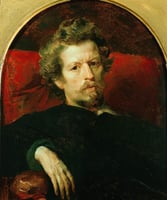
Analisi esperta di Mark the Evangelist di Karl Bryullov
Stile: Romanticism · Genere: religious painting
Expert Analysis: Mark the Evangelist by Karl Bryullov
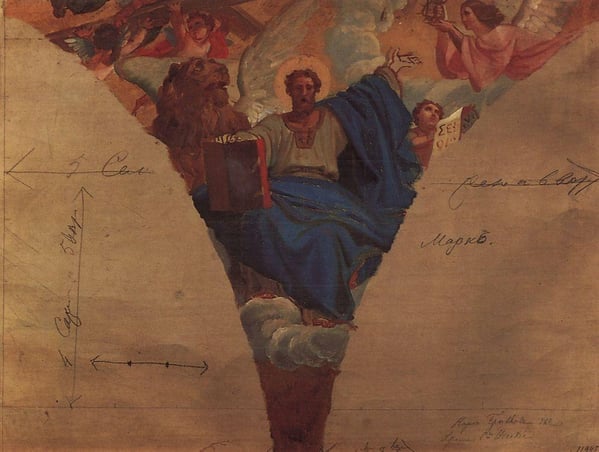
Karl Bryullov’s Mark the Evangelist stands as a compelling example of Romantic religious painting, a genre the artist reshaped by infusing traditional iconography with the period’s hallmark emotional intensity and dramatic naturalism. Bryullov, best known for his monumental The Last Day of Pompeii, here turns to a quieter but no less powerful subject: the saint as a vessel of divine inspiration.
Significance within Romanticism:
The painting departs from the static, idealized depictions of evangelists common in earlier academic or iconographic traditions. Instead, Bryullov captures Saint Mark in a moment of fervent spiritual rapture—his eyes cast upward, hand poised over the scroll, as if directly receiving the word of God. This aligns with Romanticism’s fascination with individual genius and sublime experience; Mark is not merely a scribe but a creative, impassioned figure, akin to the Romantic poet or artist.
Bryullov’s masterful use of chiaroscuro heightens the drama: a warm, almost supernatural light falls across the saint’s face and hands, while deep shadows envelop the background, focusing attention on the inner fire of faith. The swirling drapery and vigorous brushwork in Mark’s robes convey kinetic energy, a signature Romantic technique that transforms a static devotional subject into a dynamic psychological study.
Significance within Bryullov’s Oeuvre:
This work demonstrates Bryullov’s ability to merge Western European Romanticism—particularly the influence of Venetian colorism and Caravaggesque tenebrism—with a distinctly Russian sensitivity to spiritual depth. It reflects the broader 19th-century Russian turn toward emotional, narrative-driven religious art, moving away from rigid Orthodox conventions toward a more universal, humanistic interpretation of sacred figures.
Mark the Evangelist is thus significant not only as a finely executed religious painting but as a testament to Romanticism’s power to reinvent tradition: here, the saint becomes a symbol of creative and spiritual transcendence, a perfect emblem of the Romantic era’s faith in the passionate, visionary individual.
Visivamente simili
20 opere con composizione e palette affini
The Virgin Appearing to St Dominic
Giovanni Battista Tiepolo
Transportation of the Holy House of Nazareth to Loreto
Giovanni Battista Tiepolo
The Glory of St Dominic
Giovanni Battista Tiepolo
The Assumption of the Virgin (detail)
Correggio
The Asumption of the Virgin
Luca Giordano
A Concert of Angels
Philippe de Champaigne
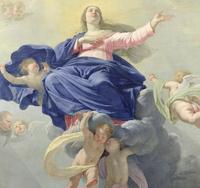
The Assumption of the Virgin
Philippe de Champaigne
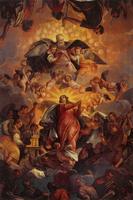
Assumption
Paolo Veronese
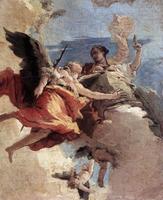
Allegory of Strength and Wisdom
Giovanni Battista Tiepolo
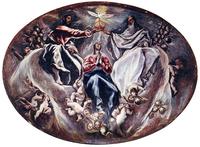
Coronation of the Virgin
El Greco
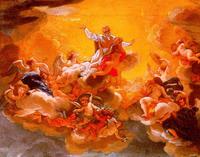
The Apotheosis of St. Ignatius
Giovanni Battista Gaulli
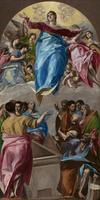
Assumption of the Virgin
El Greco
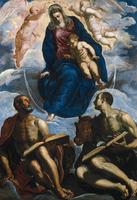
Mary with the Child Venerated by St Marc and St Luke
Tintoretto

The Glorification of the government of Burgundy
Pierre-Paul Prud'hon
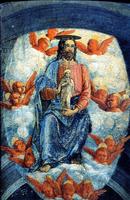
Christ with the soul of the Virgin
Andrea Mantegna
The Eternal Father
Francisco Bayeu y Subias
The Vision of St. John in Patmos
Correggio
Gloria Di Santa Marta
Giovanni Battista Gaulli

Cristo in Gloria Con Apostoli E Santi Francescani
Giovanni Battista Gaulli
The Holy Trinity and Saints in Glory
Sebastiano Conca