Expertenanalyse zu Karl Bryullovs Plafond
Stil: Romanticism · Genre: quadratura
Expert Analysis of "Plafond" by Karl Bryullov
Context and Stylistic Significance
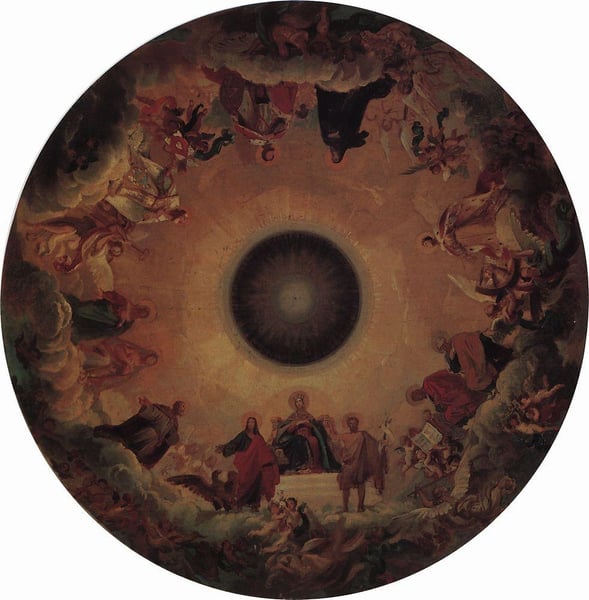
Karl Bryullov (1799–1852) is celebrated as a pivotal figure in Russian Romanticism, renowned for his dramatic historical canvases like The Last Day of Pompeii. However, his work “Plafond” represents a fascinating intersection of Romanticism and the Baroque-derived genre of quadratura—an illusionistic ceiling painting technique that uses architectural perspective to create the impression of an open sky or grand architectural vault. This piece is significant precisely because it demonstrates how Romantic artists adapted a traditional, often decorative genre to express the movement’s core values: emotional intensity, sublime nature, and dynamic movement.
Technical Achievement in Quadratura
Quadratura typically relies on meticulous linear perspective and trompe-l’œil to deceive the eye into believing a flat ceiling is a three-dimensional space. Bryullov’s “Plafond” elevates this academic rigor with Romantic energy. The composition likely features figures—perhaps mythological or allegorical—who appear to burst through the architectural framework, defying the static order typical of earlier quadratura (e.g., by Andrea Pozzo). The dramatic foreshortening and deep chiaroscuro not only enhance illusionism but also inject a sense of fleeting motion, aligning with Romanticism’s fascination with the momentary and the overwhelming.
Romantic Interpretation of Space
What makes this work significant within Romanticism is its departure from the genre’s original function as a mere decorative extension of the palace or church interior. Bryullov uses quadratura as a vehicle for Romantic expression: the “plafond” (ceiling) becomes a window into a dynamic, often turbulent cosmos. The sky or architectural opening is not static—it suggests a sublime, almost untamed infinity where clouds, light, and figures are caught in a swirling rhythm. This contrasts with the rational, orderly heavens of Neoclassicism, instead embracing Romanticism’s love of the vast, the unpredictable, and the emotionally charged.
Cultural and Artistic Legacy
Bryullov’s “Plafond” is significant as a testament to the versatility of Romanticism, which could revitalize even the most established genres. It also reflects the contemporary Russian fascination with integrating Western technical traditions (Italian quadratura) with national Romantic sensibility. By harmonizing Baroque illusionism with Romantic dynamism, Bryullov created a work that bridges art-historical periods—proof that the Romantic spirit could flourish not only in history painting but also in the most architecturally deceptive of art forms. For these reasons, “Plafond” stands as a singular example of how genre boundaries dissolve under the pressure of a passionate artistic vision.
Visuell ähnlich
20 Werke mit ähnlicher Komposition und Farbpalette
St. Agnes is Received into Heaven
Giovanni Battista Gaulli
Assunzione della Vergine
Palma il Giovane

Mark the Evangelist
Karl Bryullov
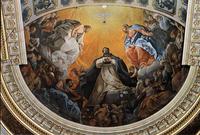
The Glory of St Dominic
Guido Reni
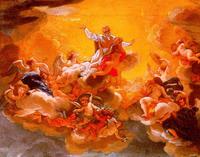
The Apotheosis of St. Ignatius
Giovanni Battista Gaulli

Cristo in Gloria Con Apostoli E Santi Francescani
Giovanni Battista Gaulli
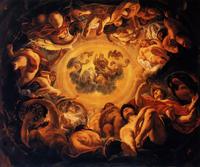
Psyche hosted on Olympus
Jacob Jordaens
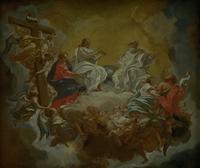
St Agnes in Glory
Giovanni Battista Gaulli
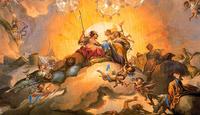
The happy union of Spain and Parma promotes science and the arts
Francisco Bayeu y Subias
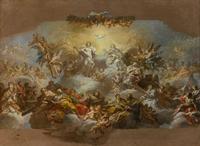
The Holy Trinity and Saints in Glory
Sebastiano Conca
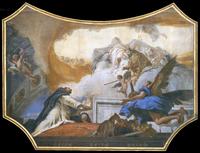
The Virgin Appearing to St Dominic
Giovanni Battista Tiepolo
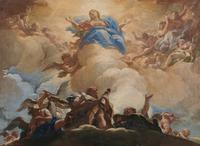
The Asumption of the Virgin
Luca Giordano
Les Neuf chœurs des Esprits célestes
Louis Licherie de Beurie
The Eternal Father
Francisco Bayeu y Subias
Apotheosis of Saint Sebastian
Johann Jakob Zeiller
Assumption
Paolo Veronese
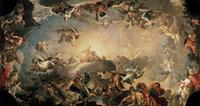
Olympus: The Fall of the Giants
Francisco Bayeu y Subias
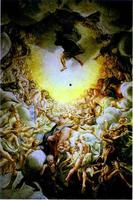
The Assumption of the Virgin (detail)
Correggio
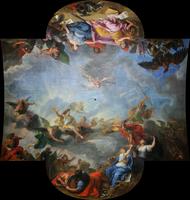
Prise De La Ville Et De La Citadelle De Gand En Six Jours
Charles Le Brun
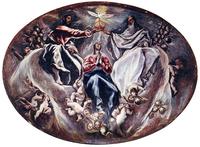
Coronation of the Virgin
El Greco