Analisi esperta di High and Low di M.C. Escher
Stile: Surrealism · Genere: capriccio
Expert Analysis of "High and Low" by M.C. Escher
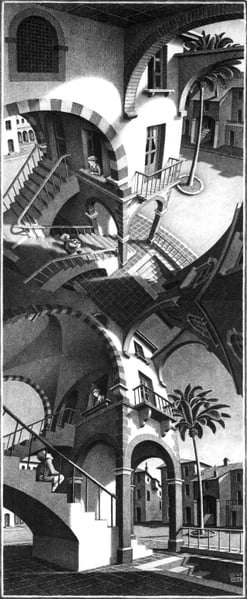
M.C. Escher’s "High and Low" is a masterful example of Surrealist capriccio, a genre defined by whimsical, fantastical, and often architectural invention. The work’s significance within Surrealism lies in its subversion of spatial logic and perceptual stability—a hallmark of Escher’s mature style. Rather than depicting dreamlike or subconscious imagery typical of some Surrealists, Escher achieves the uncanny through rigorous, rational manipulation of perspective.
Compositionally, the print is divided into two interlocking halves: the upper half presents a view from above (a bird’s-eye perspective), while the lower half shows the same scene from below (a worm’s-eye view). The architecture seamlessly transitions from one viewpoint to the other along a diagonal, forcing the viewer’s eye to reconcile two contradictory spatial realities simultaneously. This effect—a paradoxical, impossible space—embodies Escher’s fascination with the limits of human perception and the arbitrary nature of a fixed viewpoint.
As a capriccio, "High and Low" invents an architecture that could never exist in reality, yet it is rendered with such precise, realistic detail that it tricks the brain into momentarily accepting its logic. This tension between the believable and the absurd is central to its impact. The work challenges the very nature of representation, suggesting that what we see is a construction of the mind rather than a transparent window onto the world.
Within Escher’s oeuvre and Surrealism more broadly, "High and Low" is significant for demonstrating how mathematical and optical principles can generate the fantastical. It does not rely on narrative or symbolism but on a direct, intellectual disruption of visual convention—a pure, surreal paradox made manifest through architectural caprice.
Visivamente simili
20 opere con composizione e palette affini
Belvedere
M.C. Escher
Relativity lattice
M.C. Escher
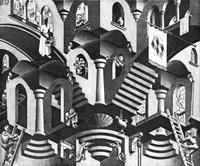
Convex and Concave
M.C. Escher
Cascada imposible
Javier Ibarrondo Los Arcos
Ascending & Descending
M.C. Escher
Waterfall
M.C. Escher
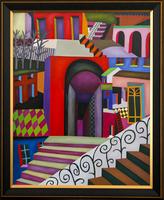
Way Home
Enkhjargal Tsagaandari
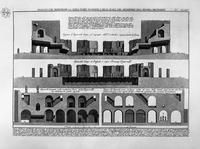
Split, showing the scene in front of building, and stairs, which ascend to the second precision
Giovanni Battista Piranesi
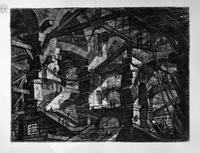
The Gothic Arch
Giovanni Battista Piranesi
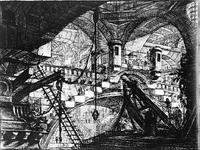
The Prisons
Giovanni Battista Piranesi
The Arch with a Shell Ornament
Giovanni Battista Piranesi
A World
Ángeles Santos Torroella
The Roman antiquities, t. 4, Plate XXXI. Section one of the wedges of the Theatre of Marcellus.
Giovanni Battista Piranesi
Kondor Béla, Pokolbéli Kocsmaú
Kondor Béla
The Staircase with Trophies
Giovanni Battista Piranesi
The Bridge
M.C. Escher
Balcony
M.C. Escher
Untitled
Minas Avetisyan
Ruin at Daphne
Edwin Dickinson
Print Gallery
M.C. Escher