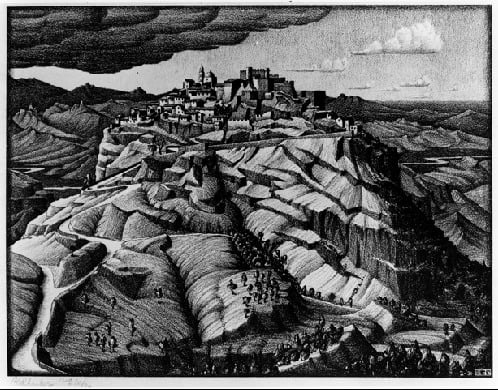
Expert analysis of M.C. Escher’s Santa Severina, Calabria (February 1931)
Style: Surrealism · Genre: landscape
Expert Analysis: "Santa Severina, Calabria (February 1931)" by M.C. Escher
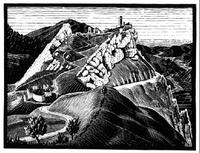
As an early work by M.C. Escher, this landscape is significant for bridging his initial realist precision with the emerging surrealist sensibilities that would define his later career. Though created before his most famous tessellations and impossible constructions, the piece already displays the meticulous draftsmanship and otherworldly atmosphere that marks Escher’s unique contribution to Surrealism.
Composition and Technique
The scene depicts the hilltop town of Santa Severina in Calabria, southern Italy, viewed from a low angle that emphasizes the verticality of its medieval architecture. Escher’s use of fine, controlled lines and careful chiaroscuro—rather than painterly looseness—imbues the landscape with a hyper-real clarity. This extreme precision, typical of his early prints, paradoxically pushes the scene into a dreamlike state: every stone, window, and shadow is so sharply defined that the ordinary becomes uncanny.
Surrealist Significance
Within the Surrealist movement, which prized the irrational, the unexpected, and the uncanny, Escher’s landscapes stand apart. Instead of overt fantasy or biomorphic forms, he finds strangeness in the real world through unusual perspectives, stark contrasts, and a sense of frozen time. Here, the steep hillside and compressed spatial depth create a vertiginous, almost impossible viewpoint—a hallmark of surrealist dislocation. The town seems simultaneously solid and ethereal, as if existing outside of normal geography.
Context within Escher’s Oeuvre
This work represents a transitional moment. Escher’s earlier Italian landscapes (e.g., from his 1920s travels) are more documentary, while later works like The Metamorphoses actively distort reality. Santa Severina retains topographic fidelity yet already hints at the surrealist logic that would fully emerge in his 1937 Still Life and Street. Its significance lies in demonstrating how Escher’s obsessive realism itself became a vehicle for the surreal—a reminder that the most potent fantasies often arise from the most rigorous observation of the actual.
Visually similar
20 works with related composition and palette
Italian Town
M.C. Escher
The Citadel Of Arco In The South Tyrol
Albrecht Durer
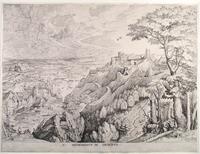
Jerome in the desert
Pieter Bruegel the Elder
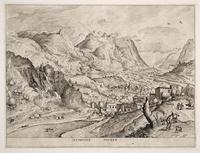
Crafty Bird Catcher
Pieter Bruegel the Elder
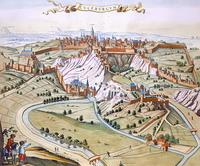
Luxembourg, the capital of the Duchy
Joan Blaeu
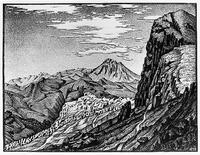
Caltavuturo in The Madonie Mountains, Sicily
M.C. Escher
Italy
Nicholas Roerich
View of the Arco Valley in the Tyrol
Albrecht Durer
Hohenasperg siege by Georg von Frundsberg in war of Swabian federal versus Herzog Ulrich
Albrecht Durer
Star the Wormwood
Konstantin Bogaevsky
The 1530 Siege of Florence
Giorgio Vasari
Armenian Landscape
Martiros Sarian
Antique town view of Wildberg, Baden-Wurttemberg
Matthaus Merian the elder
The cart, the Belgic
Pieter Bruegel the Elder
Armenia
Martiros Sarian
Rustic Market
Pieter Bruegel the Elder
Palizzi, Calabria (October 1930)
M.C. Escher
Morano Calabria
M.C. Escher
Scáfani, sicilie
M.C. Escher
A Fortified Village in a Rocky Landscape
Jan Wyck